
Verwandte Artikel zu Introduction to Deep Learning: From Logical Calculus...
Introduction to Deep Learning: From Logical Calculus to Artificial Intelligence (Undergraduate Topics in Computer Science) - Softcover
Buch 64 von 99: Undergraduate Topics in Computer Science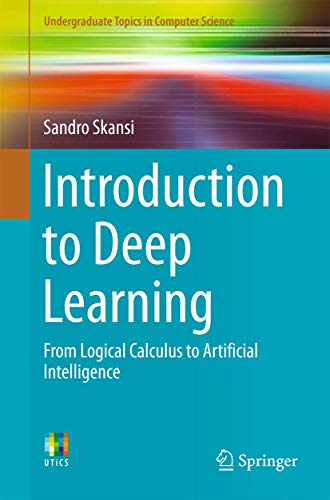
Inhaltsangabe
This textbook presents a concise, accessible and engaging first introduction to deep learning, offering a wide range of connectionist models which represent the current state-of-the-art. The text explores the most popular algorithms and architectures in a simple and intuitive style, explaining the mathematical derivations in a step-by-step manner. The content coverage includes convolutional networks, LSTMs, Word2vec, RBMs, DBNs, neural Turing machines, memory networks and autoencoders. Numerous examples in working Python code are provided throughout the book, and the code is also supplied separately at an accompanying website.
Topics and features: introduces the fundamentals of machine learning, and the mathematical and computational prerequisites for deep learning; discusses feed-forward neural networks, and explores the modifications to these which can be applied to any neural network; examines convolutional neural networks, and the recurrent connections to a feed-forward neural network; describes the notion of distributed representations, the concept of the autoencoder, and the ideas behind language processing with deep learning; presents a brief history of artificial intelligence and neural networks, and reviews interesting open research problems in deep learning and connectionism.This clearly written and lively primer on deep learning is essential reading for graduate and advanced undergraduate students of computer science, cognitive science and mathematics, as well as fields such as linguistics, logic, philosophy, and psychology.
Die Inhaltsangabe kann sich auf eine andere Ausgabe dieses Titels beziehen.
Über die Autorin bzw. den Autor
Dr. Sandro Skansi is an Assistant Professor of Logic at the University of Zagreb and Lecturer in Data Science at University College Algebra, Zagreb, Croatia.
Von der hinteren Coverseite
This textbook presents a concise, accessible and engaging first introduction to deep learning, offering a wide range of connectionist models which represent the current state-of-the-art. The text explores the most popular algorithms and architectures in a simple and intuitive style, explaining the mathematical derivations in a step-by-step manner. The content coverage includes convolutional networks, LSTMs, Word2vec, RBMs, DBNs, neural Turing machines, memory networks and autoencoders. Numerous examples in working Python code are provided throughout the book, and the code is also supplied separately at an accompanying website.
Topics and features:
- Introduces the fundamentals of machine learning, and the mathematical and computational prerequisites for deep learning
- Discusses feed-forward neural networks, and explores the modifications to these which can be applied to any neural network
- Examines convolutional neural networks, and the recurrent connections to a feed-forward neural network
- Describes the notion of distributed representations, the concept of the autoencoder, and the ideas behind language processing with deep learning
- Presents a brief history of artificial intelligence and neural networks, and reviews interesting open research problems in deep learning and connectionism
This clearly written and lively primer on deep learning is essential reading for graduate and advanced undergraduate students of computer science, cognitive science and mathematics, as well as fields such as linguistics, logic, philosophy, and psychology.
Dr. Sandro Skansi is an Assistant Professor of Logic at the University of Zagreb and Lecturer in Data Science at University College Algebra, Zagreb, Croatia.
„Über diesen Titel“ kann sich auf eine andere Ausgabe dieses Titels beziehen.
Suchergebnisse für Introduction to Deep Learning: From Logical Calculus...

Beispielbild für diese ISBN
Introduction to Deep Learning : From Logical Calculus to Artificial Intelligence
Verlag:
Springer International Publishing AG, 2018
ISBN 10: 3319730037
ISBN 13: 9783319730035
Gebraucht
Softcover
Anbieter: Better World Books Ltd, Dunfermline, Vereinigtes Königreich
Verkäuferbewertung 5 von 5 Sternen

Zustand: Very Good. Former library copy. Pages intact with possible writing/highlighting. Binding strong with minor wear. Dust jackets/supplements may not be included. Includes library markings. Stock photo provided. Product includes identifying sticker. Better World Books: Buy Books. Do Good. Artikel-Nr. 58177846-20
Gebraucht kaufen
EUR 41,43
EUR 5,91 Versand
Versand von Vereinigtes Königreich nach USA
Versand von Vereinigtes Königreich nach USA
Anzahl: 1 verfügbar
Beispielbild für diese ISBN
Introduction to Deep Learning: From Logical Calculus to Artificial Intelligence (Undergraduate Topics in Computer Science)
Anbieter: Ria Christie Collections, Uxbridge, Vereinigtes Königreich
Verkäuferbewertung 5 von 5 Sternen
Zustand: New. In English. Artikel-Nr. ria9783319730035_new
Neu kaufen
EUR 68,09
EUR 11,07 Versand
Versand von Vereinigtes Königreich nach USA
Versand von Vereinigtes Königreich nach USA
Anzahl: Mehr als 20 verfügbar
Beispielbild für diese ISBN
Introduction to Deep Learning: From Logical Calculus to Artificial Intelligence
Anbieter: Revaluation Books, Exeter, Vereinigtes Königreich
Verkäuferbewertung 5 von 5 Sternen
Paperback. Zustand: Brand New. 191 pages. 9.25x6.00x0.75 inches. In Stock. Artikel-Nr. x-3319730037
Neu kaufen
EUR 87,07
EUR 11,81 Versand
Versand von Vereinigtes Königreich nach USA
Versand von Vereinigtes Königreich nach USA
Anzahl: 2 verfügbar
Beispielbild für diese ISBN
Introduction to Deep Learning
Verlag:
Springer International Publishing, 2018
ISBN 10: 3319730037
ISBN 13: 9783319730035
Gebraucht
Softcover
Anbieter: Mooney's bookstore, Den Helder, Niederlande
Verkäuferbewertung 4 von 5 Sternen

Zustand: Very Good. Artikel-Nr. 8A4552625F52880
Gebraucht kaufen
EUR 97,25
EUR 14,95 Versand
Versand von Niederlande nach USA
Versand von Niederlande nach USA
Anzahl: 1 verfügbar
Foto des Verkäufers
Introduction to Deep Learning | From Logical Calculus to Artificial Intelligence
Anbieter: preigu, Osnabrück, Deutschland
Verkäuferbewertung 5 von 5 Sternen
Taschenbuch. Zustand: Neu. Introduction to Deep Learning | From Logical Calculus to Artificial Intelligence | Sandro Skansi | Taschenbuch | Undergraduate Topics in Computer Science | xiii | Englisch | 2018 | Springer | EAN 9783319730035 | Verantwortliche Person für die EU: Springer Verlag GmbH, Tiergartenstr. 17, 69121 Heidelberg, juergen[dot]hartmann[at]springer[dot]com | Anbieter: preigu. Artikel-Nr. 111048578
Neu kaufen
EUR 54,90
EUR 70,00 Versand
Versand von Deutschland nach USA
Versand von Deutschland nach USA
Anzahl: 5 verfügbar