
Verwandte Artikel zu Geometric Optics: Theory and Design of Astronomical...
Geometric Optics: Theory and Design of Astronomical Optical Systems Using Mathematica® (Modeling and Simulation in Science, Engineering and Technology) - Hardcover
Buch 40 von 55: Modeling and Simulation in Science, Engineering and Technology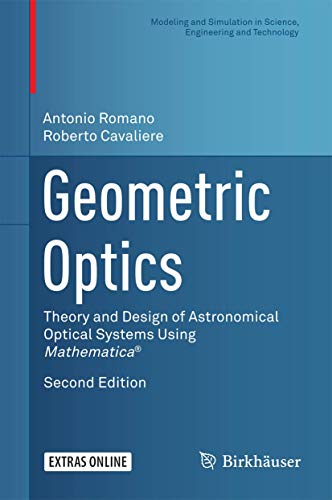
Inhaltsangabe
This text, now in its second edition, presents the mathematical background needed to design many optical combinations that are used in astronomical telescopes and cameras. It uses a novel approach to third-order aberration theory based on Fermat’s principle and the use of particular optical paths (called stigmatic paths) instead of rays, allowing for easier derivation of third-order formulae. Each optical combination analyzed is accompanied by a downloadable Mathematica® notebook that automates its third-order design, eliminating the need for lengthy calculations.
The essential aspects of an optical system with an axis of rotational symmetry are introduced first, along with a development of Gaussian optics from Fermat’s principal. A simpler approach to third-order monochromatic aberrations based on both Fermat’s principle and stigmatic paths is then described, followed by a new chapter on fifth-order aberrations and their classification. Several specific optical devices are discussed and analyzed, including the Newtonian and Cassegrain telescopes; the Schmidt, Wright, Houghton, and Maksutov cameras; the Klevtsov telescope; the Baker-Schmidt flat-field camera; the Buchroeder camera; and, new in this edition, the Baker-Nunn camera and optical combinations with sub-corrector and Petzval objectives. Finally, the Lagrangian and Hamiltonian formulations of geometric optics and Seidel’s third-order aberration theory are presented, and a new chapter considers optics in anisotropic media. Numerous diagrams, worked-out examples, and exercises for further practice of key concepts are included throughout the book.
Geometric Optics is an excellent reference for advanced graduate students, researchers, and practitioners in applied mathematics, engineering, astronomy, and astronomical optics. It can also be used as a supplementary textbook for graduate-level courses inastronomical optics, optical design, optical engineering, programming with Mathematica®, or geometric optics.
Die Inhaltsangabe kann sich auf eine andere Ausgabe dieses Titels beziehen.
Über die Autorin bzw. den Autor
Antonio Romano is Professor Emeritus at the Universitá degli Studi di Napoli Federico II in Naples, Italy.
Addolorata Morasco is a Researcher in mathematical physics at the Universitá degli Studi di Napoli Federico II in Naples, Italy.
Von der hinteren Coverseite
This text, now in its second edition, presents the mathematical background needed to design many optical combinations that are used in astronomical telescopes and cameras. It uses a novel approach to third-order aberration theory based on Fermat’s principle and the use of particular optical paths (called stigmatic paths) instead of rays, allowing for easier derivation of third-order formulae. Each optical combination analyzed is accompanied by a downloadable Mathematica® notebook that automates its third-order design, eliminating the need for lengthy calculations.
The essential aspects of an optical system with an axis of rotational symmetry are introduced first, along with a development of Gaussian optics from Fermat’s principal. A simpler approach to third-order monochromatic aberrations based on both Fermat’s principle and stigmatic paths is then described, followed by a new chapter on fifth-order aberrations and their classification. Several specific optical devices are discussed and analyzed, including the Newtonian and Cassegrain telescopes; the Schmidt, Wright, Houghton, and Maksutov cameras; the Klevtsov telescope; the Baker-Schmidt flat-field camera; the Buchroeder camera; and, new in this edition, the Baker-Nunn camera and optical combinations with sub-corrector and Petzval objectives. Finally, the Lagrangian and Hamiltonian formulations of geometric optics and Seidel’s third-order aberration theory are presented, and a new chapter considers optics in anisotropic media. Numerous diagrams, worked-out examples, and exercises for further practice of key concepts are included throughout the book.
Geometric Optics is an excellent reference for advanced graduate students, researchers, and practitioners in applied mathematics, engineering, astronomy, and astronomical optics. It can also be used as a supplementary textbook for graduate-level courses in astronomical optics, optical design, optical engineering, programming with Mathematica®, or geometric optics.
„Über diesen Titel“ kann sich auf eine andere Ausgabe dieses Titels beziehen.
Suchergebnisse für Geometric Optics: Theory and Design of Astronomical...

Beispielbild für diese ISBN
Geometric Optics : Theory and Design of Astronomical Optical Systems Using Mathematica®
Anbieter: Buchpark, Trebbin, Deutschland
Verkäuferbewertung 5 von 5 Sternen

Zustand: Sehr gut. Zustand: Sehr gut | Seiten: 304 | Sprache: Englisch | Produktart: Bücher | This text, now in its second edition, presents the mathematical background needed to design many optical combinations that are used in astronomical telescopes and cameras. It uses a novel approach to third-order aberration theory based on Fermat¿s principle and the use of particular optical paths (called stigmatic paths) instead of rays, allowing for easier derivation of third-order formulae. Each optical combination analyzed is accompanied by a downloadable Mathematica® notebook that automates its third-order design, eliminating the need for lengthy calculations.The essential aspects of an optical system with an axis of rotational symmetry are introduced first, along with a development of Gaussian optics from Fermat¿s principal. A simpler approach to third-order monochromatic aberrations based on both Fermat¿s principle and stigmatic paths is then described, followed by a new chapter on fifth-order aberrations and their classification. Several specific optical devices are discussed and analyzed, including the Newtonian and Cassegrain telescopes; the Schmidt, Wright, Houghton, and Maksutov cameras; the Klevtsov telescope; the Baker-Schmidt flat-field camera; the Buchroeder camera; and, new in this edition, the Baker-Nunn camera and optical combinations with sub-corrector and Petzval objectives. Finally, the Lagrangian and Hamiltonian formulations of geometric optics and Seidel¿s third-order aberration theory are presented, and a new chapter considers optics in anisotropic media. Numerous diagrams, worked-out examples, and exercises for further practice of key concepts are included throughout the book.Geometric Optics is an excellent reference for advanced graduate students, researchers, and practitioners in applied mathematics, engineering, astronomy, and astronomical optics. It can also be used as a supplementary textbook for graduate-level courses inastronomical optics, optical design, optical engineering, programming with Mathematica®, or geometric optics. Artikel-Nr. 26945392/12
Gebraucht kaufen
EUR 46,82
EUR 105,00 Versand
Versand von Deutschland nach USA
Versand von Deutschland nach USA
Anzahl: 1 verfügbar
Beispielbild für diese ISBN
Geometric Optics: Theory and Design of Astronomical Optical Systems Using Mathematica® (Modeling and Simulation in Science, Engineering and Technology)
Anbieter: Ria Christie Collections, Uxbridge, Vereinigtes Königreich
Verkäuferbewertung 5 von 5 Sternen
Zustand: New. In English. Artikel-Nr. ria9783319437316_new
Neu kaufen
EUR 142,32
EUR 13,22 Versand
Versand von Vereinigtes Königreich nach USA
Versand von Vereinigtes Königreich nach USA
Anzahl: Mehr als 20 verfügbar
Foto des Verkäufers
Geometric Optics : Theory and Design of Astronomical Optical Systems Using Mathematica®
Anbieter: AHA-BUCH GmbH, Einbeck, Deutschland
Verkäuferbewertung 5 von 5 Sternen
Buch. Zustand: Neu. Druck auf Anfrage Neuware - Printed after ordering - This text, now in its second edition, presents the mathematical background needed to design many optical combinations that are used in astronomical telescopes and cameras. It uses a novel approach to third-order aberration theory based on Fermat's principle and the use of particular optical paths (called stigmatic paths) instead of rays, allowing for easier derivation of third-order formulae. Each optical combination analyzed is accompanied by a downloadable Mathematica® notebook that automates its third-order design, eliminating the need for lengthy calculations.The essential aspects of an optical system with an axis of rotational symmetry are introduced first, along with a development of Gaussian optics from Fermat's principal. A simpler approach to third-order monochromatic aberrations based on both Fermat's principle and stigmatic paths is then described, followed by a new chapter on fifth-order aberrations and their classification. Several specific optical devices are discussed and analyzed, including the Newtonian and Cassegrain telescopes; the Schmidt, Wright, Houghton, and Maksutov cameras; the Klevtsov telescope; the Baker-Schmidt flat-field camera; the Buchroeder camera; and, new in this edition, the Baker-Nunn camera and optical combinations with sub-corrector and Petzval objectives. Finally, the Lagrangian and Hamiltonian formulations of geometric optics and Seidel's third-order aberration theory are presented, and a new chapter considers optics in anisotropic media. Numerous diagrams, worked-out examples, and exercises for further practice of key concepts are included throughout the book.Geometric Optics is an excellent reference for advanced graduate students, researchers, and practitioners in applied mathematics, engineering, astronomy, and astronomical optics. It can also be used as a supplementary textbook for graduate-level courses inastronomical optics, optical design, optical engineering, programming with Mathematica®, or geometric optics. Artikel-Nr. 9783319437316
Neu kaufen
EUR 140,65
EUR 35,00 Versand
Versand von Deutschland nach USA
Versand von Deutschland nach USA
Anzahl: 1 verfügbar
Beispielbild für diese ISBN
Geometric Optics: Theory and Design of Astronomical Optical Systems Using Mathematica®
Anbieter: Revaluation Books, Exeter, Vereinigtes Königreich
Verkäuferbewertung 5 von 5 Sternen
Hardcover. Zustand: Brand New. 2nd edition. 304 pages. 9.50x6.50x1.00 inches. In Stock. Artikel-Nr. x-3319437313
Neu kaufen
EUR 185,63
EUR 14,64 Versand
Versand von Vereinigtes Königreich nach USA
Versand von Vereinigtes Königreich nach USA
Anzahl: 2 verfügbar
Beispielbild für diese ISBN
Geometric Optics
Anbieter: Kennys Bookstore, Olney, MD, USA
Verkäuferbewertung 5 von 5 Sternen
Zustand: New. This book offers a new approach to third-order aberrations theory. It presents the basic elements of third-order aberrations of optical telescopes, along with the necessary mathematical background, to design almost all optical combinations used in astronomy. Series: Modeling and Simulation in Science, Engineering and Technology. Num Pages: 301 pages, 112 black & white illustrations, 56 colour illustrations, 54 colour tables, biography. BIC Classification: PBWH; PGC; TTB; UYM. Category: (P) Professional & Vocational. Dimension: 235 x 155 x 18. Weight in Grams: 619. . 2016. 2 Rev ed. Hardback. . . . . Books ship from the US and Ireland. Artikel-Nr. V9783319437316
Neu kaufen
EUR 195,02
EUR 9,27 Versand
Versand innerhalb von USA
Versand innerhalb von USA
Anzahl: 15 verfügbar