
Verwandte Artikel zu Precision Interferometry in a New Shape: Higher-order...
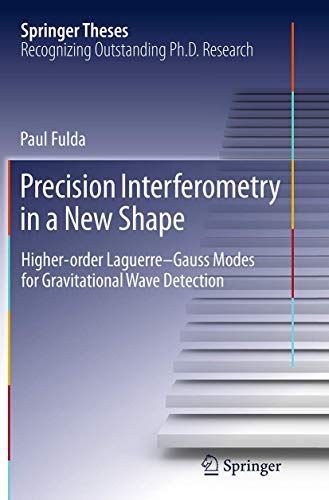
Precision Interferometry in a New Shape: Higher-order Laguerre-Gauss Modes for Gravitational Wave Detection (Springer Theses) - Softcover
Inhaltsangabe
With his Ph.D. thesis, presented here in the format of a "Springer Theses", Paul Fulda won the 2012 GWIC thesis prize awarded by the Gravitational Wave International Committee. The impact of thermal noise on future gravitational wave detectors depends on the size and shape of the interrogating laser beam. It had been known since 2006 that, in theory, higher-order Laguerre-Gauss modes could reduce thermal noise. Paul Fulda’s research brings Laguerre-Gauss modes an enormous step forward. His work includes analytical, numerical and experimental work on table-top setups as well as experiments at the Glasgow 10m prototype interferometer. Using numerical simulations the LG33 mode was selected as the optical mode to be tested. Further research by Paul and his colleagues since then concentrated on this mode. Paul has developed and demonstrated simple and effective methods to create this mode with diffractive optics and successfully demonstrated its compatibility with the essential building blocks of gravitational wave detectors, namely, optical cavities, Michelson interferometers and opto-electronic sensing and control systems. Through this work, Laguerre-Gauss modes for interferometers have been transformed from an essentially unknown entity to a well understood option with an experimental basis.
Die Inhaltsangabe kann sich auf eine andere Ausgabe dieses Titels beziehen.
Über die Autorin bzw. den Autor
Dr. Paul Fulda received his PhD in 2012 at the University of Birmingham. He is the winner of the 2012 GWIC Thesis Prize awarded by the Gravitational Wave International Committee.
Von der hinteren Coverseite
With his Ph.D. thesis, presented here in the format of a "Springer Theses", Paul Fulda won the 2012 GWIC thesis prize awarded by the Gravitational Wave International Committee. The impact of thermal noise on future gravitational wave detectors depends on the size and shape of the interrogating laser beam. It had been known since 2006 that, in theory, higher-order Laguerre-Gauss modes could reduce thermal noise. Paul Fulda’s research brings Laguerre-Gauss modes an enormous step forward. His work includes analytical, numerical and experimental work on table-top setups as well as experiments at the Glasgow 10m prototype interferometer. Using numerical simulations the LG33 mode was selected as the optical mode to be tested. Further research by Paul and his colleagues since then concentrated on this mode. Paul has developed and demonstrated simple and effective methods to create this mode with diffractive optics and successfully demonstrated its compatibility with the essential building blocks of gravitational wave detectors, namely, optical cavities, Michelson interferometers and opto-electronic sensing and control systems. Through this work, Laguerre-Gauss modes for interferometers have been transformed from an essentially unknown entity to a well understood option with an experimental basis.
„Über diesen Titel“ kann sich auf eine andere Ausgabe dieses Titels beziehen.
Suchergebnisse für Precision Interferometry in a New Shape: Higher-order...

Beispielbild für diese ISBN
Precision Interferometry in a New Shape: Higher-order Laguerre-Gauss Modes for Gravitational Wave Detection (Springer Theses)
Anbieter: Ria Christie Collections, Uxbridge, Vereinigtes Königreich
Verkäuferbewertung 5 von 5 Sternen

Zustand: New. In. Artikel-Nr. ria9783319347561_new
Neu kaufen
EUR 116,53
EUR 13,99 Versand
Versand von Vereinigtes Königreich nach USA
Versand von Vereinigtes Königreich nach USA
Anzahl: Mehr als 20 verfügbar
Foto des Verkäufers
Precision Interferometry in a New Shape : Higher-order Laguerre-Gauss Modes for Gravitational Wave Detection
Verlag:
Springer International Publishing, 2016
ISBN 10: 331934756X
ISBN 13: 9783319347561
Neu
Taschenbuch
Anbieter: AHA-BUCH GmbH, Einbeck, Deutschland
Verkäuferbewertung 5 von 5 Sternen
Taschenbuch. Zustand: Neu. Druck auf Anfrage Neuware - Printed after ordering - With his Ph.D. thesis, presented here in the format of a 'Springer Theses', Paul Fulda won the 2012 GWIC thesis prize awarded by the Gravitational Wave International Committee. The impact of thermal noise on future gravitational wave detectors depends on the size and shape of the interrogating laser beam. It had been known since 2006 that, in theory, higher-order Laguerre-Gauss modes could reduce thermal noise. Paul Fulda's research brings Laguerre-Gauss modes an enormous step forward. His work includes analytical, numerical and experimental work on table-top setups as well as experiments at the Glasgow 10m prototype interferometer. Using numerical simulations the LG33 mode was selected as the optical mode to be tested. Further research by Paul and his colleagues since then concentrated on this mode. Paul has developed and demonstrated simple and effective methods to create this mode with diffractive optics and successfully demonstrated its compatibility with the essential building blocks of gravitational wave detectors, namely, optical cavities, Michelson interferometers and opto-electronic sensing and control systems. Through this work, Laguerre-Gauss modes for interferometers have been transformed from an essentially unknown entity to a well understood option with an experimental basis. Artikel-Nr. 9783319347561
Neu kaufen
EUR 106,99
EUR 61,39 Versand
Versand von Deutschland nach USA
Versand von Deutschland nach USA
Anzahl: 1 verfügbar