
Verwandte Artikel zu Finite Volumes for Complex Applications VII-Elliptic,...
Finite Volumes for Complex Applications VII-Elliptic, Parabolic and Hyperbolic Problems: FVCA 7, Berlin, June 2014 (Springer Proceedings in Mathematics & Statistics, 78, Band 78) - Hardcover
Buch 70 von 464: Springer Proceedings in Mathematics & Statistics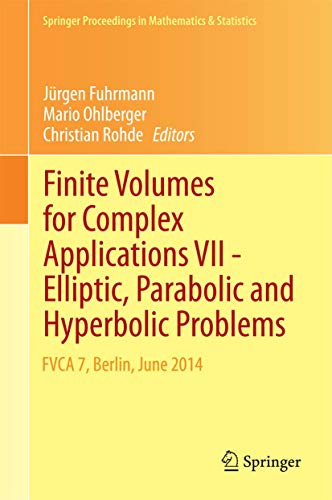
Inhaltsangabe
The methods considered in the 7th conference on "Finite Volumes for Complex Applications" (Berlin, June 2014) have properties which offer distinct advantages for a number of applications. The second volume of the proceedings covers reviewed contributions reporting successful applications in the fields of fluid dynamics, magnetohydrodynamics, structural analysis, nuclear physics, semiconductor theory and other topics.
The finite volume method in its various forms is a space discretization technique for partial differential equations based on the fundamental physical principle of conservation. Recent decades have brought significant success in the theoretical understanding of the method. Many finite volume methods preserve further qualitative or asymptotic properties, including maximum principles, dissipativity, monotone decay of free energy, and asymptotic stability. Due to these properties, finite volume methods belong to the wider class of compatible discretization methods, which preserve qualitative properties of continuous problems at the discrete level. This structural approach to the discretization of partial differential equations becomes particularly important for multiphysics and multiscale applications.
Researchers, PhD and masters level students in numerical analysis, scientific computing and related fields such as partial differential equations will find this volume useful, as will engineers working in numerical modeling and simulations.
Die Inhaltsangabe kann sich auf eine andere Ausgabe dieses Titels beziehen.
Von der hinteren Coverseite
The methods considered in the 7th conference on "Finite Volumes for Complex Applications" (Berlin, June 2014) have properties which offer distinct advantages for a number of applications. The second volume of the proceedings covers reviewed contributions reporting successful applications in the fields of fluid dynamics, magnetohydrodynamics, structural analysis, nuclear physics, semiconductor theory and other topics.
The finite volume method in its various forms is a space discretization technique for partial differential equations based on the fundamental physical principle of conservation. Recent decades have brought significant success in the theoretical understanding of the method. Many finite volume methods preserve further qualitative or asymptotic properties, including maximum principles, dissipativity, monotone decay of free energy, and asymptotic stability. Due to these properties, finite volume methods belong to the wider class of compatible discretization methods, which preserve qualitative properties of continuous problems at the discrete level. This structural approach to the discretization of partial differential equations becomes particularly important for multiphysics and multiscale applications.
Researchers, PhD and masters level students in numerical analysis, scientific computing and related fields such as partial differential equations will find this volume useful, as will engineers working in numerical modeling and simulations.
„Über diesen Titel“ kann sich auf eine andere Ausgabe dieses Titels beziehen.
Suchergebnisse für Finite Volumes for Complex Applications VII-Elliptic,...

Beispielbild für diese ISBN
Finite Volumes for Complex Applications VII-Elliptic, Parabolic and Hyperbolic Problems : FVCA 7, Berlin, June 2014
Anbieter: Buchpark, Trebbin, Deutschland
Verkäuferbewertung 5 von 5 Sternen

Zustand: Sehr gut. Zustand: Sehr gut | Seiten: 540 | Sprache: Englisch | Produktart: Bücher | The methods considered in the 7th conference on "Finite Volumes for Complex Applications" (Berlin, June 2014) have properties which offer distinct advantages for a number of applications. The second volume of the proceedings covers reviewed contributions reporting successful applications in the fields of fluid dynamics, magnetohydrodynamics, structural analysis, nuclear physics, semiconductor theory and other topics. The finite volume method in its various forms is a space discretization technique for partial differential equations based on the fundamental physical principle of conservation. Recent decades have brought significant success in the theoretical understanding of the method. Many finite volume methods preserve further qualitative or asymptotic properties, including maximum principles, dissipativity, monotone decay of free energy, and asymptotic stability. Due to these properties, finite volume methods belong to the wider class of compatible discretization methods, which preserve qualitative properties of continuous problems at the discrete level. This structural approach to the discretization of partial differential equations becomes particularly important for multiphysics and multiscale applications. Researchers, PhD and masters level students in numerical analysis, scientific computing and related fields such as partial differential equations will find this volume useful, as will engineers working in numerical modeling and simulations. Artikel-Nr. 24746289/2
Gebraucht kaufen
EUR 24,43
EUR 105,00 Versand
Versand von Deutschland nach USA
Versand von Deutschland nach USA
Anzahl: 1 verfügbar
Foto des Verkäufers
Finite Volumes for Complex Applications VII-Elliptic, Parabolic and Hyperbolic Problems
Verlag:
Springer International Publishing, 2014
ISBN 10: 3319055909
ISBN 13: 9783319055909
Neu
Hardcover
Anbieter: moluna, Greven, Deutschland
Verkäuferbewertung 5 von 5 Sternen
Zustand: New. Artikel-Nr. 4497321
Neu kaufen
EUR 136,16
EUR 48,99 Versand
Versand von Deutschland nach USA
Versand von Deutschland nach USA
Anzahl: Mehr als 20 verfügbar
Beispielbild für diese ISBN
Finite Volumes for Complex Applications VII-Elliptic, Parabolic and Hyperbolic Problems: FVCA 7, Berlin, June 2014 (Springer Proceedings in Mathematics & Statistics, 78)
Anbieter: Ria Christie Collections, Uxbridge, Vereinigtes Königreich
Verkäuferbewertung 5 von 5 Sternen
Zustand: New. In English. Artikel-Nr. ria9783319055909_new
Neu kaufen
EUR 182,44
EUR 17,43 Versand
Versand von Vereinigtes Königreich nach USA
Versand von Vereinigtes Königreich nach USA
Anzahl: Mehr als 20 verfügbar
Foto des Verkäufers
Finite Volumes for Complex Applications VII-Elliptic, Parabolic and Hyperbolic Problems : FVCA 7, Berlin, June 2014
Anbieter: AHA-BUCH GmbH, Einbeck, Deutschland
Verkäuferbewertung 5 von 5 Sternen
Buch. Zustand: Neu. Druck auf Anfrage Neuware - Printed after ordering - The methods considered in the 7th conference on 'Finite Volumes for Complex Applications' (Berlin, June 2014) have properties which offer distinct advantages for a number of applications. The second volume of the proceedings covers reviewed contributions reporting successful applications in the fields of fluid dynamics, magnetohydrodynamics, structural analysis, nuclear physics, semiconductor theory and other topics.The finite volume method in its various forms is a space discretization technique for partial differential equations based on the fundamental physical principle of conservation. Recent decades have brought significant success in the theoretical understanding of the method. Many finite volume methods preserve further qualitative or asymptotic properties, including maximum principles, dissipativity, monotone decay of free energy, and asymptotic stability. Due to these properties, finite volume methods belong to the wider class of compatible discretization methods, which preserve qualitative properties of continuous problems at the discrete level. This structural approach to the discretization of partial differential equations becomes particularly important for multiphysics and multiscale applications.Researchers, PhD and masters level students in numerical analysis, scientific computing and related fields such as partial differential equations will find this volume useful, as will engineers working in numerical modeling and simulations. Artikel-Nr. 9783319055909
Neu kaufen
EUR 176,33
EUR 35,00 Versand
Versand von Deutschland nach USA
Versand von Deutschland nach USA
Anzahl: 1 verfügbar
Beispielbild für diese ISBN
Finite Volumes for Complex Applications VII- Elliptic, Parabolic and Hyperbolic Problems: Fvca 7, Berlin, June 2014
Anbieter: Revaluation Books, Exeter, Vereinigtes Königreich
Verkäuferbewertung 5 von 5 Sternen
Hardcover. Zustand: Brand New. 2014 edition. 518 pages. 9.20x6.20x1.30 inches. In Stock. Artikel-Nr. x-3319055909
Neu kaufen
EUR 247,89
EUR 17,50 Versand
Versand von Vereinigtes Königreich nach USA
Versand von Vereinigtes Königreich nach USA
Anzahl: 2 verfügbar