
Verwandte Artikel zu A Comprehensive Treatment of q-Calculus
Inhaltsangabe
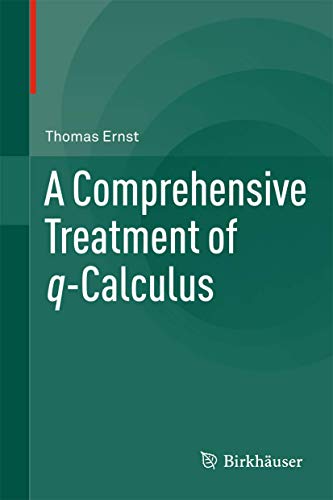
To date, the theoretical development of q-calculus has rested on a non-uniform basis. Generally, the bulky Gasper-Rahman notation was used, but the published works on q-calculus looked different depending on where and by whom they were written. This confusion of tongues not only complicated the theoretical development but also contributed to q-calculus remaining a neglected mathematical field. This book overcomes these problems by introducing a new and interesting notation for q-calculus based on logarithms.For instance, q-hypergeometric functions are now visually clear and easy to trace back to their hypergeometric parents. With this new notation it is also easy to see the connection between q-hypergeometric functions and the q-gamma function, something that until now has been overlooked.
The book covers many topics on q-calculus, including special functions, combinatorics, and q-difference equations. Apart from a thorough review of the historical development of q-calculus, this book also presents the domains of modern physics for which q-calculus is applicable, such as particle physics and supersymmetry, to name just a few.
Die Inhaltsangabe kann sich auf eine andere Ausgabe dieses Titels beziehen.
Über die Autorin bzw. den Autor
Kerstin Wilhelms (Münster), Immanuel Nover (Koblenz-Landau), Eva Stubenrauch (Bonn), Anna Seidel (Münster), Melanie Schiller (Groningen), Matthias Schaffrick (Siegen), Christoph Jürgensen (Bamberg), Jan Herbst (Huddersfield), Lea Espinoza Garrido (Wuppertal), Thomas Ernst (Antwerpen) und Moritz Baßler (Münster)
Von der hinteren Coverseite
To date, the theoretical development of q-calculus has rested on a non-uniform basis. Generally, the bulky Gasper-Rahman notation was used, but the published works on q-calculus looked different depending on where and by whom they were written. This confusion of tongues not only complicated the theoretical development but also contributed to q-calculus remaining a neglected mathematical field. This book overcomes these problems by introducing a new and interesting notation for q-calculus based on logarithms. For instance, q-hypergeometric functions are now visually clear and easy to trace back to their hypergeometric parents. With this new notation it is also easy to see the connection between q-hypergeometric functions and the q-gamma function, something that until now has been overlooked.
The book covers many topics on q-calculus, including special functions, combinatorics, and q-difference equations. Beyond a thorough review of the historical development of q-calculus, it also presents the domains of modern physics for which q-calculus is applicable, such as particle physics and supersymmetry, to name just a few.
„Über diesen Titel“ kann sich auf eine andere Ausgabe dieses Titels beziehen.
Suchergebnisse für A Comprehensive Treatment of q-Calculus

Beispielbild für diese ISBN
Comprehensive Treatment of q-Calculus
Anbieter: GreatBookPricesUK, Woodford Green, Vereinigtes Königreich
Verkäuferbewertung 5 von 5 Sternen

Zustand: New. Artikel-Nr. 17848286-n
Neu kaufen
EUR 123,51
EUR 17,98 Versand
Versand von Vereinigtes Königreich nach USA
Versand von Vereinigtes Königreich nach USA
Anzahl: 2 verfügbar
Foto des Verkäufers
A Comprehensive Treatment of q-Calculus
Anbieter: AHA-BUCH GmbH, Einbeck, Deutschland
Verkäuferbewertung 5 von 5 Sternen
Buch. Zustand: Neu. Druck auf Anfrage Neuware - Printed after ordering - To date, the theoretical development of q-calculus has rested on a non-uniform basis. Generally, the bulky Gasper-Rahman notation was used, but the published works on q-calculus looked different depending on where and by whom they were written. This confusion of tongues not only complicated the theoretical development but also contributed to q-calculus remaining a neglected mathematical field. This book overcomes these problems by introducing a new and interesting notation for q-calculus based on logarithms.For instance, q-hypergeometric functions are now visually clear and easy to trace back to their hypergeometric parents. With this new notation it is also easy to see the connection between q-hypergeometric functions and the q-gamma function, something that until now has been overlooked.The book covers many topics on q-calculus, including special functions, combinatorics, and q-difference equations. Apart from a thorough review of the historical development of q-calculus, this book also presents the domains of modern physics for which q-calculus is applicable, such as particle physics and supersymmetry, to name just a few. Artikel-Nr. 9783034804301
Neu kaufen
EUR 124,85
EUR 35,00 Versand
Versand von Deutschland nach USA
Versand von Deutschland nach USA
Anzahl: 1 verfügbar
Beispielbild für diese ISBN
A Comprehensive Treatment of Q-calculus
Anbieter: Revaluation Books, Exeter, Vereinigtes Königreich
Verkäuferbewertung 5 von 5 Sternen
Hardcover. Zustand: Brand New. 2012 edition. 511 pages. 9.61x6.38x1.26 inches. In Stock. Artikel-Nr. x-303480430X
Neu kaufen
EUR 161,02
EUR 14,98 Versand
Versand von Vereinigtes Königreich nach USA
Versand von Vereinigtes Königreich nach USA
Anzahl: 2 verfügbar
Foto des Verkäufers
Comprehensive Treatment of q-Calculus
Anbieter: GreatBookPricesUK, Woodford Green, Vereinigtes Königreich
Verkäuferbewertung 5 von 5 Sternen
Zustand: As New. Unread book in perfect condition. Artikel-Nr. 17848286
Gebraucht kaufen
EUR 225,90
EUR 17,98 Versand
Versand von Vereinigtes Königreich nach USA
Versand von Vereinigtes Königreich nach USA
Anzahl: 2 verfügbar