
Verwandte Artikel zu Know It All: Finding the Impossible Country; A Memoir...
Inhaltsangabe
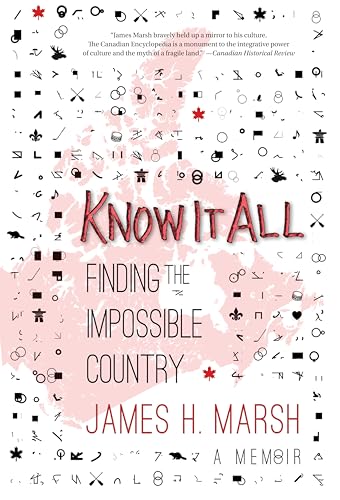
<p>In <em>Know It All: Finding the Impossible Country</em> James Marsh tells of his evolution from a troubled childhood to a long career in Canadian publishing that culminated in the creation of The Canadian Encyclopedia — what one reviewer called “the intellectual equivalent of the building of the CPR.” Through friendships, curiosity, the insights of a charismatic psychiatrist, his passion for books, and the intimate encounters with the authors he met, he championed a diverse and inclusive view of Canada, which was used to draw the great minds of an impossible nation together in a common national enterprise. While exploring how memory works and how we learn to think of ourselves, <em>Know It All</em> offers insights into the intricacies of Canadian identity, the profession of book editors, and is the most comprehensive first-hand story about the creation of The Canadian Encyclopedia.</p>
Die Inhaltsangabe kann sich auf eine andere Ausgabe dieses Titels beziehen.
Über die Autorinnen und Autoren
James H. Marsh grew up in the rough Toronto neighbourhood of the Junction, surviving a difficult childhood with the support and love of a woman who adopted him from his abusive family. He began his career in publishing at a summer job with Holt, Rinehart and Winston learning the nuts and bolts of the business from copy editing to typesetting and printing. At HRW, he was the editor of a centennial history of Canada called Canada: Unity and Diversity, later becoming the editor of the Carleton Library Series, a series of scholarly works on Canadian history and the social sciences. His love of the book business led him into a prized job at The Canadian Encyclopedia, where he was editor-in-chief of all three print editions (1985, 1988, 1999), of The Junior Encyclopedia of Canada, and also took the encyclopedia into the digital world with numerous CD-ROM versions and an online version that is still used worldwide. Marsh was described as “a Canadian who changed the world” by The Globe and Mail and was rewarded with numerous awards, including The Order of Canada, the prestigious Centenary Lorne Dawson Chauveau Medal of the Royal Society of Canada, the Secretary of State Prize for Excellence for outstanding contributions to Canadian Studies, and the Grant MacEwan Award of Excellence.
James H. Marsh grew up in the rough Toronto neighbourhood of the Junction, surviving a difficult childhood. He began his career in publishing at a summer job with Holt, Rinehart and Winston learning the business from copy editing to typesetting and printing. At HRW, he was the editor of a centennial history of Canada called Canada: Unity and Diversity, later becoming the editor of the Carleton Library Series. His love of the book business led him into a prized job at The Canadian Encyclopedia, where he was editor in chief.
Auszug. © Genehmigter Nachdruck. Alle Rechte vorbehalten.
<p>Prologue</p><p>One spring day in 1979 I was scrummaging around the National Archives in Ottawa, researching a book that I was editing. I loved the atmosphere there—quiet, serious, a sense of importance. At frequent intervals I headed to the sixth-floor coffee shop to meet friends, most of whom were graduate students from Carleton University. On this day, my friend and future co-author, Dan Francis asked me if I had seen an ad in The Globe and Mail for an editor in chief for a new national encyclopedia of Canada, an epic publishing project underway in Edmonton, Alberta. Dan told me that I should apply. I never did see the ad but I found Hurtig Publisher’s address in Edmonton. I wrote them a letter, not knowing that over three hundred other people had seen that ad and had already responded.<br>I had met Mel Hurtig on a few occasions at book publishing meetings and was always impressed with his energy and fervent advocacy of Canadian publishing. I had never seen anyone so at home on a podium, so perfectly dressed—by the great Edmonton haberdasher Henry Singer as I later found out. His speeches were full of impressive anecdotal evidence of how corporate America was destroying Canadians’ ability to publish their own authors. In response to my application, Mel sent me a note scribbled with a large black Sharpie telling me to write him a letter, no more than a page and a half long, telling him who I was and what I had done to qualify for such a significant job.<br>What should I say? I really was not at a stage of my life where I was comfortable summing up. I had an eventful editorial career, I thought, with several Canadian publishers. I had written a number of books, including a two-volume Social History of Canada, and I was currently on a joint appointment between Carleton University and publisher McClelland & Stewart, where I had edited almost a hundred scholarly books on Canadian history and social sciences. Several other applicants had, I was sure, as much or more experience. What other qualities might Mel be looking for in a candidate to lead the grandiose project of a new, comprehensive encyclopedia of the entire country?<br>My family and friends encouraged me, but I had serious doubts about my prospects, particularly about my lack of knowledge of the French language in a national endeavour. I also had reservations about my ability to be “chief” of anything, as I had no managerial experience. I eventually received a note from Mel, telling me that he was headed to Ottawa and that we should meet. This letter to me had been lost in the Carleton University mail system for two weeks and I’d only received it two days before Mel arrived. He was in Ottawa to be interviewed on the radio. After a hasty phone call, we arranged to meet afterward at the restaurant that was in those days located in the basement of the Ch?teau Laurier hotel. I listened to the CBC interview on the car radio. Mel was having a terrible time speaking, apologizing for his persistent cough.<br>At brunch with Mel at the Ch?teau Laurier, he recounted anecdotes of customers to his bookstore, of his authors, of his golf game, or of his victories over hapless opponents in debates. Mel’s charm and earnestness always tempered his ample self-importance. After considerable time, he finally asked me about my background in publishing. Almost with a sense of naivet? he asked me if I was a “generalist.” I was prepared for that question and responded that I had some knowledge about a lot of things: literature, classical music, sports, art, social science, philosophy, biography, and history. Above all, I told him that the driving force, almost the redeeming force, in my mental life from the time I was a boy was my curiosity and my love of books. How much of our lives is determined by these encounters, in which each person tries to evaluate the other, guessing, interpreting, and either trusting or evading our instincts? Mel persuaded me that he was an accomplished, ambitious man, but what did he think of me? As long as I knew him, he never said.<br>So, who was I? And what had I done to deserve such a significant job?</p><p> </p>
„Über diesen Titel“ kann sich auf eine andere Ausgabe dieses Titels beziehen.
Suchergebnisse für Know It All: Finding the Impossible Country; A Memoir...

Beispielbild für diese ISBN
Know It All : Finding the Impossible Country
Verlag:
Durvile Publications Ltd., 2022
ISBN 10: 1988824842
ISBN 13: 9781988824840
Gebraucht
Softcover
Anbieter: Better World Books, Mishawaka, IN, USA
Verkäuferbewertung 5 von 5 Sternen

Zustand: Good. Former library copy. Pages intact with minimal writing/highlighting. The binding may be loose and creased. Dust jackets/supplements are not included. Includes library markings. Stock photo provided. Product includes identifying sticker. Better World Books: Buy Books. Do Good. Artikel-Nr. 56457675-6
Gebraucht kaufen
EUR 13,96
Versand gratis
Versand innerhalb von USA
Versand innerhalb von USA
Anzahl: 1 verfügbar