
Verwandte Artikel zu Professional Troublemaker: The Fear-Fighter Manual
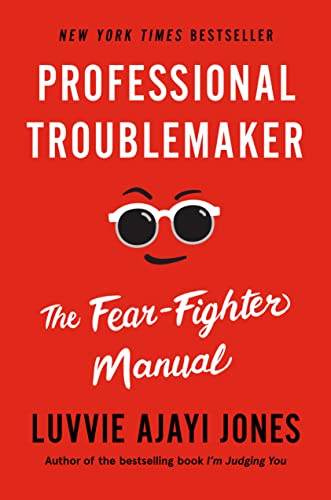
Inhaltsangabe
INSTANT NEW YORK TIMES BESTSELLER
From the New York Times bestselling author of I'm Judging You, a hilarious and transformational book about how to tackle fear--that everlasting hater--and audaciously step into lives, careers, and legacies that go beyond even our wildest dreams
Luvvie Ajayi Jones is known for her trademark wit, warmth, and perpetual truth-telling. But even she's been challenged by the enemy of progress known as fear. She was once afraid to call herself a writer, and nearly skipped out on doing a TED talk that changed her life because of imposter syndrome. As she shares in Professional Troublemaker, she's not alone.
We're all afraid. We're afraid of asking for what we want because we're afraid of hearing "no." We're afraid of being different, of being too much or not enough. We're afraid of leaving behind the known for the unknown. But in order to do the things that will truly, meaningfully change our lives, we have to become professional troublemakers: people who are committed to not letting fear talk them out of the things they need to do or say to live free.
With humor and honesty, and guided by the influence of her professional troublemaking Nigerian grandmother, Funmilayo Faloyin, Luvvie walks us through what we must get right within ourselves before we can do the things that scare us; how to use our voice for a greater good; and how to put movement to the voice we've been silencing--because truth-telling is a muscle.
The point is not to be fearless, but to know we are afraid and charge forward regardless. It is to recognize that the things we must do are more significant than our fears. This book is about how to live boldly in spite of all the reasons we have to cower. Let's go!
Die Inhaltsangabe kann sich auf eine andere Ausgabe dieses Titels beziehen.
Über die Autorin bzw. den Autor
Luvvie Ajayi Jones is an award-winning author, speaker, and podcast host who thrives at the intersection of humor, technology, and justice. She is the author of the New York Times bestseller I'm Judging You: The Do-Better Manual. And her app, LuvvNation, is a safe space in a dumpster fire world.
Auszug. © Genehmigter Nachdruck. Alle Rechte vorbehalten.
1: Know Yourself
We fear our full selves.
We are afraid of who we are, in all our glory (and grit). We’re constantly “searching” for that person. Or forgetting that person. Or repressing that person. Instead of standing strong in who that person is.
Being FULLY ourselves is necessary for us because it serves as a grounding force. I find that it’s the case for me. There is a lot to be afraid of in this world, because in general, things can be a wreck out there. And none of us needs to be afraid of who we are in our whole personhood, because who has the time?
This standing in your full self isn’t about being an immovable person, whose beliefs are stuck in a rock. It’s not that can’t nobody tell you shit, or you not being able to admit when you’re wrong. Instead, it’s about having a strong sense of identity. It’s about knowing you belong in this world just as much as anyone else. It’s about taking up the space you earned simply by being born.
One of my favorite poems is the Desiderata, written by Max Ehrmann. My favorite part is: “You are a child of the universe / no less than the trees and the stars; you have a right to be here /And whether or not it is clear to you / no doubt the universe is unfolding as it should.”
“YOU HAVE A RIGHT TO BE HERE.” You sure in the hell do.
Oddly enough, knowing this fullness of who you are doesn’t make you more stubborn. Instead, it makes you more likely to grow, since you know you have a solid foundation that doesn’t change even as you’ve learned new things and new perspectives. This is a step you need to be a professional troublemaker. Because you will GET IN TROUBLE. Guaranteed. What makes you realize it’s worth it? This process of knowing the fullness of who you are.
A lot of fear fighting and professional troublemaking is confronting things that will knock us off our square. Things that will slap us into dizziness and make us forget everything we know is real. We need solid feet, rooted in something strong to continue to stand. Knowing ourselves is important because it provides that foundation for us. It doesn’t allow anyone or anything to tell us who we are. Because when people tell us how amazing we are, that’s good to absorb. But what about when someone tells us we aren’t worthy? Or we don’t have value? Or we don’t deserve kindness and love? Or that we deserve papercuts? To know thyself is to not take all the praise to head or take all the shaming to heart.
To know thyself is to know your core, and for me, to know your core is to feel rooted in something outside of myself. It is to know, not only who I am but whose I am.
Whose We Are
Whose I am is not about belonging to someone or being beholden to people. It is about the community you are tied to that holds you accountable. It is about knowing you are part of a tribe that is greater than yourself. It is about feeling deeply connected to someone, and that no matter where you go, you have a base. If we’re phones, knowing whose we are is our charging station.
I learned the importance of WHOSE you are growing up. As a Yoruba girl, I am a part of a tribe that prioritizes your people sometimes as much as it prioritizes an individual. Collectivism comes alive for us through the traditional ORÍKÌ (oh-ree-kee).
What’s an ORIKI? It is a Yoruba word that combines two words to mean “praising your head/mind.” Ori is “head” and Ki is “to greet or praise.” An Oriki is a greeting that praises you through praising your kinship and speaking life to your destiny. It is your personal hype mantra, and can be spoken or sung.
The original attempts to tell you who you are make up your oriki. It's used to remind you of your roots and your history. It might include the city your father’s from, and where his father is from. It might include the things that make your family name special. It brags on your people. It lets people know who you WERE, who you ARE, who you WILL BE. It reminds you of those who came before you and blesses those who will come after. It might even include some shade.
Orikis are often sung at your birthday or celebrations. They also sing them to see you off to the next life. An oriki connects you to your ancestors, and it will move even the most stoic to cry because you feel it in your chest. Your tear ducts just give up the ghost and let the water go.
I am the granddaughter of a woman named Olufunmilayo Juliana Faloyin[1], and she’s the one who serves as my compass. When Grandma would say her name, she’d always say it with a smile. Which makes sense, because her name literally means “God gave me joy.” It was like her very self and presence brought her joy. When they sang my grandmother’s oriki at her funeral, I got emotional because it was a poetic affirmation of her presence on this earth and a send off. It was a standing ovation for her spirit.
This is part of my Grandma’s oriki:
Ọmọ Ògbóni Modù lorè, mẹ̀rẹ̀ ní àkún.
Ọmọ Fulani Ùjẹ̀ṣà a múni má parò oko ọni.
Ọmọ a fi ọṣẹ fọ aṣọ kí ọ́mọ Ẹlòmíràn fi eérú fọ ti ẹ̀.
Ọmọ arúgbìnrin owó bọ̀dìdẹ̀
What it loosely means (because there are some Yoruba words that don’t exist in English) is:
The child of the Ìjẹ̀ṣà Fulani who acquires one without killing the birds in one’s farm.
The child who brings out soap to wash his/her own clothes while someone else’s child brings out ashes to wash his/hers.
The child that springs up money (wealth) in multiples.
It ties her back to those who came before her and gasses her up.
*
I don’t know my oriki. Many of us don’t. Like a lot of traditions, orikis have been de-prioritized as generations pass. I’m out here oriki-less AF. But it’s okay. I’m fine, really. I’m not mad at all that by the time I came along, folks were more blasé about it (clearly I’m lowkey salty but I’ll deal with that with my therapist).
However, a lot of what we already do are derivatives of orikis and we don’t even realize it. The tradition of the ORIKI isn’t just in Yorubaland; it’s gone on through the diaspora. You can see it in the way people rap about themselves. It’s in the way people praise God. It’s in the way we say who we are in the moments we feel most proud.
When Christians praise God, we say: King of kings. Lord of Lords. Alpha and Omega. The beginning and the end. The I am. The Waymaker. That’s an oriki if I ever heard one.
When we think about how people are introduced in something as made up as the TV show Game of Thrones, it tracks. “Daenerys Stormborn of the House Targaryen. First of Her Name. The Unburnt. Queen of the Andals and the First Men. Khaleesi of the Great Grass Sea. Breaker of Chains. Mother of Dragons.” THAT IS SUCH AN ORIKI! Didn’t you feel gassed up on her behalf anytime they introduced her? I know I did. That’s what it...
„Über diesen Titel“ kann sich auf eine andere Ausgabe dieses Titels beziehen.
Suchergebnisse für Professional Troublemaker: The Fear-Fighter Manual

Beispielbild für diese ISBN
Professional Troublemaker The
Anbieter: World of Books (was SecondSale), Montgomery, IL, USA
Verkäuferbewertung 5 von 5 Sternen

Zustand: Good. Item in good condition. Textbooks may not include supplemental items i.e. CDs, access codes etc. Artikel-Nr. 00076426122
Gebraucht kaufen
EUR 3,72
Versand gratis
Versand innerhalb von USA
Versand innerhalb von USA
Anzahl: 9 verfügbar
Beispielbild für diese ISBN
Professional Troublemaker The
Anbieter: World of Books (was SecondSale), Montgomery, IL, USA
Verkäuferbewertung 5 von 5 Sternen
Zustand: Very Good. Item in very good condition! Textbooks may not include supplemental items i.e. CDs, access codes etc. Artikel-Nr. 00102135705
Gebraucht kaufen
EUR 3,72
Versand gratis
Versand innerhalb von USA
Versand innerhalb von USA
Anzahl: 2 verfügbar
Beispielbild für diese ISBN
Professional Troublemaker: The Fear-Fighter Manual
Verlag:
Penguin Life (edition ), 2021
ISBN 10: 1984881906
ISBN 13: 9781984881908
Gebraucht
Hardcover
Anbieter: BooksRun, Philadelphia, PA, USA
Verkäuferbewertung 5 von 5 Sternen
Hardcover. Zustand: Very Good. With dust jacket. It's a well-cared-for item that has seen limited use. The item may show minor signs of wear. All the text is legible, with all pages included. It may have slight markings and/or highlighting. Artikel-Nr. 1984881906-8-6-29
Gebraucht kaufen
EUR 5,29
Versand gratis
Versand innerhalb von USA
Versand innerhalb von USA
Anzahl: 1 verfügbar
Beispielbild für diese ISBN
Professional Troublemaker : The Fear-Fighter Manual
Anbieter: Better World Books: West, Reno, NV, USA
Verkäuferbewertung 5 von 5 Sternen
Zustand: Very Good. Former library copy. Pages intact with possible writing/highlighting. Binding strong with minor wear. Dust jackets/supplements may not be included. Includes library markings. Stock photo provided. Product includes identifying sticker. Better World Books: Buy Books. Do Good. Artikel-Nr. 42481376-6
Gebraucht kaufen
EUR 6,19
Versand gratis
Versand innerhalb von USA
Versand innerhalb von USA
Anzahl: 4 verfügbar
Beispielbild für diese ISBN
Professional Troublemaker : The Fear-Fighter Manual
Anbieter: Better World Books, Mishawaka, IN, USA
Verkäuferbewertung 5 von 5 Sternen
Zustand: Good. Former library copy. Pages intact with minimal writing/highlighting. The binding may be loose and creased. Dust jackets/supplements are not included. Includes library markings. Stock photo provided. Product includes identifying sticker. Better World Books: Buy Books. Do Good. Artikel-Nr. 39525088-6
Gebraucht kaufen
EUR 6,19
Versand gratis
Versand innerhalb von USA
Versand innerhalb von USA
Anzahl: 1 verfügbar
Beispielbild für diese ISBN
Professional Troublemaker : The Fear-Fighter Manual
Anbieter: Better World Books, Mishawaka, IN, USA
Verkäuferbewertung 5 von 5 Sternen
Zustand: Very Good. Former library copy. Pages intact with possible writing/highlighting. Binding strong with minor wear. Dust jackets/supplements may not be included. Includes library markings. Stock photo provided. Product includes identifying sticker. Better World Books: Buy Books. Do Good. Artikel-Nr. 42481376-6
Gebraucht kaufen
EUR 6,19
Versand gratis
Versand innerhalb von USA
Versand innerhalb von USA
Anzahl: 2 verfügbar
Beispielbild für diese ISBN
Professional Troublemaker : The Fear-Fighter Manual
Anbieter: Better World Books: West, Reno, NV, USA
Verkäuferbewertung 5 von 5 Sternen
Zustand: Good. Former library copy. Pages intact with minimal writing/highlighting. The binding may be loose and creased. Dust jackets/supplements are not included. Includes library markings. Stock photo provided. Product includes identifying sticker. Better World Books: Buy Books. Do Good. Artikel-Nr. 39525088-6
Gebraucht kaufen
EUR 6,19
Versand gratis
Versand innerhalb von USA
Versand innerhalb von USA
Anzahl: 1 verfügbar
Beispielbild für diese ISBN
Professional Troublemaker : The Fear-Fighter Manual
Anbieter: Better World Books, Mishawaka, IN, USA
Verkäuferbewertung 5 von 5 Sternen
Zustand: Good. Pages intact with minimal writing/highlighting. The binding may be loose and creased. Dust jackets/supplements are not included. Stock photo provided. Product includes identifying sticker. Better World Books: Buy Books. Do Good. Artikel-Nr. 39768550-6
Gebraucht kaufen
EUR 6,19
Versand gratis
Versand innerhalb von USA
Versand innerhalb von USA
Anzahl: 2 verfügbar
Beispielbild für diese ISBN
Professional Troublemaker : The Fear-Fighter Manual
Anbieter: Better World Books: West, Reno, NV, USA
Verkäuferbewertung 5 von 5 Sternen
Zustand: Good. Pages intact with minimal writing/highlighting. The binding may be loose and creased. Dust jackets/supplements are not included. Stock photo provided. Product includes identifying sticker. Better World Books: Buy Books. Do Good. Artikel-Nr. 39768550-6
Gebraucht kaufen
EUR 6,19
Versand gratis
Versand innerhalb von USA
Versand innerhalb von USA
Anzahl: 2 verfügbar
Beispielbild für diese ISBN
Professional Troublemaker: The Fear-Fighter Manual
Anbieter: ThriftBooks-Dallas, Dallas, TX, USA
Verkäuferbewertung 5 von 5 Sternen
Hardcover. Zustand: Very Good. No Jacket. Former library book; May have limited writing in cover pages. Pages are unmarked. ~ ThriftBooks: Read More, Spend Less. Artikel-Nr. G1984881906I4N10
Gebraucht kaufen
EUR 6,41
Versand gratis
Versand innerhalb von USA
Versand innerhalb von USA
Anzahl: 1 verfügbar