
Verwandte Artikel zu The Family Firm: A Data-Driven Guide to Better Decision...
The Family Firm: A Data-Driven Guide to Better Decision Making in the Early School Years (The ParentData Series, Band 3) - Softcover
Buch 3 von 4: The ParentData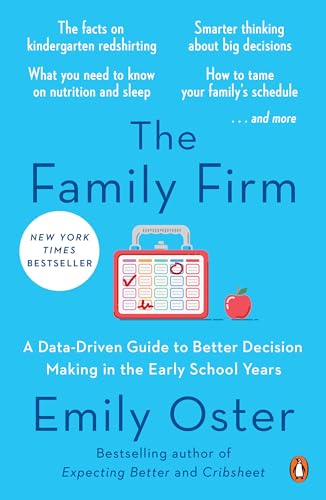
Inhaltsangabe
The instant New York Times bestseller • A Behavioral Scientist Notable Book of 2021
“Emily Oster dives into the data on parenting issues, cuts through the clutter, and gives families the bottom line to help them make better decisions.” –Good Morning America
From the bestselling author of Expecting Better and Cribsheet, the next step in data driven parenting from economist Emily Oster.
In The Family Firm, Brown professor of economics and mom of two Emily Oster offers a classic business school framework for data-driven parents to think more deliberately about the key issues of the elementary years: school, health, extracurricular activities, and more.
Unlike the hourly challenges of infant parenting, the big questions in this age come up less frequently. But we live with the consequences of our decisions for much longer. What's the right kind of school and at what age should a particular kid start? How do you encourage a healthy diet? Should kids play a sport and how seriously? How do you think smartly about encouraging children's independence? Along with these bigger questions, Oster investigates how to navigate the complexity of day-to-day family logistics.
Making these decisions is less about finding the specific answer and more about taking the right approach. Parents of this age are often still working in baby mode, which is to say, under stress and on the fly. That is a classic management problem, and Oster takes a page from her time as a business school professor at the University of Chicago to show us that thoughtful business process can help smooth out tough family decisions.
The Family Firm is a smart and winning guide to how to think clearly--and with less ambient stress--about the key decisions of the elementary school years.
Parenting is a full-time job. It's time we start treating it like one.
Die Inhaltsangabe kann sich auf eine andere Ausgabe dieses Titels beziehen.
Über die Autorin bzw. den Autor
Emily Oster is a professor of economics at Brown University and the author of Expecting Better, Cribsheet, and The Family Firm. She writes the newsletter ParentData and her work has been featured in The New York Times, The Wall Street Journal, The Washington Post, The Atlantic, and Bloomberg. She has two children.
Auszug. © Genehmigter Nachdruck. Alle Rechte vorbehalten.
1
Creating the "Big Picture"
In his book on families, Stephen Covey, of The 7 Habits of Highly Effective People fame, argues that your family needs a "mission statement." This is a grounding document to highlight your central family values. It's not dissimilar to the mission statement a firm might have. Your central family values may be religious or articulate a family-first focus. They might say something like "Prioritize family time and raise thoughtful kids." Maybe your mission articulates a particular approach to child independence (i.e., are you a free-range parent, or more of a helicopter type?).
You should have such a mission statement! But I'm going to suggest going beyond that and directly addressing the interaction between these broad priorities and concrete decisions. When I talk about creating the family Big Picture, I'm talking about these overall principles, but I'm also talking about confronting "What does Thursday night look like?"
There's a parallel to firms. The statement "Create a great search engine and don't be evil" is perhaps a good mission statement for Google, but it's not a recipe for how to run the firm. Just as "Prioritize family time and raise thoughtful kids" may be a good broad mission, but it doesn't tell you the right bedtime.
These logistical details matter, because if you fail to think about the logistics holistically, you could find yourself almost accidentally in a very different place than you imagined. Each individual choice may seem inconsequential in the moment, but they add up.
Think, for example, about birthdays. Imagine you have three kids, all in school, in classes of twenty kids each. And imagine that each kid in each class has a birthday party. That is sixty birthday parties a year. When each Evite rolls in, you think, "Oh, okay, it's just one birthday party." But by the end of the year, you've spent literally every weekend at Sky Zone, Jump For Fun, Kidz Kastle, or, my personal favorite, Dave & Buster's.
At some point you may think, "Enough is enough," and put the kibosh on attending any more parties that year. But then it's your middle daughter's best friend's birthday and she absolutely has to go. So that's another weekend down.
In economics parlance, your sequential birthday approach means you're making each invite decision "on the margin." But while adding each marginal birthday has a small effect, the aggregate may be, quite simply, not acceptable.
In the grand scheme of things, birthday parties are a minor issue. But this kind of slippery-slope experience can pervade our parenting decisions. You let in one late-night extracurricular, then another, and pretty soon your image of dinner as a family at six every night has vanished. And if this dinner is a priority for you, that's a problem.
It shouldn't escape our notice that failing to articulate these priorities is a recipe for conflict in cases where there are multiple decision makers (say, two parents) in the household. Let's say bedtime by 8:30 is a key priority for me, and I've worked out the family schedule so it happens every night that I'm around. Now imagine that I'm out of town for work and I call my partner at 10 p.m. to learn that the older child is still up, watching The Great British Baking Show.
"WHAT IS THE MATTER WITH YOU?!" I yell through the phone.
"This is your rule, not mine," comes the retort. "You want it done your way? Don't leave town."
What is the problem here? Perhaps many things, but at least one is failing to get on the same page about bedtime as a priority. If you have two (or more!) parents involved in raising a child, they'll inevitably parent at least slightly differently. My husband, for example, adheres much less stringently to the every-other-day bath system than I do. When he's in charge, baths tend to be a little less frequent. And this is okay, because although I have a particular bath system, it's not actually that important to me. In contrast, maintaining a fixed bedtime is extremely important to me. But unless we had talked it through, how would Jesse know that my feelings on bath frequency and bedtime are fundamentally different?
It is also useful to recognize that every small thing cannot be a hill to die on. If you start this process and it turns out one of you has rigid preferences about everything, that doesn't leave much space for joint problem-solving. Articulating priorities together may help you recognize which are really important to you and realize that they cannot all be equally crucial.
The first step in creating your Family Firm is to outline your mission, and then think carefully about what your family will prioritize, what your day looks like, and the basic logistics of your family. To be clear, you could think about this at any time in life-before kids, with an infant, with a toddler-but around school-entry time is a good point to revisit your mission statement carefully. For one thing, once your kid is in school, you'll adopt a schedule that you will keep-more or less-for the next thirteen years (or longer, if you have other kids). For another, this is often around the time things calm down at least a bit and you get more mental space to think about your choices.
The Process
Creating the family Big Picture is not the activity of a single afternoon, and you'll probably need to revisit pieces of it more than once as your children age. And you may choose to do this a bit differently. That's okay! Think of this as a guide or a starting point.
To help you out, I've made a workbook. In the pages that follow, I'll talk about structuring some of these conversations, about writing things down. You don't need a workbook to do this, but I think it will help.
(Also, I love workbooks. True story: My mother still remembers that at my third-grade parent-teacher conference, Mrs. Totman said, not entirely positively, "I just cannot understand why she likes workbooks so much.")
There are two basic steps. First, at the broadest level, expressing and aligning values and priorities. Second, getting to the more granular: creating the day-to-day schedule, establishing some family principles, and assigning responsibilities.
But before you get into actually doing any of this, please read the next section of the book, which has some big data pieces you might want to consider. As you think about the family schedule, knowing more about sleep-Is it important? How much do kids need?-is important. As you think about your level of parental involvement with your kid, you may want to consider what the evidence says on the relationship between parental involvement and children's independence or performance in school. The data chapters won't tell you how to make these choices for your family, but they may provide some important input.
Step 1: Values and Priorities
In a business-school class in negotiations, a common topic is the "Theory of Anchoring." Basically, the opening bid in a negotiation "anchors" the price. By the same token, collective decisions can be thrown off by having one person publicly state their views first. If we are trying to decide, as a firm, how much to bid for a company, and the first person to speak suggests $20 million, I may be embarrassed to say I thought it was worth only $2 million. But knowing that we disagree is valuable! One approach to learning that is to ask people to write down their valuations privately and then share them simultaneously.
We'll take a similar approach here. Start with all the parenting stakeholders, whoever that is in your family. This exercise is likely to be useful even if you are parenting alone, just not for quite the same reasons. Everyone gets a piece of paper (or a copy of the first workbook page) and writes down:
Your overarching family mission statement. Whatever you want! One...
„Über diesen Titel“ kann sich auf eine andere Ausgabe dieses Titels beziehen.
Suchergebnisse für The Family Firm: A Data-Driven Guide to Better Decision...

Beispielbild für diese ISBN
The Family Firm A DataDriven G
Anbieter: World of Books (was SecondSale), Montgomery, IL, USA
Verkäuferbewertung 5 von 5 Sternen

Zustand: Very Good. Item in very good condition! Textbooks may not include supplemental items i.e. CDs, access codes etc. Artikel-Nr. 00109954514
Gebraucht kaufen
EUR 6,00
Versand gratis
Versand innerhalb von USA
Versand innerhalb von USA
Anzahl: 3 verfügbar
Beispielbild für diese ISBN
The Family Firm A DataDriven G
Anbieter: World of Books (was SecondSale), Montgomery, IL, USA
Verkäuferbewertung 5 von 5 Sternen
Zustand: Good. Item in good condition. Textbooks may not include supplemental items i.e. CDs, access codes etc. Artikel-Nr. 00106977414
Gebraucht kaufen
EUR 6,00
Versand gratis
Versand innerhalb von USA
Versand innerhalb von USA
Anzahl: 5 verfügbar
Foto des Verkäufers
The Family Firm: A Data-Driven Guide to Better Decision Making in the Early School Years (The ParentData Series)
Anbieter: Dream Books Co., Denver, CO, USA
Verkäuferbewertung 5 von 5 Sternen
Zustand: acceptable. This copy has clearly been enjoyedâ"expect noticeable shelf wear and some minor creases to the cover. Binding is strong, and all pages are legible. May contain previous library markings or stamps. Artikel-Nr. DBV.1984881779.A
Gebraucht kaufen
EUR 6,05
Versand gratis
Versand innerhalb von USA
Versand innerhalb von USA
Anzahl: 1 verfügbar
Beispielbild für diese ISBN
The Family Firm : A Data-Driven Guide to Better Decision Making in the Early School Years
Verlag:
Penguin Publishing Group, 2022
ISBN 10: 1984881779
ISBN 13: 9781984881779
Gebraucht
Softcover
Anbieter: Better World Books: West, Reno, NV, USA
Verkäuferbewertung 5 von 5 Sternen
Zustand: Very Good. Pages intact with possible writing/highlighting. Binding strong with minor wear. Dust jackets/supplements may not be included. Stock photo provided. Product includes identifying sticker. Better World Books: Buy Books. Do Good. Artikel-Nr. 51738902-6
Gebraucht kaufen
EUR 9,88
Versand gratis
Versand innerhalb von USA
Versand innerhalb von USA
Anzahl: 1 verfügbar
Beispielbild für diese ISBN
The Family Firm: A Data-driven Guide to Better Decision Making in the Early School Years
Anbieter: Revaluation Books, Exeter, Vereinigtes Königreich
Verkäuferbewertung 5 von 5 Sternen
Paperback. Zustand: Brand New. 320 pages. 8.43x5.50x0.78 inches. In Stock. Artikel-Nr. __1984881779
Neu kaufen
EUR 19,58
EUR 11,66 Versand
Versand von Vereinigtes Königreich nach USA
Versand von Vereinigtes Königreich nach USA
Anzahl: 2 verfügbar
Beispielbild für diese ISBN
The Family Firm: A Data-driven Guide to Better Decision Making in the Early School Years
Anbieter: Revaluation Books, Exeter, Vereinigtes Königreich
Verkäuferbewertung 5 von 5 Sternen
Paperback. Zustand: Brand New. 320 pages. 8.43x5.50x0.78 inches. In Stock. Artikel-Nr. xr1984881779
Neu kaufen
EUR 20,65
EUR 11,66 Versand
Versand von Vereinigtes Königreich nach USA
Versand von Vereinigtes Königreich nach USA
Anzahl: 2 verfügbar
Beispielbild für diese ISBN
The Family Firm: A Data-Driven Guide to Better Decision Making in the Early School Years
Anbieter: Kennys Bookstore, Olney, MD, USA
Verkäuferbewertung 5 von 5 Sternen
Zustand: New. 2022. paperback. . . . . . Books ship from the US and Ireland. Artikel-Nr. V9781984881779
Neu kaufen
EUR 23,18
EUR 9,16 Versand
Versand innerhalb von USA
Versand innerhalb von USA
Anzahl: 15 verfügbar
Beispielbild für diese ISBN
The Family Firm: A Data-Driven Guide to Better Decision Making in the Early School Years
Anbieter: Majestic Books, Hounslow, Vereinigtes Königreich
Verkäuferbewertung 4 von 5 Sternen

Zustand: New. pp. 320. Artikel-Nr. 389409499
Neu kaufen
EUR 25,35
EUR 7,58 Versand
Versand von Vereinigtes Königreich nach USA
Versand von Vereinigtes Königreich nach USA
Anzahl: 1 verfügbar
Beispielbild für diese ISBN
The Family Firm: A Data-Driven Guide to Better Decision Making in the Early School Years (The ParentData Series, Band 3)
Anbieter: Turor Books, Hückelhoven, Deutschland
Verkäuferbewertung 4 von 5 Sternen
paperback. Zustand: New. Artikel-Nr. 01M20ZM1V9FGKMH
Neu kaufen
EUR 18,50
EUR 32,71 Versand
Versand von Deutschland nach USA
Versand von Deutschland nach USA
Anzahl: 1 verfügbar
Foto des Verkäufers
The Family Firm : A Data-Driven Guide to Better Decision Making in the Early School Years
Anbieter: AHA-BUCH GmbH, Einbeck, Deutschland
Verkäuferbewertung 5 von 5 Sternen
Taschenbuch. Zustand: Neu. Neuware - The instant New York Times bestseller A Behavioral Scientist Notable Book of the Year Emily Oster dives into the data on parenting issues, cuts through the clutter, and gives families the bottom line to help them make better decisions. Good Morning AmericaFrom the bestselling author of Expecting Better and Cribsheet, the next step in data driven parenting from economist Emily Oster.In The Family Firm, Brown professor of economics and mom of two Emily Oster offers a classic business school framework for data-driven parents to think more deliberately about the key issues of the elementary years: school, health, extracurricular activities, and more.Unlike the hourly challenges of infant parenting, the big questions in this age come up less frequently. But we live with the consequences of our decisions for much longer. What's the right kind of school and at what age should a particular kid start How do you encourage a healthy diet Should kids play a sport and how seriously How do you think smartly about encouraging children's independence Along with these bigger questions, Oster investigates how to navigate the complexity of day-to-day family logistics.Making these decisions is less about finding the specific answer and more about taking the right approach. Parents of this age are often still working in baby mode, which is to say, under stress and on the fly. That is a classic management problem, and Oster takes a page from her time as a business school professor at the University of Chicago to show us that thoughtful business process can help smooth out tough family decisions.The Family Firm is a smart and winning guide to how to think clearly--and with less ambient stress--about the key decisions of the elementary school years.Parenting is a full-time job. It's time we start treating it like one. Artikel-Nr. 9781984881779
Neu kaufen
EUR 32,80
EUR 30,50 Versand
Versand von Deutschland nach USA
Versand von Deutschland nach USA
Anzahl: 1 verfügbar