
Verwandte Artikel zu The College Conversation: A Practical Companion for...
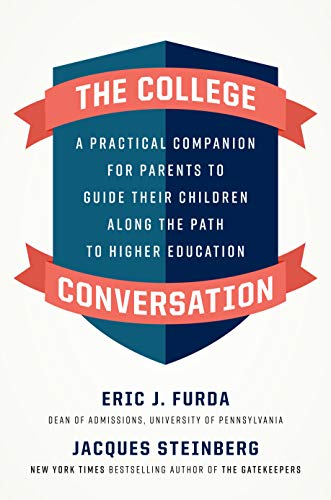
The College Conversation: A Practical Companion for Parents to Guide Their Children Along the Path to Higher Education - Hardcover
Inhaltsangabe
From an Ivy League dean and a college admissions expert, a guide to help parents support their children as they navigate their way to college
The College Conversation is a comprehensive resource for mapping the path through the college application process that provides practical advice and reassurance to keep both anxious parents and confused children sane and grounded. Rather than adding to the existing canon of "How to Get In" college guides or rankings, Eric Furda and Jacques Steinberg provide a step-by-step approach to having the tough conversations on this topic with less stress and more success.
The book is organized around key discussions and themes that trace the chronological arc of admissions and financial aid--beginning before the assembly of a list of potential colleges and continuing through the receipt of decisions--with a final section that includes advice on the first year of college. The topics include preliminary conversations about the search, and specifically how parents can think about their children's interests and what kind of college would best suit them; choosing a college (based on its curriculum, culture, and community); writing the most effective essays; assessing acceptances, including considerations of finances and aid; and making the transition from high school to college life.
The College Conversation will provide parents, students, and counselors with the credible, level-headed information often missing in this process, as well as a much-needed dash of perspective borne of experience.
Die Inhaltsangabe kann sich auf eine andere Ausgabe dieses Titels beziehen.
Über die Autorin bzw. den Autor
Eric J. Furda is the former dean of admissions at the University of Pennsylvania and the former executive director of admissions at Columbia University.
Jacques Steinberg is the New York Times bestselling author of The Gatekeepers and You Are an Ironman, and is a former New York Times education journalist. He has served as a senior executive at Say Yes Education and on the board of the National Association for College Admission Counseling. He appears periodically as a college admissions expert on NBC's Today show.
Auszug. © Genehmigter Nachdruck. Alle Rechte vorbehalten.
A. The "Why College?" Conversation
These are most certainly days of disruption in higher education. At some private four-year colleges and universities, the full cost of attendance (before financial aid) can approach $80,000. That figure is not only well above the median family income in this country ($63,179, according to the U.S. Census Bureau) but it has increased at rates far higher than inflation at many points over the last few decades. At prices this high, families are wise to consider the return on such an investment, including its usefulness as preparation for entering the workforce and a career.
We believe that there is still a strong case to be made for acquiring a traditional four-year bachelor's degree, beyond its utilitarian value, though with a few caveats. Once again, you need to know your child-and to ask them, and yourself, some fundamental questions. Do you, as a parent, feel that as the end of their senior year of high school approaches, they are emotionally ready for a four-year college experience, whether living at home or independently on campus? Even with the range of price points for four-year college tuition (whether at an in-state public institution, which is typically more reasonably priced, or at a private institution that offers deep discounts in the form of financial aid), is a bachelor's degree something that you as a family can afford?
There is also the question of the goal and purpose of your child's attending a four-year institution. Are they interested, for example, in the intrinsic value of learning and knowledge? Of having opportunities to build relationships and to network? And to what extent do they see college as a pathway to a career, or at least as laying the groundwork for it? Finally, does your child view college, at least in part, as preparation for a graduate school experience, including medical school, law school, or other professional degree?
In this section we hope to provide you with some supporting evidence for the importance of a four-year degree and a return on that investment. But we'll also consider other paths-including associate's degrees, the transfer process between community college and more traditional four-year colleges, and career credentialing. In some ways the range of such educational choices following high school is unique to the United States, where one doesn't have to decide on a career at eighteen years old.
When we refer to "discovery" in the title of this chapter, we're imagining conversations in which your child will discover aspects of themselves that will help guide them through this process and will serve not only to enlighten them but you as a parent, too. Before we get started, let's define a few basic terms.
Bachelor's Degree
A strong body of evidence exists that supports the value of studying for and completing a bachelor's degree. In terms of lifetime earnings, the latest figures from the Bureau of Labor Statistics reveal that people who attain at least a bachelor's degree will earn roughly $2.4 million over their lifetime-about $1 million more than someone whose education did not advance beyond a high school degree and $600,000 more than those with an associate's degree. Meanwhile, that bachelor's is an essential gateway to a master's degree ($2.8 million in lifetime earnings) and a professional degree ($4.2 million).
Omar Monteagudo, the principal of the School for Advanced Studies in Miami, a partnership between the Miami Dade County Public Schools and Miami Dade College, tells students as well as parents, "The bachelor's degree is what the high school diploma used to be ten, twenty, thirty years ago."
Jennifer Delahunty, the former dean of admissions of Kenyon College in Ohio is the editor of a book with a title intended as a not-so-subtle rebuke from children to their parents-I'm Going to College, Not You! It includes an essay by Gail Hudson, a writer based in Seattle, who advises families to broaden the concept of the return on investment of a bachelor's degree beyond just dollars and cents. "More income doesn't necessarily mean more happiness," she writes. "Education can't buy us loving spouses and joyful lives."
If a bachelor's-degree-granting institution, particularly one rooted in the liberal arts, is doing its job well, then its graduates will develop critical-thinking skills and the ability to communicate clearly and persuasively. These are skills and qualities that can ultimately benefit the larger community and are essential to the functioning of a democratic society.
For young people who may be the first in their families to attend college-or those whose family income ranks among the lowest in the nation-there is also persuasive research demonstrating the value of a bachelor's degree as a vehicle for social mobility. For example, children from low-income families who graduate from the nation's most selective colleges have nearly the same odds of reaching the top fifth of the nation's income distribution as their peers from higher-income families, according to a study by the Equality of Opportunity Project.
"A college education acts as a leveler, dramatically reducing the correlation between parents' income and the adult incomes of their children," the researchers Richard V. Reeves and Eleanor Krause wrote in a Brookings Institution blog post in January 2018. "This is true for elite colleges, other four-year institutions, and community colleges."
Enrolling in a bachelor's-degree-granting institution should not be assumed to be a guarantee of completion. Studies have shown that as many as 40 percent of young people who enroll in a four-year college or university don't go on to graduate from that institution. While some will transfer to other schools and complete their degrees there, many others will drop out as a result of not being properly prepared for college work and the college experience, or being swamped in debt, to say nothing of being distracted by hours spent working a part-time job to defray the cost of that education.
Associate's Degree
There are many reasons-and arguably more today than ever before-why your child might want to at least consider beginning their education after high school at a community college. Parents and young people alike would do well to bear in mind what Alfred Herrera, an assistant vice provost at UCLA, told us: "Community college is college."
A big argument for community college is economic. While many families hesitate to commit to the cost of a traditional four-year college degree, an associate's program can be a much more economical option. For example, a year spent as a full-time student in an associate's program at a community college will have an annual average cost of less than $4,000. That compares to roughly $40,000, on average, for tuition for a year of full-time study at a four-year private college or university.
In an ideal world some, if not all, community college credits would be transferable to a four-year institution-enabling your child to save no small amount on the first year or two of tuition while still graduating with a bachelor's degree. The State University System of Florida and the California State University system are among many across the country that have so-called articulation agreements that formalize the transfer of associate's credits to bachelor's programs. A student who successfully completes an associate's degree at one of 115 California community colleges is guaranteed priority admission to at least one college in its state university system, though not necessarily to the campus of their choice. (The program even has the catchy name "Degree with a...
„Über diesen Titel“ kann sich auf eine andere Ausgabe dieses Titels beziehen.
Suchergebnisse für The College Conversation: A Practical Companion for...

Beispielbild für diese ISBN
The College Conversation: A Practical Companion for Parents to Guide Their Children Along the Path to Higher Education
Anbieter: World of Books (was SecondSale), Montgomery, IL, USA
Verkäuferbewertung 5 von 5 Sternen

Zustand: Good. Item in good condition. Textbooks may not include supplemental items i.e. CDs, access codes etc. Artikel-Nr. 00099810591
Gebraucht kaufen
EUR 4,44
Versand gratis
Versand innerhalb von USA
Versand innerhalb von USA
Anzahl: 1 verfügbar
Beispielbild für diese ISBN
The College Conversation: A Practical Companion for Parents to Guide Their Children Along the Path to Higher Education
Anbieter: World of Books (was SecondSale), Montgomery, IL, USA
Verkäuferbewertung 5 von 5 Sternen
Zustand: Very Good. Item in very good condition! Textbooks may not include supplemental items i.e. CDs, access codes etc. Artikel-Nr. 00106069842
Gebraucht kaufen
EUR 4,44
Versand gratis
Versand innerhalb von USA
Versand innerhalb von USA
Anzahl: 1 verfügbar
Beispielbild für diese ISBN
The College Conversation: A Practical Companion for Parents to Guide Their Children Along the Path to Higher Education
Anbieter: BooksRun, Philadelphia, PA, USA
Verkäuferbewertung 5 von 5 Sternen
Hardcover. Zustand: Very Good. With dust jacket. It's a well-cared-for item that has seen limited use. The item may show minor signs of wear. All the text is legible, with all pages included. It may have slight markings and/or highlighting. Artikel-Nr. 1984878344-8-1-29
Gebraucht kaufen
EUR 5,46
Versand gratis
Versand innerhalb von USA
Versand innerhalb von USA
Anzahl: 1 verfügbar
Beispielbild für diese ISBN
The College Conversation : A Practical Companion for Parents to Guide Their Children along the Path to Higher Education
Verlag:
Penguin Publishing Group, 2020
ISBN 10: 1984878344
ISBN 13: 9781984878342
Gebraucht
Hardcover
Anbieter: Better World Books, Mishawaka, IN, USA
Verkäuferbewertung 5 von 5 Sternen
Zustand: Very Good. Former library copy. Pages intact with possible writing/highlighting. Binding strong with minor wear. Dust jackets/supplements may not be included. Includes library markings. Stock photo provided. Product includes identifying sticker. Better World Books: Buy Books. Do Good. Artikel-Nr. 46980426-6
Gebraucht kaufen
EUR 6,17
Versand gratis
Versand innerhalb von USA
Versand innerhalb von USA
Anzahl: 3 verfügbar
Beispielbild für diese ISBN
The College Conversation : A Practical Companion for Parents to Guide Their Children along the Path to Higher Education
Verlag:
Penguin Publishing Group, 2020
ISBN 10: 1984878344
ISBN 13: 9781984878342
Gebraucht
Hardcover
Anbieter: Better World Books, Mishawaka, IN, USA
Verkäuferbewertung 5 von 5 Sternen
Zustand: Good. Former library copy. Pages intact with minimal writing/highlighting. The binding may be loose and creased. Dust jackets/supplements are not included. Includes library markings. Stock photo provided. Product includes identifying sticker. Better World Books: Buy Books. Do Good. Artikel-Nr. 41595039-6
Gebraucht kaufen
EUR 6,17
Versand gratis
Versand innerhalb von USA
Versand innerhalb von USA
Anzahl: 3 verfügbar
Beispielbild für diese ISBN
The College Conversation : A Practical Companion for Parents to Guide Their Children along the Path to Higher Education
Verlag:
Penguin Publishing Group, 2020
ISBN 10: 1984878344
ISBN 13: 9781984878342
Gebraucht
Hardcover
Anbieter: Better World Books, Mishawaka, IN, USA
Verkäuferbewertung 5 von 5 Sternen
Zustand: Very Good. Pages intact with possible writing/highlighting. Binding strong with minor wear. Dust jackets/supplements may not be included. Stock photo provided. Product includes identifying sticker. Better World Books: Buy Books. Do Good. Artikel-Nr. 41593506-6
Gebraucht kaufen
EUR 6,17
Versand gratis
Versand innerhalb von USA
Versand innerhalb von USA
Anzahl: 1 verfügbar
Beispielbild für diese ISBN
The College Conversation: A Practical Companion for Parents to Guide Their Children Along the Path to Higher Education
Anbieter: ThriftBooks-Dallas, Dallas, TX, USA
Verkäuferbewertung 5 von 5 Sternen
Hardcover. Zustand: As New. No Jacket. Pages are clean and are not marred by notes or folds of any kind. ~ ThriftBooks: Read More, Spend Less. Artikel-Nr. G1984878344I2N00
Gebraucht kaufen
EUR 6,28
Versand gratis
Versand innerhalb von USA
Versand innerhalb von USA
Anzahl: 1 verfügbar
Beispielbild für diese ISBN
The College Conversation: A Practical Companion for Parents to Guide Their Children Along the Path to Higher Education
Anbieter: ThriftBooks-Dallas, Dallas, TX, USA
Verkäuferbewertung 5 von 5 Sternen
Hardcover. Zustand: Very Good. No Jacket. Missing dust jacket; May have limited writing in cover pages. Pages are unmarked. ~ ThriftBooks: Read More, Spend Less. Artikel-Nr. G1984878344I4N01
Gebraucht kaufen
EUR 6,28
Versand gratis
Versand innerhalb von USA
Versand innerhalb von USA
Anzahl: 1 verfügbar
Beispielbild für diese ISBN
The College Conversation: A Practical Companion for Parents to Guide Their Children Along the Path to Higher Education
Anbieter: Books From California, Simi Valley, CA, USA
Verkäuferbewertung 4 von 5 Sternen

hardcover. Zustand: Good. Minor wear creasing. Artikel-Nr. mon0003578681
Gebraucht kaufen
EUR 3,56
EUR 4,32 Versand
Versand innerhalb von USA
Versand innerhalb von USA
Anzahl: 1 verfügbar
Beispielbild für diese ISBN
The College Conversation: A Practical Companion for Parents to Guide Their Children Along the Path to Higher Education
Anbieter: Revaluation Books, Exeter, Vereinigtes Königreich
Verkäuferbewertung 5 von 5 Sternen
Hardcover. Zustand: Brand New. 249 pages. 9.25x6.25x1.00 inches. In Stock. Artikel-Nr. 1984878344
Neu kaufen
EUR 28,00
EUR 11,69 Versand
Versand von Vereinigtes Königreich nach USA
Versand von Vereinigtes Königreich nach USA
Anzahl: 1 verfügbar