
Verwandte Artikel zu Closer by Sea
Inhaltsangabe
INSTANT NATIONAL BESTSELLER
CBC Books “86 Works of Canadian Fiction to Read in the First Half of 2023”
CBC Books “40 Canadian Books to Read This Summer”
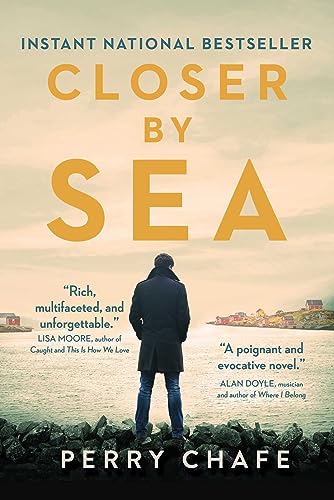
From the writer and producer of the hit TV shows Republic of Doyle and Son of a Critch, a poignant coming-of-age debut novel about the mysterious disappearance of a young girl and the fragility of childhood bonds, set against the backdrop of a small island community adapting to an ever-changing landscape.
In 1991, on a small, isolated island off the coast of Newfoundland, twelve-year-old Pierce Jacobs struggles to come to terms with the death of his father. It’s been three years since his dad, a fisherman, disappeared in the cold, unforgiving Atlantic, his body never recovered. Pierce is determined to save enough money to fix his father’s old boat and take it out to sea. But life on the island is quiet and hard. The local fishing industry is on the brink of collapse, threatening to take an ages-old way of life with it. The community is hit even harder when a young teen named Anna Tessier goes missing.
With the help of his three friends, Pierce sets out to find Anna, with whom he shared an unusual but special bond. They soon cross paths with Solomon Vickers, a mysterious, hermetic fisherman who may have something to do with the missing girl. Their search brings them into contact with unrelenting bullies, magnificent sea creatures, fierce storms, and glacial giants. But most of all, it brings them closer to the brutal reality of both the natural and the modern world.
Part coming-of-age story, part literary mystery, and part suspense thriller, Closer by Sea is a page-turning, poignant, and powerful novel about family, friendship, and community set at a pivotal time in modern Newfoundland history. It is an homage to a people and a place, and above all it captures that delicate and tender moment when the wonder of childhood innocence gives way to the harsh awakening of adult experience.
Die Inhaltsangabe kann sich auf eine andere Ausgabe dieses Titels beziehen.
Über die Autorin bzw. den Autor
Perry Chafe is a Canadian television writer, showrunner, producer, and songwriter. He is a cofounder and partner in Take the Shot Productions. Perry was the cocreator, showrunner, and head writer for the TV series Republic of Doyle, which ran for six seasons on the CBC, and an executive producer and writer for the Netflix/Discovery series Frontier, starring Jason Momoa. In addition, he was an executive producer and writer for Caught, a CBC limited series based on Lisa Moore’s award-winning novel of the same name. He is currently a writer and producer on the hugely successful CBC series Son of a Critch. Born and raised in the small fishing community of Petty Harbour, Newfoundland, he now lives in St. John’s, Newfoundland. Closer by Sea is his debut novel. Connect with him on Twitter @PerryChafe.
Auszug. © Genehmigter Nachdruck. Alle Rechte vorbehalten.
Chapter One ONE
From the sloping incline behind my house, I would watch the boats steam through the narrows atop my dad’s grounded, overturned thirty-foot trap skiff. It was the early summer of 1991, and the boat had been lying in our back garden for three years. The white paint covering the overlapping spruce planks that ran the length of his boat was peeling badly and some rot was settling in. The vessel had braved the extreme weather conditions that came with life on and around an island in the cold North Atlantic, but it was no longer getting the attention needed to ensure its continued survival. Even my name, which I had etched into the planks with my knife, was beginning to disappear. PIERCE. It was my great-grandfather’s name too, an old name for a now twelve-year-old boy.
“It has character,” my mother said. “You’ll grow into it. One day.”
The truth is, I liked being the only Pierce on our small island. And somehow, being the only one gave me a reprieve from the often unflattering nicknames given to distinguish those with the same first names.
The boat took up a good deal of space in our garden. Before it was parked there, we grew potatoes, carrots, cabbage, and turnips, or whatever the soil would allow. But we hadn’t planted anything in a long while, a combination of waning interest and declining necessity since it was just the two of us now, me and my mother, in our small two-story, saltbox-style clapboard house. It was my grandfather’s house. And his father’s before him. We could trace our family back some two hundred years, like most families on Perigo Island. And we were all tethered to the fishery.
Looking through the scratched lenses of a worn pair of binoculars, I would check the horizon every few minutes. During the summer months, the boats would leave our harbor early in the morning, just before sunrise, and would return hours later, hopefully with a load of fish. Cod to be precise. Though only twelve, I had become very good at being able to guess how much fish a boat was carrying given how it was riding on the ocean. You wanted to see a boat riding low, with the water almost up to the gunwale near the top edge of the boat. That translated into at least a couple of thousand pounds of fish. A fine day’s catch. On the contrary, a boat riding high on the waves usually meant a few hundred pounds; sometimes it meant no fish at all. We were currently on a string of days without anyone landing a good haul.
In our world, cod was king. Though it was a relatively short season, running from June to September, this fishery guaranteed our very survival. For us, it was a family-based industry with everyone involved one way or the other, either catching the fish with lines and nets or processing the haul in our local plant. In school, we were told that Newfoundland cod was exported all over the world, to markets in the United States, Japan, the United Kingdom, Brazil, and Puerto Rico. It was funny to think that fish taken from our waters would end up in places we could only ever dream of visiting.
Since my father’s disappearance, I had developed a strong dislike of the ocean, an affliction that often proved problematic, considering I spent most of my childhood surrounded by it. During particularly bad storms, I would lie awake and listen to the pounding waves crash into the shoreline not far from my bedroom window. The salt spray would coat not only our front door but also every car, bike, or piece of metal we owned, reducing everything to piles of rust. Salt also weathered the paint on our clapboard house and made it difficult to grow any root vegetables in the front garden. But such was life in the cold North Atlantic on a small island only sixteen miles long and half as wide. It was named by Portuguese fishermen and means “danger,” perhaps a reference to the difficulty that fishermen had navigating the currents around it. Perigo was only a thirty-minute ferry ride to the larger island of Newfoundland, but it might as well have been a million miles away.
Through the lens, I could see the corner of our small school. It was there that we first learned that the very ground we were standing on was composed of limestone, granite, and volcanic rock, some of the oldest on the planet. These lessons conjured images of molten lava spewing up from the depths, which did little to alleviate my distrust of the ocean. We were also told that we had subarctic terrain, which explained the bogs and barrens that were a prominent feature of Perigo’s landscape. There was only one wooded area left on the island, a small stand of spruce and fir trees, the rest having been cut down over generations for lumber and firewood. All this meant was that it was easy to get around on our trikes. These three-wheeled, all-terrain fun machines skipped across the land with ease, their only limitation being the jagged cliffs that fenced the island in.
From the top of my dad’s boat, I could also see the heavily tarred flat roof of our fish plant, which processed thousands of pounds of fish a day, impressive for a community of under 1,500 residents, most of whom either worked the plant or fished cod for a living. The rest braved the ferry run, day in and day out, for work across the way. After unloading their catch on the north side, the boats would steam across the way and tie up at either the south side or at the very end of the harbor. A small breakwater protected the entrance to the harbor from large waves. This man-made barrier ran from the north to the south side with a wide enough opening in the middle to allow boats to safely pass through but too wide to jump across, as proven by Billy Maddox in the summer of ’85. His failed attempt earned him a nickname he would carry with him for the rest of his life: Just Short.
The breakwater and adjoining fish plant were always a beehive of activity during the summer months. There was even money to be made for a bunch of twelve-year-olds with sharp knives.
As I swept back over the horizon, adjusting the large focusing knob, I spotted what I’d been waiting for—boats steaming toward the harbor. They were riding fairly low in the water. They had fish. I slipped on my rubber boots, picked up my white plastic pail, and ran my thumb across the blade of my knife, checking the sharpness before inserting it in the sheath that hung from a loop on my belt. My dad had given me the knife, which I had promptly inscribed with my name on the wooden handle.
I ran down the gravel lane of my house, took a hard right, and headed up toward the fish plant. As I neared my destination, I could hear the unmistakable put-put of a single-cylinder make-and-break engine. The name was in reference to the motor’s ignition system, which made a spark before breaking once a certain speed was reached. One fisherman, however, said the name had more to do with the fact that you could make something to fix those engines whenever they broke down. Before their invention, people like my great-grandfather had to row to the fishing grounds. “Back then, the men around here had arms like legs,” my father used to say. The image always made me smile.
I rounded a bend in the road that took me within fifty feet of the ocean and found myself running parallel to one of the boats that was about to cross through the breakwater and into the harbor. Jacob Maloney, a man who knew the fishing grounds like the cracks in his leathery hands, was at the rudder, while his son, Bobby, was up at the bow, uncoiling rope in preparation for docking. They were now within earshot.
“Can I have your tongues?” I shouted at Jacob.
Jacob looked across at me. We were almost eye level now; I was on land and they were on the water. He nodded...
„Über diesen Titel“ kann sich auf eine andere Ausgabe dieses Titels beziehen.
Suchergebnisse für Closer by Sea

Beispielbild für diese ISBN
Closer by Sea
Anbieter: Better World Books, Mishawaka, IN, USA
Verkäuferbewertung 5 von 5 Sternen

Zustand: Good. Former library copy. Pages intact with minimal writing/highlighting. The binding may be loose and creased. Dust jackets/supplements are not included. Includes library markings. Stock photo provided. Product includes identifying sticker. Better World Books: Buy Books. Do Good. Artikel-Nr. 46717317-6
Gebraucht kaufen
EUR 6,37
Versand gratis
Versand innerhalb von USA
Versand innerhalb von USA
Anzahl: 2 verfügbar
Beispielbild für diese ISBN
Closer by Sea
Anbieter: Better World Books, Mishawaka, IN, USA
Verkäuferbewertung 5 von 5 Sternen
Zustand: Very Good. Pages intact with possible writing/highlighting. Binding strong with minor wear. Dust jackets/supplements may not be included. Stock photo provided. Product includes identifying sticker. Better World Books: Buy Books. Do Good. Artikel-Nr. 46715846-6
Gebraucht kaufen
EUR 6,37
Versand gratis
Versand innerhalb von USA
Versand innerhalb von USA
Anzahl: 1 verfügbar
Beispielbild für diese ISBN
Closer by Sea
Anbieter: Better World Books, Mishawaka, IN, USA
Verkäuferbewertung 5 von 5 Sternen
Zustand: Very Good. Former library copy. Pages intact with possible writing/highlighting. Binding strong with minor wear. Dust jackets/supplements may not be included. Includes library markings. Stock photo provided. Product includes identifying sticker. Better World Books: Buy Books. Do Good. Artikel-Nr. 50163877-6
Gebraucht kaufen
EUR 6,37
Versand gratis
Versand innerhalb von USA
Versand innerhalb von USA
Anzahl: 2 verfügbar
Beispielbild für diese ISBN
Closer by Sea
Anbieter: Better World Books, Mishawaka, IN, USA
Verkäuferbewertung 5 von 5 Sternen
Zustand: Good. Pages intact with minimal writing/highlighting. The binding may be loose and creased. Dust jackets/supplements are not included. Stock photo provided. Product includes identifying sticker. Better World Books: Buy Books. Do Good. Artikel-Nr. 50573305-6
Gebraucht kaufen
EUR 6,37
Versand gratis
Versand innerhalb von USA
Versand innerhalb von USA
Anzahl: 2 verfügbar
Beispielbild für diese ISBN
Closer by Sea
Anbieter: ThriftBooks-Dallas, Dallas, TX, USA
Verkäuferbewertung 5 von 5 Sternen
Paperback. Zustand: Fair. No Jacket. Readable copy. Pages may have considerable notes/highlighting. ~ ThriftBooks: Read More, Spend Less. Artikel-Nr. G1982185252I5N00
Gebraucht kaufen
EUR 8,17
Versand gratis
Versand innerhalb von USA
Versand innerhalb von USA
Anzahl: 1 verfügbar
Beispielbild für diese ISBN
Closer by Sea
Anbieter: ThriftBooks-Atlanta, AUSTELL, GA, USA
Verkäuferbewertung 5 von 5 Sternen
Paperback. Zustand: Very Good. No Jacket. Former library book; May have limited writing in cover pages. Pages are unmarked. ~ ThriftBooks: Read More, Spend Less. Artikel-Nr. G1982185252I4N10
Gebraucht kaufen
EUR 8,17
Versand gratis
Versand innerhalb von USA
Versand innerhalb von USA
Anzahl: 1 verfügbar
Beispielbild für diese ISBN
Closer by Sea
Anbieter: ThriftBooks-Atlanta, AUSTELL, GA, USA
Verkäuferbewertung 5 von 5 Sternen
Paperback. Zustand: Good. No Jacket. Pages can have notes/highlighting. Spine may show signs of wear. ~ ThriftBooks: Read More, Spend Less. Artikel-Nr. G1982185252I3N00
Gebraucht kaufen
EUR 8,17
Versand gratis
Versand innerhalb von USA
Versand innerhalb von USA
Anzahl: 1 verfügbar
Beispielbild für diese ISBN
Closer by Sea
Anbieter: ThriftBooks-Dallas, Dallas, TX, USA
Verkäuferbewertung 5 von 5 Sternen
Paperback. Zustand: Very Good. No Jacket. May have limited writing in cover pages. Pages are unmarked. ~ ThriftBooks: Read More, Spend Less. Artikel-Nr. G1982185252I4N00
Gebraucht kaufen
EUR 8,17
Versand gratis
Versand innerhalb von USA
Versand innerhalb von USA
Anzahl: 1 verfügbar
Beispielbild für diese ISBN
Closer by Sea
Anbieter: ThriftBooks-Atlanta, AUSTELL, GA, USA
Verkäuferbewertung 5 von 5 Sternen
Paperback. Zustand: Fair. No Jacket. Readable copy. Pages may have considerable notes/highlighting. ~ ThriftBooks: Read More, Spend Less. Artikel-Nr. G1982185252I5N00
Gebraucht kaufen
EUR 8,17
Versand gratis
Versand innerhalb von USA
Versand innerhalb von USA
Anzahl: 1 verfügbar
Beispielbild für diese ISBN
Closer by Sea
Anbieter: medimops, Berlin, Deutschland
Verkäuferbewertung 5 von 5 Sternen
Zustand: good. Befriedigend/Good: Durchschnittlich erhaltenes Buch bzw. Schutzumschlag mit Gebrauchsspuren, aber vollständigen Seiten. / Describes the average WORN book or dust jacket that has all the pages present. Artikel-Nr. M01982185252-G
Gebraucht kaufen
EUR 15,63
EUR 10,00 Versand
Versand von Deutschland nach USA
Versand von Deutschland nach USA
Anzahl: 1 verfügbar