
Verwandte Artikel zu Generations: The Real Differences Between Gen Z, Millennials...
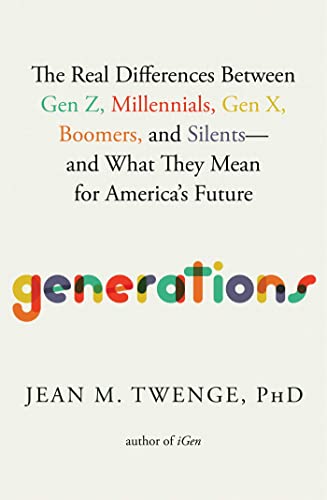
Generations: The Real Differences Between Gen Z, Millennials, Gen X, Boomers, and Silents―and What They Mean for America's Future - Hardcover
Inhaltsangabe
A groundbreaking, revelatory portrait of the five generations that make up today’s population, from the bestselling author of Generation Me and iGen. Dr. Jean Twenge has analyzed millions of data points to glean the attitudes, characteristics, and life circumstances that define each generation, resulting in a fascinating look at how they connect, conflict, and compete with each other.
Upending the conventional theory that generational differences are caused by major events, Dr. Jean Twenge analyzes data on 39 million people from robust national surveys—some going back nearly a century—to show that changes in technology are the underlying driver of each generation’s unique makeup. In this revelatory work, Twenge outlines key shifts in attitudes and lifestyle choices that define each generation regarding gender, income, politics, race, sexuality, marriage, mental health, and much more.
Surprising, engaging, and informative, Generations “gets you thinking about how appreciating generational differences can, ironically, bring us together” (Angela Duckworth, New York Times bestselling author). It will forever change the way you view your parents, peers, coworkers, and children, no matter which generation you call your own.
Die Inhaltsangabe kann sich auf eine andere Ausgabe dieses Titels beziehen.
Über die Autorin bzw. den Autor
Jean M. Twenge, PhD, a professor of psychology at San Diego State University, is the author of more than 190 scientific publications and several books based on her research, including Ten Rules for Raising Kids in a High-Tech World, Generations, iGen, and Generation Me. Her research has been covered in Time, The Atlantic, Newsweek, The New York Times, USA TODAY, and The Washington Post. She has also been featured on Today, Good Morning America, Fox and Friends, CBS This Morning, Real Time with Bill Maher, and NPR. She lives in San Diego with her husband and three daughters.
Auszug. © Genehmigter Nachdruck. Alle Rechte vorbehalten.
Chapter 1: The How and Why of Generations CHAPTER 1 The How and Why of Generations
In the Bay of Bengal between India and Myanmar lies North Sentinel, an island about the size of Manhattan. In 2018, a 26-year-old American paid a group of fishermen to take him there. He was never seen again.
North Sentinel is the home of one of the last groups of humans isolated from the rest of the world. Outsiders have visited over the centuries, including a group of anthropologists between the 1960s and 1990s, but the tribe has made it clear they want to be left alone. Boats and helicopters that get too close are greeted by tribesmen waving spears and bows, and the few lone outsiders who have ventured there have been killed, leading India to ban boats from traveling within a three-mile radius of the island. Although the tribe uses metal from shipwrecks for their weapons, they have no modern technology. Their day-to-day lives today are, in all likelihood, barely different from how they were two hundred years ago.
As a result, parents on North Sentinel are not shooing their kids off video games and telling them to go outside and play. Parents are not worrying that their teenage children are spending too much time on TikTok. They are hunting, gathering, and cooking over an open fire instead of picking the best Amazon Fresh delivery window. With no birth control, young women on the island have children at about the same age that their mothers, grandmothers, and great-grandmothers did. We can guess that cultural values have changed little; the North Sentinelese likely follow the same rules for communal living as their ancestors.
Not so in most of the rest of the world. New technologies have reshaped social interaction and leisure time, value systems have shifted from rigid rules and strict social roles to individual expression and an embrace of diversity, and the milestones of adolescence and adulthood are now reached much later than they were seventy years ago. A time traveler from 1950 would be shocked that same-sex marriage was legal—and then they’d probably faint after seeing a smartphone.
The breakneck speed of cultural change means that growing up today is a completely different experience from growing up in the 1950s or the 1980s—or even the 2000s. These changes have an impact: The era when you were born has a substantial influence on your behaviors, attitudes, values, and personality traits. In fact, when you were born has a larger effect on your personality and attitudes than the family who raised you does.
These differences based on birth year are most easily understood as differences among generations. Traditionally, the word generation has been used to describe family relationships—for example, that a three-generation household includes grandparents, parents, and children. The word generation is now more commonly used to refer to social generations: those born around the same time who experienced roughly the same culture growing up.
The United States is currently populated by six generations: Silents (born 1925–1945), Boomers (1946–1964), Generation X (1965–1979), Millennials (1980–1994), Generation Z (aka iGen or Zoomers, 1995–2012), and an as-yet-unnamed generation born after 2013 (I call them Polars; some marketers have called them Alphas). Generations aren’t just an American phenomenon; most other countries have similar generational divisions, though with their own cultural twists.
Not that long ago, it was difficult to determine whether and how generations differed from each other, even on average. More than one pundit has complained that musings on generations occasionally resemble horoscopes. They have a point: Many books and articles on generational differences are long on subjective observations but short on hard data. Others poll a small segment of people and attempt to draw broad conclusions. With the age of Big Data upon us, that no longer needs to be the case. In these pages, you’ll find the results of generational analyses spanning twenty-four datasets including thirty-nine million people—nearly as many people as live in California, the most populous state in the U.S. With so much data, it’s possible to get a better understanding of generational differences than ever before.
Appreciating generational differences is crucial for understanding family relationships (Why is my teen always on her phone? Why do my parents not know what nonbinary is?), the workplace (Why are younger employees so different? Why does my boss think that way?), mental health (Which generations are more likely to be depressed, and why?), politics (How will each generation vote as they grow older?), economic policy (Are Millennials actually poor?), marketing (What does each generation value?), and public discourse (Why are more young people so negative about the country? Is putting your pronouns in your email signature just a fad?). These questions capture just a few of the reasons why generations are endlessly discussed online. At a time when generational conflict—from work attitudes to cancel culture to “OK, Boomer”—is at a level not seen since the 1960s, separating the myths from the reality of generations is more important than ever.
Studying the ebb and flow of generations is also a unique way to understand history. Events such as wars, economic downturns, and pandemics are often experienced differently depending on your age. Having Dad at home because he was laid off during the recession might be fun for the kids but terrifying for Dad. However, history is not just a series of events; it’s also the ebb and flow of a culture and all that entails: technology, attitudes, beliefs, behavioral norms, diversity, prejudice, time use, education, family size, divorce. What your grandmother called “living in sin” is today’s accepted unmarried partnership. What a teenager now considers entertaining (Instagram scrolling) is very different from what her parents considered entertaining when they were teens (driving around with their friends).
Generational differences also provide a glimpse into the future. Where will we be in ten years? Twenty? Because some traits and attitudes change little with age or change in predictable ways, the data—especially on younger people—can show us where we are going as well as where we are. Although people continue to change throughout their lives, our fundamental views of the world are often shaped during adolescence and young adulthood, making the younger generations a crystal ball for what is to come.
I’ve spent my entire academic career—more than thirty years—studying generational differences. It all began when I noticed something odd while working on my college honors thesis in 1992: College women in the 1990s scored as significantly more assertive and independent on a common personality test than their counterparts in the 1970s. But this was at the University of Chicago, where everyone is a little weird, so I thought it might just be a fluke. After getting the same result the next year with undergraduates at the University of Michigan (who were considerably less weird), I realized there might be something more systemic going on. A few months of library work later, I’d found a steady rise in college women’s self-reported assertiveness and independence across 98 psychology studies from 1973 to 1994—a result that made perfect sense given the shift in women’s career aspirations over that time. I’d documented my first generational difference.
Over the coming years, I would gather studies from scientific journals ensconced on dusty shelves, finding generational differences in personality traits, self-views, and attitudes. By the mid-2000s, large,...
„Über diesen Titel“ kann sich auf eine andere Ausgabe dieses Titels beziehen.
Suchergebnisse für Generations: The Real Differences Between Gen Z, Millennials...

Foto des Verkäufers
Generations: The Real Differences Between Gen Z, Millennials, Gen X, Boomers, and Silentsâand What They Mean for America's Future
Anbieter: Dream Books Co., Denver, CO, USA
Verkäuferbewertung 5 von 5 Sternen

Zustand: good. Gently used with minimal wear on the corners and cover. A few pages may contain light highlighting or writing, but the text remains fully legible. Dust jacket may be missing, and supplemental materials like CDs or codes may not be included. May be ex-library with library markings. Ships promptly! Artikel-Nr. DBV.1982181613.G
Gebraucht kaufen
EUR 6,14
Versand gratis
Versand innerhalb von USA
Versand innerhalb von USA
Anzahl: 3 verfügbar
Beispielbild für diese ISBN
Generations
Anbieter: World of Books (was SecondSale), Montgomery, IL, USA
Verkäuferbewertung 5 von 5 Sternen
Hardback. Zustand: Fair. A groundbreaking, revelatory portrait of the six generations that currently live in the United States and how they connect, conflict, and compete with one another?from the acclaimed author of Generation Me and iGen. The United States is currently home to six generations of people: -the Silents, born 1925?1945 -Baby Boomers, born 1946?1964 -Gen X, born 1965?1979 -Millennials, born 1980?1994 -Gen Z, born 1995?2012 -and the still-to-be-named cohorts born after 2012. They have had vastly different life experiences and thus, one assumes, they must have vastly diverging beliefs and behaviors. But what are those differences, what causes them, and how deep do they actually run? Professor of psychology and ?reigning expert on generational change? (Lisa Wade, PhD, author of American Hookup), Jean Twenge does a deep dive into a treasure trove of long-running, government-funded surveys and databases to answer these questions. Are we truly defined by major historical events, such as the Great Depression for the Silents and September 11 for Millennials? Or, as Twenge argues, is it the rapid evolution of technology that differentiates the generations? With her clear-eyed and insightful voice, Twenge explores what the Silents and Boomers want out of the rest of their lives; how Gen X-ers are facing middle age; the ideals of Millennials as parents and in the workplace; and how Gen Z has been changed by COVID, among other fascinating topics. Surprising, engaging, and informative, Generations will forever change the way you view your parents, peers, coworkers, and children, no matter which generation you call your own. Artikel-Nr. 00109581196
Gebraucht kaufen
EUR 6,32
Versand gratis
Versand innerhalb von USA
Versand innerhalb von USA
Anzahl: 2 verfügbar
Beispielbild für diese ISBN
Generations
Anbieter: World of Books (was SecondSale), Montgomery, IL, USA
Verkäuferbewertung 5 von 5 Sternen
Hardback. Zustand: Good. A groundbreaking, revelatory portrait of the six generations that currently live in the United States and how they connect, conflict, and compete with one another?from the acclaimed author of Generation Me and iGen. The United States is currently home to six generations of people: -the Silents, born 1925?1945 -Baby Boomers, born 1946?1964 -Gen X, born 1965?1979 -Millennials, born 1980?1994 -Gen Z, born 1995?2012 -and the still-to-be-named cohorts born after 2012. They have had vastly different life experiences and thus, one assumes, they must have vastly diverging beliefs and behaviors. But what are those differences, what causes them, and how deep do they actually run? Professor of psychology and ?reigning expert on generational change? (Lisa Wade, PhD, author of American Hookup), Jean Twenge does a deep dive into a treasure trove of long-running, government-funded surveys and databases to answer these questions. Are we truly defined by major historical events, such as the Great Depression for the Silents and September 11 for Millennials? Or, as Twenge argues, is it the rapid evolution of technology that differentiates the generations? With her clear-eyed and insightful voice, Twenge explores what the Silents and Boomers want out of the rest of their lives; how Gen X-ers are facing middle age; the ideals of Millennials as parents and in the workplace; and how Gen Z has been changed by COVID, among other fascinating topics. Surprising, engaging, and informative, Generations will forever change the way you view your parents, peers, coworkers, and children, no matter which generation you call your own. Artikel-Nr. 00108824159
Gebraucht kaufen
EUR 6,32
Versand gratis
Versand innerhalb von USA
Versand innerhalb von USA
Anzahl: 13 verfügbar
Beispielbild für diese ISBN
Generations
Anbieter: World of Books (was SecondSale), Montgomery, IL, USA
Verkäuferbewertung 5 von 5 Sternen
Hardback. Zustand: Very Good. A groundbreaking, revelatory portrait of the six generations that currently live in the United States and how they connect, conflict, and compete with one another?from the acclaimed author of Generation Me and iGen. The United States is currently home to six generations of people: -the Silents, born 1925?1945 -Baby Boomers, born 1946?1964 -Gen X, born 1965?1979 -Millennials, born 1980?1994 -Gen Z, born 1995?2012 -and the still-to-be-named cohorts born after 2012. They have had vastly different life experiences and thus, one assumes, they must have vastly diverging beliefs and behaviors. But what are those differences, what causes them, and how deep do they actually run? Professor of psychology and ?reigning expert on generational change? (Lisa Wade, PhD, author of American Hookup), Jean Twenge does a deep dive into a treasure trove of long-running, government-funded surveys and databases to answer these questions. Are we truly defined by major historical events, such as the Great Depression for the Silents and September 11 for Millennials? Or, as Twenge argues, is it the rapid evolution of technology that differentiates the generations? With her clear-eyed and insightful voice, Twenge explores what the Silents and Boomers want out of the rest of their lives; how Gen X-ers are facing middle age; the ideals of Millennials as parents and in the workplace; and how Gen Z has been changed by COVID, among other fascinating topics. Surprising, engaging, and informative, Generations will forever change the way you view your parents, peers, coworkers, and children, no matter which generation you call your own. Artikel-Nr. 00110542755
Gebraucht kaufen
EUR 6,32
Versand gratis
Versand innerhalb von USA
Versand innerhalb von USA
Anzahl: 2 verfügbar
Beispielbild für diese ISBN
Generations: The Real Differences Between Gen Z, Millennials, Gen X, Boomers, and Silentsâand What They Mean for America's Future
Anbieter: BooksRun, Philadelphia, PA, USA
Verkäuferbewertung 5 von 5 Sternen
Hardcover. Zustand: Very Good. With dust jacket. It's a well-cared-for item that has seen limited use. The item may show minor signs of wear. All the text is legible, with all pages included. It may have slight markings and/or highlighting. Artikel-Nr. 1982181613-11-1-29
Gebraucht kaufen
EUR 6,33
Versand gratis
Versand innerhalb von USA
Versand innerhalb von USA
Anzahl: 1 verfügbar
Beispielbild für diese ISBN
Generations: The Real Differences Between Gen Z, Millennials, Gen X, Boomers, and Silents--And What They Mean for America's Future
Anbieter: ThriftBooks-Dallas, Dallas, TX, USA
Verkäuferbewertung 5 von 5 Sternen
Hardcover. Zustand: Very Good. No Jacket. Former library book; May have limited writing in cover pages. Pages are unmarked. ~ ThriftBooks: Read More, Spend Less. Artikel-Nr. G1982181613I4N10
Gebraucht kaufen
EUR 6,63
Versand gratis
Versand innerhalb von USA
Versand innerhalb von USA
Anzahl: 1 verfügbar
Beispielbild für diese ISBN
Generations: The Real Differences Between Gen Z, Millennials, Gen X, Boomers, and Silents--And What They Mean for America's Future
Anbieter: ThriftBooks-Dallas, Dallas, TX, USA
Verkäuferbewertung 5 von 5 Sternen
Hardcover. Zustand: Good. No Jacket. Former library book; Pages can have notes/highlighting. Spine may show signs of wear. ~ ThriftBooks: Read More, Spend Less. Artikel-Nr. G1982181613I3N10
Gebraucht kaufen
EUR 6,63
Versand gratis
Versand innerhalb von USA
Versand innerhalb von USA
Anzahl: 1 verfügbar
Beispielbild für diese ISBN
Generations: The Real Differences Between Gen Z, Millennials, Gen X, Boomers, and Silents--And What They Mean for America's Future
Anbieter: ThriftBooks-Dallas, Dallas, TX, USA
Verkäuferbewertung 5 von 5 Sternen
Hardcover. Zustand: Fair. No Jacket. Readable copy. Pages may have considerable notes/highlighting. ~ ThriftBooks: Read More, Spend Less. Artikel-Nr. G1982181613I5N00
Gebraucht kaufen
EUR 6,63
Versand gratis
Versand innerhalb von USA
Versand innerhalb von USA
Anzahl: 1 verfügbar
Beispielbild für diese ISBN
Generations: The Real Differences Between Gen Z, Millennials, Gen X, Boomers, and Silents--And What They Mean for America's Future
Anbieter: ThriftBooks-Phoenix, Phoenix, AZ, USA
Verkäuferbewertung 5 von 5 Sternen
Hardcover. Zustand: Good. No Jacket. Missing dust jacket; Pages can have notes/highlighting. Spine may show signs of wear. ~ ThriftBooks: Read More, Spend Less. Artikel-Nr. G1982181613I3N01
Gebraucht kaufen
EUR 6,63
Versand gratis
Versand innerhalb von USA
Versand innerhalb von USA
Anzahl: 1 verfügbar
Beispielbild für diese ISBN
Generations: The Real Differences Between Gen Z, Millennials, Gen X, Boomers, and Silents--And What They Mean for America's Future
Anbieter: ThriftBooks-Reno, Reno, NV, USA
Verkäuferbewertung 5 von 5 Sternen
Hardcover. Zustand: Good. No Jacket. Missing dust jacket; Pages can have notes/highlighting. Spine may show signs of wear. ~ ThriftBooks: Read More, Spend Less. Artikel-Nr. G1982181613I3N01
Gebraucht kaufen
EUR 6,63
Versand gratis
Versand innerhalb von USA
Versand innerhalb von USA
Anzahl: 1 verfügbar