
Verwandte Artikel zu Move: The Forces Uprooting Us
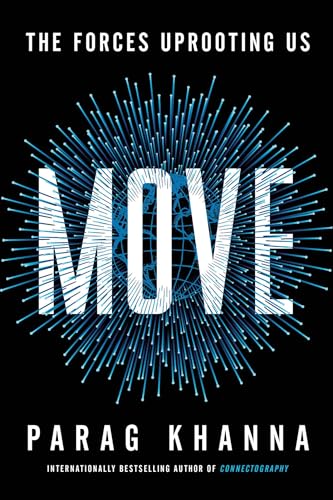
Inhaltsangabe
*A Financial Times Best Book of the Year*
A “provocative” (Booklist) and compelling look at the powerful global forces that will cause billions of us to move geographically over the next decades, ushering in an era of radical change.
In the 60,000 years since people began colonizing the continents, a recurring feature of human civilization has been mobility—the ever-constant search for resources and stability. Seismic global events—wars and genocides, revolutions and pandemics—have only accelerated the process. The map of humanity isn’t settled—not now, not ever.
As climate change tips toward full-blown crisis, economies collapse, governments destabilize, and technology disrupts, we’re entering a new age of mass migrations—one that will scatter both the dispossessed and the well-off. Which areas will people abandon and where will they resettle? Which countries will accept or reject them? As today’s world population, which includes four billion restless youth, votes with their feet, what map of human geography will emerge?
In Move, celebrated futurist Parag Khanna provides an illuminating and authoritative vision of the next phase of human civilization—one that is both mobile and sustainable. As the book explores, in the years ahead people will move people to where the resources are and technologies will flow to the people who need them, returning us to our nomadic roots while building more secure habitats.
“An urgent, powerful argument for more open international borders” (Kirkus Reviews, starred review), Move is a fascinating look at the deep trends that are shaping the most likely scenarios for the future. Most important, it guides each of us as we determine our optimal location on humanity’s ever-changing map.
Die Inhaltsangabe kann sich auf eine andere Ausgabe dieses Titels beziehen.
Über die Autorin bzw. den Autor
Parag Khanna is the founder and CEO of AlphaGeo, the leading AI-powered geospatial predictive location analytics platform. He is the internationally bestselling author of seven books including MOVE: Where People Are Going for a Better Future (2021), preceded by The Future Is Asian: Commerce, Conflict & Culture in the 21st Century (2019), as well as a trilogy of books on the future of world order beginning with The Second World: Empires and Influence in the New Global Order (2008), followed by How to Run the World: Charting a Course to the Next Renaissance (2011), and concluding with Connectography: Mapping the Future of Global Civilization (2016). He is also the author of Technocracy in America: Rise of the Info-State (2017) and coauthor of Hybrid Reality: Thriving in the Emerging Human-Technology Civilization (2012). Parag was named one of Esquire’s “75 Most Influential People of the 21st Century,” and featured in WIRED’s “Smart List.” He holds a PhD from the London School of Economics, and bachelor’s and master’s degrees from the School of Foreign Service at Georgetown University. Born in India and raised in the UAE, New York, and Germany, he has traveled to more than 150 countries and is a Young Global Leader of the World Economic Forum.
Auszug. © Genehmigter Nachdruck. Alle Rechte vorbehalten.
Chapter 1: Mobility Is Destiny CHAPTER 1 MOBILITY IS DESTINY
Geography is what we make of it
Ask anyone who graduated from Georgetown’s School of Foreign Service between 1990 and 2005 which one course they’ll remember until the day they die. Their eyes will light up, a smirk will appear, and one word will come out of their mouths: “Map.” A mere one-credit, pass-fail class quickly became so legendary that students intentionally failed its placement test just to take it. They were quickly joined by hundreds of other undergrads who just wanted to sit in, requiring larger auditoriums each year. All for the pleasure of witnessing the thunderous lectures of the encyclopedic and cantankerous Dr. Charles Pirtle, a human cannon of notable facts about every single country, capital, body of water, mountain range, and border dispute on Earth. In 2005, Newsweek magazine featured “Map of the Modern World” in its list of “College Classes for Masochists.” We couldn’t get enough.
Pirtle’s noble objective was twofold: to combat geographical ignorance and, just as important, to demonstrate that the world map is an ever evolving collision of environment, politics, technology, and demographics. It’s thanks to Pirtle that analyzing the interplay of these forces became my professional obsession. After all, high school geography class in the 1990s was hardly inspiring: It was basically earth science (mostly geology; no mention of climate change) with a static layer of borders on top. For most students, the study of geography sadly defaults to this political geography, as if the most arbitrary lines on our maps (borders) are the most permanent. In reality, states are more like porous containers shaped by the flows of people and resources within and across them. Without these, what is a state even worth?
This is a book about the geography that matters most to us: human geography. Human geography investigates the where and the how of the distribution of our species across 150 million square kilometers of land on six continents. Think of it like climatology, a deep science of how we relate to one another and the planet. Human geography subsumes hot-button topics like demographics (the age and gender balance of populations) and migration (the resettlement of people), but goes much deeper into our ethnographic composition, and even our genetic adaptation to a changing environment. Climate refugees and economic migrants, intermarriage and even evolution—all are part of the grand story of our human geography.
Why does human geography matter so much today? Because our species is in for a rough ride, and we can no longer take for granted a stable relationship between our geographic layers such as nature (where the water, energy, mineral, and food resources are), politics (where the territorial borders are that demarcate states), and economics (where the infrastructure and industries are located). These are among the major forces that have determined our human geography for the past thousands of years—and in turn, our human geography has shaped them.
But never before have the feedback loops among these layers been so intense and complex. Human economic activity has accelerated the deforestation and industrial emissions that cause global warming, rising sea levels, and massive drought. Four of America’s most important cities are most at risk: New York City and Miami may drown, while Los Angeles is running out of water and San Francisco is blanketed by wildfires.
The chain reactions slamming millions of people in America apply to billions in Asia. Consider this: Asia’s spectacular economic rise in recent decades was propelled by breakneck population growth, urbanization, and industrialization, all of which have spiked its emissions output. This has contributed to rising sea levels that threaten the teeming populations of its coastal megacities on the Pacific Rim and Indian Ocean. So the rise of Asia is accelerating the sinking of Asia—which could cause ever more Asians to flee across borders and spark resource conflicts. We push the system, then the system pushes us.
This seems an appropriate moment to take stock of how badly out of sync these layers of geography have become. We have wealthy countries across North America and Europe with 300 million and counting aging people and decaying infrastructure—but roughly 2 billion young people sitting idle in Latin America, the Middle East, and Asia who are capable of caring for the elderly and maintaining public services. We have countless hectares of arable farmland across depopulated Canada and Russia, while millions of destitute African farmers are driven from their lands by drought. There are countries with sterling political systems yet few citizens, such as Finland and New Zealand, but also hundreds of millions of people suffering under despotic regimes or living in refugee camps.
Is it any surprise that record numbers of people have been on the move?
Children of the twentieth century know the adages “Geography is destiny” and “Demography is destiny.” The former implies that location and resources determine our fate, while the latter suggests that population size and age structure are the most important factors. Together, they tell us that we’re stuck where we are—better hope it’s a well-populated and resource-rich country. Should we continue to buy into such determinism? Of course not. Geography is not destiny. Geography is what we make of it.
In my 2016 book Connectography I proposed a third axiom to explain the arc of global civilization: “Connectivity is destiny.” Our vast infrastructure networks—a mechanical exoskeleton of railways, electricity grids, Internet cables, and more—enable the rapid movement of people, goods, services, capital, technology, and ideas on a planetary scale. Connectivity and mobility are complementary, two sides of the same coin, and together they give rise to a fourth axiom that will define our future: Mobility is destiny.
So what’s stopping us from using our connectivity to the fullest? The root of our collective inertia lies in borders—physical, legal, and psychological. The world’s political map looks the way it does mostly for contingent reasons: where ancient civilizations settled, where European empires conquered and divided, and where natural features separate populations. Borders are where they are because that’s where they’ve been. But the Earth is ours—not America’s or Russia’s or Canada’s or China’s. The question is: Can we discover a new cartographic pragmatism that brings political geography more in line with today’s needs?
The management guru Peter Drucker warned that “the greatest danger in times of turbulence is not the turbulence itself but to act with yesterday’s logic.”1 We can no longer afford to be passive observers of how human geography unfolds. Instead, we must actively realign our geographies, moving people and technologies where they are needed while keeping livable places habitable. This requires an epochal shift in the organization of global civilization, a collective resettlement strategy for the world population. But if we get this right, we’ll strengthen our odds of survival as a species, revitalize floundering economies, and forge a more sensible map of humanity.
Mass migrations are inevitable, and...
„Über diesen Titel“ kann sich auf eine andere Ausgabe dieses Titels beziehen.
Suchergebnisse für Move: The Forces Uprooting Us

Beispielbild für diese ISBN
Move: The Forces Uprooting Us
Anbieter: World of Books (was SecondSale), Montgomery, IL, USA
Verkäuferbewertung 5 von 5 Sternen

Zustand: Good. Item in good condition. Textbooks may not include supplemental items i.e. CDs, access codes etc. Artikel-Nr. 00071755991
Gebraucht kaufen
EUR 4,62
Versand gratis
Versand innerhalb von USA
Versand innerhalb von USA
Anzahl: 4 verfügbar
Beispielbild für diese ISBN
Move: The Forces Uprooting Us
Anbieter: World of Books (was SecondSale), Montgomery, IL, USA
Verkäuferbewertung 5 von 5 Sternen
Zustand: Very Good. Item in very good condition! Textbooks may not include supplemental items i.e. CDs, access codes etc. Artikel-Nr. 00070357136
Gebraucht kaufen
EUR 4,62
Versand gratis
Versand innerhalb von USA
Versand innerhalb von USA
Anzahl: 3 verfügbar
Beispielbild für diese ISBN
Move: The Forces Uprooting Us
Anbieter: BooksRun, Philadelphia, PA, USA
Verkäuferbewertung 5 von 5 Sternen
Hardcover. Zustand: Very Good. With dust jacket. It's a well-cared-for item that has seen limited use. The item may show minor signs of wear. All the text is legible, with all pages included. It may have slight markings and/or highlighting. Artikel-Nr. 1982168978-11-1-29
Gebraucht kaufen
EUR 5,07
Versand gratis
Versand innerhalb von USA
Versand innerhalb von USA
Anzahl: 1 verfügbar
Beispielbild für diese ISBN
Move : The Forces Uprooting Us
Anbieter: Better World Books, Mishawaka, IN, USA
Verkäuferbewertung 5 von 5 Sternen
Zustand: Very Good. Former library copy. Pages intact with possible writing/highlighting. Binding strong with minor wear. Dust jackets/supplements may not be included. Includes library markings. Stock photo provided. Product includes identifying sticker. Better World Books: Buy Books. Do Good. Artikel-Nr. 42542886-6
Gebraucht kaufen
EUR 6,65
Versand gratis
Versand innerhalb von USA
Versand innerhalb von USA
Anzahl: 2 verfügbar
Beispielbild für diese ISBN
Move: The Forces Uprooting Us
Anbieter: ThriftBooks-Atlanta, AUSTELL, GA, USA
Verkäuferbewertung 5 von 5 Sternen
Hardcover. Zustand: Very Good. No Jacket. Missing dust jacket; May have limited writing in cover pages. Pages are unmarked. ~ ThriftBooks: Read More, Spend Less. Artikel-Nr. G1982168978I4N01
Gebraucht kaufen
EUR 7,04
Versand gratis
Versand innerhalb von USA
Versand innerhalb von USA
Anzahl: 1 verfügbar
Beispielbild für diese ISBN
Move: The Forces Uprooting Us
Anbieter: ThriftBooks-Dallas, Dallas, TX, USA
Verkäuferbewertung 5 von 5 Sternen
Hardcover. Zustand: Very Good. No Jacket. Former library book; May have limited writing in cover pages. Pages are unmarked. ~ ThriftBooks: Read More, Spend Less. Artikel-Nr. G1982168978I4N10
Gebraucht kaufen
EUR 7,04
Versand gratis
Versand innerhalb von USA
Versand innerhalb von USA
Anzahl: 1 verfügbar
Beispielbild für diese ISBN
Move: The Forces Uprooting Us
Anbieter: WorldofBooks, Goring-By-Sea, WS, Vereinigtes Königreich
Verkäuferbewertung 5 von 5 Sternen
Paperback. Zustand: Very Good. The book has been read, but is in excellent condition. Pages are intact and not marred by notes or highlighting. The spine remains undamaged. Artikel-Nr. GOR012618850
Gebraucht kaufen
EUR 7,44
EUR 6,50 Versand
Versand von Vereinigtes Königreich nach USA
Versand von Vereinigtes Königreich nach USA
Anzahl: 2 verfügbar
Beispielbild für diese ISBN
Move: The Forces Uprooting Us
Anbieter: Revaluation Books, Exeter, Vereinigtes Königreich
Verkäuferbewertung 5 von 5 Sternen
Hardcover. Zustand: Brand New. 384 pages. 9.00x6.00x1.00 inches. In Stock. Artikel-Nr. 1982168978
Neu kaufen
EUR 27,70
EUR 14,52 Versand
Versand von Vereinigtes Königreich nach USA
Versand von Vereinigtes Königreich nach USA
Anzahl: 1 verfügbar