
Verwandte Artikel zu Freezing Order: A True Story of Money Laundering, Murder,...
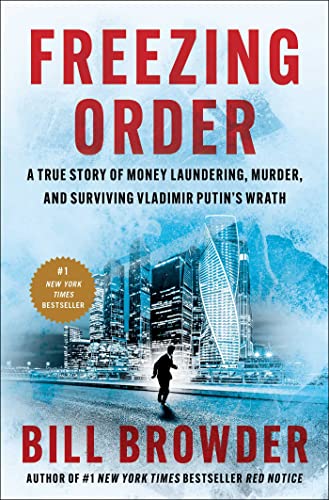
Freezing Order: A True Story of Money Laundering, Murder, and Surviving Vladimir Putin's Wrath - Hardcover
Inhaltsangabe
NEW YORK TIMES BESTSELLER
Following his explosive New York Times bestseller Red Notice, Bill Browder returns with another gripping thriller chronicling how he became Vladimir Putin’s number one enemy by exposing Putin’s campaign to steal and launder hundreds of billions of dollars and kill anyone who stands in his way.
When Bill Browder’s young Russian lawyer, Sergei Magnitsky, was beaten to death in a Moscow jail, Browder made it his life’s mission to go after his killers and make sure they faced justice. The first step of that mission was to uncover who was behind the $230 million tax refund scheme that Magnitsky was killed over. As Browder and his team tracked the money as it flowed out of Russia through the Baltics and Cyprus and on to Western Europe and the Americas, they were shocked to discover that Vladimir Putin himself was a beneficiary of the crime.
As law enforcement agencies began freezing the money, Putin retaliated. He and his cronies set up honey traps, hired process servers to chase Browder through cities, murdered more of his Russian allies, and enlisted some of the top lawyers and politicians in America to bring him down. Putin will stop at nothing to protect his money. As Freezing Order reveals, it was Browder’s campaign to expose Putin’s corruption that prompted Russia’s intervention in the 2016 US presidential election.
At once a financial caper, an international adventure, and a passionate plea for justice, Freezing Order is a stirring morality tale about how one man can take on one of the most ruthless villains in the world—and win.
Die Inhaltsangabe kann sich auf eine andere Ausgabe dieses Titels beziehen.
Über die Autorin bzw. den Autor
Bill Browder is the founder and CEO of Hermitage Capital Management and was the largest foreign investor in Russia until 2005. Since 2009, when his lawyer, Sergei Magnitsky, was murdered in prison after uncovering a $230 million fraud committed by Russian government officials, Browder has been leading a campaign to expose Russia’s endemic corruption and human rights abuses. Before founding Hermitage, Browder was vice president at Salomon Brothers. He holds a BA in economics from the University of Chicago and an MBA from Stanford Business School.
Auszug. © Genehmigter Nachdruck. Alle Rechte vorbehalten.
Chapter 1: The Madrid Arrest – 1 – The Madrid Arrest
SPRING 2018
Madrid was uncharacteristically cool for the end of spring. I’d flown in for a meeting with José Grinda, Spain’s top anti-corruption prosecutor. I was there to share evidence about how dirty money connected to the murder of my Russian lawyer, Sergei Magnitsky, had been used to purchase luxury properties along Spain’s Costa del Sol. The meeting was scheduled for 11:00 a.m. the following morning, which in Spain counts as an early meeting.
When I arrived at my hotel that evening, the manager scurried over to the check-in desk and ushered the clerk aside. “Mr. Browder?” he asked. I nodded. “Welcome to the Gran Hotel Inglés. We have a very special surprise for you!”
I stay at a lot of hotels. Managers don’t typically have surprises for me. “What’s that?” I asked.
“You will see. I will accompany you to your room.” He spoke in careful English. “Could you please give me your passport and credit card?” I handed them over. He scanned my passport and fed the credit card—a Black American Express Card to which I’d recently been upgraded—into a chip reader. He handed me a room key with both hands cupped in a vaguely Japanese manner and stepped from behind the counter. Holding out his arm, he said, “Please. After you.”
I walked to the elevator, the manager following directly behind. We rode to the top floor.
He stepped aside when the doors opened, making room for me to exit first, but once we were in the hall he shuffled past me, stopping in front of a white door. He fumbled briefly with his master key, and then opened the room. I peered inside. I’d been upgraded to the presidential suite. I was pretty sure this wasn’t because of who I was, but because of this new American Express card. I’d always wondered what the fuss was with these things. Now I knew.
“Wow,” I said.
I walked through the foyer and into a white living room decorated with tasteful modern furniture. On a low table was a spread of Spanish cheeses, Ibérico ham, and fruit. The manager talked about what an honor it was to have me as a guest, even though I doubted he knew anything about me beyond which credit card I carried.
He followed me around the suite, seeking my approval. There was a dining room, its table laid out with pastries, chocolates, and champagne on ice; then came the reading room, with a small private library; then a lounge with a glass-topped bar; then a little office with subdued lighting; and finally, the bedroom, which had a freestanding bathtub tucked under a high window.
I had to suppress laughter. Of course, I loved the room—who wouldn’t?—but I was in Madrid on a one-night business trip. It would have taken half a dozen people to eat all the food they had laid out. Moreover, if the manager had known the nature of my visit—talking to law enforcement officials about the sort of Russian gangsters who often booked suites like this—he probably wouldn’t have been so enthusiastic. Still, I wasn’t going to be rude. When we circled back to the foyer, I nodded appreciatively. “It’s very nice,” I said. “Thank you.”
As soon as he was gone, I called Elena, my wife, who was at home in London with our four children. I told her all about the room, how extravagant and ridiculous it was, and how I wished she were with me.
After our call, I changed into jeans and a light sweater before heading out for an evening walk through the streets of Madrid, mentally preparing for my meeting with José Grinda the next day. Eventually, though, I got lost in the maze-like streets and squares, and had to hail a cab to take me back to the hotel.
The following morning was bright and sunny. Unlike the previous day, it was going to be hot.
At around 8:15 a.m. I checked my papers and business cards and opened the door to go downstairs for breakfast.
I stopped short.
The manager stood on the landing, hand raised in mid-knock.
On each side of him was a uniformed police officer. The patches on their crisp, navy shirts read, POLICIA NACIONAL.
“Apologies, Mr. Browder,” the manager said, glancing at the floor. “But these men need to see your identification.”
I handed my British passport to the larger of the two stone-faced officers. He studied it, comparing it to a piece of paper in his other hand. He then spoke to the manager in Spanish, which I don’t understand.
The manager translated. “I’m sorry, Mr. Browder, but you must go with these men.”
“What for?” I asked, looking past the manager.
He turned to the larger officer and rattled off something in Spanish.
The officer, staring directly at me, stated, “Interpol. Russia.”
Fuck.
The Russians had been trying to have me arrested for years, and now it was finally happening.
You notice odd things when adrenaline hits you. I noticed there was a light out at the far end of the hall, and that there was a small stain on the manager’s lapel. I also noticed that the manager didn’t look so much contrite as concerned. I could tell this wasn’t for me. What concerned him was that his presidential suite would be unavailable so long as it contained my belongings. He wanted my things out as soon as possible.
He spoke quickly to the officers, and then said, “These gentlemen will give you a few moments to pack.”
I hurried through the series of rooms to the bedroom, leaving the officers waiting in the entryway. I suddenly realized I was alone and had an opportunity. If I’d thought the room upgrade was frivolous before, now it was a godsend.
I called Elena. But she didn’t answer.
I then called Ruperto, my Spanish lawyer who’d arranged the meeting with Prosecutor Grinda. No answer there, either.
As I rushed to pack, I remembered something Elena had said to me after I’d been detained at Geneva Airport that February. “If something like this ever happens again,” she said, “and you can’t reach anyone, post it on Twitter.” I’d started using Twitter a couple of years earlier, and now had some 135,000 followers, many of them journalists, government officials, and politicians from around the world.
I followed her instructions, tweeting: “Urgent: Just was arrested by Spanish police in Madrid on a Russian Interpol arrest warrant. Going to the police station right now.”
I grabbed my bag and returned to the two waiting officers. I expected to be formally arrested, but they didn’t behave like cops in the movies. They didn’t cuff me, frisk me, or take my things. They just told me to follow them.
We went downstairs, not a word passing between us. The officers stood behind me while I paid the bill. Other guests gawked as they filtered through the lobby.
The manager, back behind the desk, broke the silence. “Do you want to leave your bag with us, Mr. Browder, while these men take you to the police station? I’m sure this will be sorted out quickly.”
Knowing what I did about Putin and Russia, I was sure it wouldn’t be. “I’ll keep my things, thank you,” I responded.
I turned to the officers, who sandwiched me front and back. They led me outside to their small Peugeot police car. One...
„Über diesen Titel“ kann sich auf eine andere Ausgabe dieses Titels beziehen.
Suchergebnisse für Freezing Order: A True Story of Money Laundering, Murder,...

Beispielbild für diese ISBN
Freezing Order: A True Story of Money Laundering, Murder, and Surviving Vladimir Putin's Wrath
Anbieter: World of Books (was SecondSale), Montgomery, IL, USA
Verkäuferbewertung 5 von 5 Sternen

Hardback. Zustand: Very Good. NEW YORK TIMES BESTSELLER Following his explosive New York Times bestseller Red Notice, Bill Browder returns with another gripping thriller chronicling how he became Vladimir Putin's number one enemy by exposing Putin's campaign to steal and launder hundreds of billions of dollars and kill anyone who stands in his way. When Bill Browder's young Russian lawyer, Sergei Magnitsky, was beaten to death in a Moscow jail, Browder made it his life's mission to go after his killers and make sure they faced justice. The first step of that mission was to uncover who was behind the $230 million tax refund scheme that Magnitsky was killed over. As Browder and his team tracked the money as it flowed out of Russia through the Baltics and Cyprus and on to Western Europe and the Americas, they were shocked to discover that Vladimir Putin himself was a beneficiary of the crime. As law enforcement agencies began freezing the money, Putin retaliated. He and his cronies set up honey traps, hired process servers to chase Browder through cities, murdered more of his Russian allies, and enlisted some of the top lawyers and politicians in America to bring him down. Putin will stop at nothing to protect his money. As Freezing Order reveals, it was Browder's campaign to expose Putin's corruption that prompted Russia's intervention in the 2016 US presidential election. At once a financial caper, an international adventure, and a passionate plea for justice, Freezing Order is a stirring morality tale about how one man can take on one of the most ruthless villains in the world--and win. Artikel-Nr. 00110383636
Gebraucht kaufen
EUR 4,03
Versand gratis
Versand innerhalb von USA
Versand innerhalb von USA
Anzahl: 4 verfügbar
Beispielbild für diese ISBN
Freezing Order: A True Story of Money Laundering, Murder, and Surviving Vladimir Putin's Wrath
Anbieter: World of Books (was SecondSale), Montgomery, IL, USA
Verkäuferbewertung 5 von 5 Sternen
Hardback. Zustand: Good. NEW YORK TIMES BESTSELLER Following his explosive New York Times bestseller Red Notice, Bill Browder returns with another gripping thriller chronicling how he became Vladimir Putin's number one enemy by exposing Putin's campaign to steal and launder hundreds of billions of dollars and kill anyone who stands in his way. When Bill Browder's young Russian lawyer, Sergei Magnitsky, was beaten to death in a Moscow jail, Browder made it his life's mission to go after his killers and make sure they faced justice. The first step of that mission was to uncover who was behind the $230 million tax refund scheme that Magnitsky was killed over. As Browder and his team tracked the money as it flowed out of Russia through the Baltics and Cyprus and on to Western Europe and the Americas, they were shocked to discover that Vladimir Putin himself was a beneficiary of the crime. As law enforcement agencies began freezing the money, Putin retaliated. He and his cronies set up honey traps, hired process servers to chase Browder through cities, murdered more of his Russian allies, and enlisted some of the top lawyers and politicians in America to bring him down. Putin will stop at nothing to protect his money. As Freezing Order reveals, it was Browder's campaign to expose Putin's corruption that prompted Russia's intervention in the 2016 US presidential election. At once a financial caper, an international adventure, and a passionate plea for justice, Freezing Order is a stirring morality tale about how one man can take on one of the most ruthless villains in the world--and win. Artikel-Nr. 00087357564
Gebraucht kaufen
EUR 4,03
Versand gratis
Versand innerhalb von USA
Versand innerhalb von USA
Anzahl: Mehr als 20 verfügbar
Beispielbild für diese ISBN
Freezing Order: A True Story of Money Laundering, Murder, and Surviving Vladimir Putin's Wrath
Anbieter: ThriftBooks-Dallas, Dallas, TX, USA
Verkäuferbewertung 5 von 5 Sternen
Hardcover. Zustand: Very Good. No Jacket. Former library book; May have limited writing in cover pages. Pages are unmarked. ~ ThriftBooks: Read More, Spend Less. Artikel-Nr. G1982153288I4N10
Gebraucht kaufen
EUR 5,96
Versand gratis
Versand innerhalb von USA
Versand innerhalb von USA
Anzahl: 2 verfügbar
Beispielbild für diese ISBN
Freezing Order: A True Story of Money Laundering, Murder, and Surviving Vladimir Putin's Wrath
Anbieter: ThriftBooks-Dallas, Dallas, TX, USA
Verkäuferbewertung 5 von 5 Sternen
Hardcover. Zustand: Very Good. No Jacket. May have limited writing in cover pages. Pages are unmarked. ~ ThriftBooks: Read More, Spend Less. Artikel-Nr. G1982153288I4N00
Gebraucht kaufen
EUR 5,96
Versand gratis
Versand innerhalb von USA
Versand innerhalb von USA
Anzahl: 1 verfügbar
Beispielbild für diese ISBN
Freezing Order: A True Story of Money Laundering, Murder, and Surviving Vladimir Putin's Wrath
Anbieter: ThriftBooks-Dallas, Dallas, TX, USA
Verkäuferbewertung 5 von 5 Sternen
Hardcover. Zustand: Very Good. No Jacket. Missing dust jacket; May have limited writing in cover pages. Pages are unmarked. ~ ThriftBooks: Read More, Spend Less. Artikel-Nr. G1982153288I4N01
Gebraucht kaufen
EUR 5,96
Versand gratis
Versand innerhalb von USA
Versand innerhalb von USA
Anzahl: 1 verfügbar
Beispielbild für diese ISBN
Freezing Order: A True Story of Money Laundering, Murder, and Surviving Vladimir Putin's Wrath
Anbieter: ThriftBooks-Atlanta, AUSTELL, GA, USA
Verkäuferbewertung 5 von 5 Sternen
Hardcover. Zustand: Very Good. No Jacket. Missing dust jacket; May have limited writing in cover pages. Pages are unmarked. ~ ThriftBooks: Read More, Spend Less. Artikel-Nr. G1982153288I4N01
Gebraucht kaufen
EUR 5,98
Versand gratis
Versand innerhalb von USA
Versand innerhalb von USA
Anzahl: 1 verfügbar
Beispielbild für diese ISBN
Freezing Order: A True Story of Money Laundering, Murder, and Surviving Vladimir Putin's Wrath
Anbieter: ThriftBooks-Atlanta, AUSTELL, GA, USA
Verkäuferbewertung 5 von 5 Sternen
Hardcover. Zustand: Very Good. No Jacket. May have limited writing in cover pages. Pages are unmarked. ~ ThriftBooks: Read More, Spend Less. Artikel-Nr. G1982153288I4N00
Gebraucht kaufen
EUR 5,98
Versand gratis
Versand innerhalb von USA
Versand innerhalb von USA
Anzahl: 1 verfügbar
Beispielbild für diese ISBN
Freezing Order: A True Story of Money Laundering, Murder, and Surviving Vladimir Putin's Wrath
Anbieter: ThriftBooks-Atlanta, AUSTELL, GA, USA
Verkäuferbewertung 5 von 5 Sternen
Hardcover. Zustand: Very Good. No Jacket. Former library book; May have limited writing in cover pages. Pages are unmarked. ~ ThriftBooks: Read More, Spend Less. Artikel-Nr. G1982153288I4N10
Gebraucht kaufen
EUR 5,98
Versand gratis
Versand innerhalb von USA
Versand innerhalb von USA
Anzahl: 2 verfügbar
Beispielbild für diese ISBN
Freezing Order: A True Story of Money Laundering, Murder, and Surviving Vladimir Putin's Wrath
Anbieter: ThriftBooks-Phoenix, Phoenix, AZ, USA
Verkäuferbewertung 5 von 5 Sternen
Hardcover. Zustand: Very Good. No Jacket. Missing dust jacket; May have limited writing in cover pages. Pages are unmarked. ~ ThriftBooks: Read More, Spend Less. Artikel-Nr. G1982153288I4N01
Gebraucht kaufen
EUR 6,02
Versand gratis
Versand innerhalb von USA
Versand innerhalb von USA
Anzahl: 1 verfügbar
Beispielbild für diese ISBN
Freezing Order: A True Story of Money Laundering, Murder, and Surviving Vladimir Putin's Wrath
Anbieter: ThriftBooks-Reno, Reno, NV, USA
Verkäuferbewertung 5 von 5 Sternen
Hardcover. Zustand: As New. No Jacket. Pages are clean and are not marred by notes or folds of any kind. ~ ThriftBooks: Read More, Spend Less. Artikel-Nr. G1982153288I2N00
Gebraucht kaufen
EUR 6,02
Versand gratis
Versand innerhalb von USA
Versand innerhalb von USA
Anzahl: 1 verfügbar