
Verwandte Artikel zu The First: How to Think About Hate Speech, Campus Speech,...
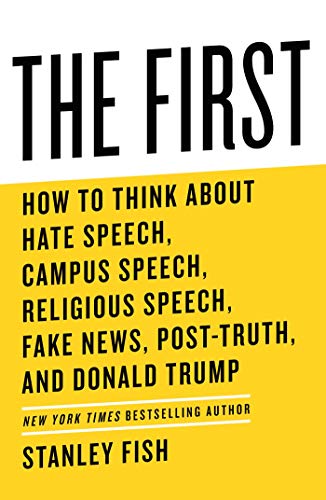
The First: How to Think About Hate Speech, Campus Speech, Religious Speech, Fake News, Post-Truth, and Donald Trump - Hardcover
Inhaltsangabe
“Fish’s points arrive in thoughtful, dense provocations.” —Kirkus Reviews
From celebrated public intellectual and New York Times bestselling author, Stanley Fish, comes an urgent and sharply observed look at one of the most hotly debated issues of our time: freedom of speech.
How does the First Amendment really work? Is it a principle or a value? What is hate speech and should it always be banned? Are we free to declare our religious beliefs in the public square? What role, if any, should companies like Facebook play in policing the exchange of thoughts, ideas, and opinions?
With clarity and power, Stanley Fish, “America’s most famous professor” (BookPage), explores these complex questions in The First. From the rise of fake news, to the role of tech companies in monitoring content (including the President’s tweets), to Colin Kaepernick’s kneeling protest, First Amendment controversies continue to dominate the news cycle. Across America, college campus administrators are being forced to balance free speech against demands for safe spaces and trigger warnings.
Ultimately, Fish argues, freedom of speech is a double-edged concept; it frees us from constraints, but it also frees us to say and do terrible things. Urgent and controversial, The First is sure to ruffle feathers, spark dialogue, and shine new light on one of America’s most cherished—and debated—constitutional rights.
Die Inhaltsangabe kann sich auf eine andere Ausgabe dieses Titels beziehen.
Über die Autorin bzw. den Autor
Stanley Fish is the Davidson-Kahn Distinguished University Professor of Humanities and Law at Florida International University and a visiting professor of law at Cardozo University. He has previously taught at the University of California at Berkeley, Johns Hopkins University, Duke University, and the University of Illinois at Chicago where he was dean of the College of Liberal Arts and Sciences. He has received many honors and awards, including being named the Chicagoan of the Year for Culture. He is the author of many renowned books, including Winning Arguments and How to Write a Sentence: And How to Read One. Fish is a former weekly columnist for The New York Times. His essays and articles have appeared in The Chronicle of Higher Education, Harper’s Magazine, Esquire, and The Atlantic.
Auszug. © Genehmigter Nachdruck. Alle Rechte vorbehalten.
Chapter 1: Why Censorship Is a Precondition of Free Speech CHAPTER 1 Why Censorship Is a Precondition of Free Speech
“Speech Is Everywhere”
The one thing speech isn’t is free. There are costs to those who produce it and costs to those who are subjected to it. Of course, the term “free speech” does have a clear meaning under the Constitution: if you want to say something, you don’t have to ask the government’s permission and you won’t be punished by the government for saying it. But even this freedom from state interference with your speech has its limits, and it does not protect you in private life, where speaking out carries with it the risk of censorship and penalty. Freedom of speech, despite ritual celebrations of it, is not all it is cracked up to be, and it is difficult even to say what it is. As a concept it refuses to sit still and remains elusive to the grasp no matter how closely and rigorously it is examined. When one says “freedom of speech,” the referent seems solid enough, but, as we shall see, it melts at the analytical touch. The phrase “free speech” doesn’t refer to a single core doctrine that works itself out in different practices. Rather, different practices, with their in-place definitions and goals, determine in any instance what “free speech” means. Yet even if freedom of speech is not a thing but a promissory note that can never be cashed in, it is a large and inescapable component of our political rhetoric. We are invested in it, and almost everything of note that happens is attached, sometimes by the loosest of ligatures, to free-speech issues.
Consider, for example, the last ten days of October 2018. A man named Cesar Sayoc sent pipe bombs to CNN and a dozen prominent critics of President Donald Trump. Another loner, Robert Bowers, killed eleven Jews in Pittsburgh as they prayed. Almost as soon as these events occurred, they became attached to issues of free speech. Sayoc drove, and sometimes slept in, a van plastered with pro-Trump stickers and with images of Hillary Clinton and other progressives portrayed as the targets of gunfire. Was that the mere expression of political opinion or a “true threat,” a term of art that means a threat likely to be acted on? Bowers spewed anti-Semitic slogans as he went about his murderous work. Both men had online histories that identified them as haters, conspiracy theorists, and racists. Should the authorities have been alert to the danger they posed? Could they act only after Sayoc and Bowers had already acted? The digital trail was long, and the van with its disturbing images was visible on the streets of Miami for some time. Should President Trump be held to account for the anti-immigrant, anti-“other” rhetoric that, some said, made atrocities like these inevitable? Did his rantings against Hillary Clinton, George Soros, Cory Booker, Kamala Harris, Barack Obama, Eric Holder, Maxine Waters, and others make up a hit list Sayoc dutifully followed? Was Trump saying to Sayoc what Henry II said to those who promptly went out and murdered Thomas Becket: “Will no one rid me of this meddlesome priest?” Was his invective more than a dog whistle? Was it, in fact, a marching order? Was the order heeded by Coast Guard Lt. Christopher Paul Hasson when, in February 2019, he compiled a list of Democrats and anti-Trump journalists whose murder would announce the beginning of the race war he hoped to bring about? At least one prominent First Amendment theorist has posed the relevant question: “[W]e might ask when the State or political leaders may be held constitutionally responsible for encouraging private parties to punish critics. I suggest here that if the president or other officials direct, encourage, fund or covertly command attacks on their critics by private mobs of foreign powers, the First Amendment should be implicated.”1
Mainstream commentators clucked over the possible relationship between Trump’s words and these horrible deeds, but mostly they muttered “First Amendment” and said that however hateful someone’s speech might be, unless it amounted to a direct incitement of violence, it was protected by the Constitution; free speech must prevail. “Free speech above all” was also the mantra of Andrew Torba, the CEO of the website Gab, Robert Bowers’s favorite venue, characterized by the New York Times as the “last refuge for internet scoundrels.” Torba often wears a green hat embroidered with the message “Make Speech Free Again.” Is he a free-speech hero, bravely suffering the vituperation hurled at him by the New York Times? Or is he a prime example of how the promotion of unregulated free speech, proclaimed by First Amendment apostles as the cornerstone of democracy, can lead to a cascade of words that in time is corrosive of that same democracy? If Sayoc and Bowers didn’t have an internet community where their views could be parroted back at them and amplified to the point where every toxic thought they entertained seemed universally shared, would the seeds of hatred perhaps not have flowered in the actions they ultimately took?
You might be surprised that actions so undeniably physical (what could be more physical than bombs and assault rifles?) turn out to be imbued with elements of speech, but as Supreme Court Justice Elena Kagan observed recently, “Speech is everywhere—a part of every human activity.”2 Everything we do sends a message and everything we say has an effect. What this means is that freedom of speech is not a discrete value. You can’t carve speech out and pay homage to it in isolation from the actions from which it is inextricable. Free speech is not, despite Justice Robert Jackson’s memorable pronouncement, the “fixed star in our constitutional constellation,” the abiding light that will guide us through the kaleidoscope of circumstances if only we keep our eyes on it.3 In fact, there is nothing “fixed” about free-speech doctrine at all. It’s a grab bag of analogies, invented-for-the-occasion arguments, rhetorical slogans, shaky distinctions, and ad hoc exceptions to those distinctions, all combining to make it an artifact of the very politics it supposedly transcends. That’s a mouthful, but what it means is that the First Amendment is a participant in the partisan battle, a prize in the political wars, and not an apolitical oasis of principle. That’s the first thesis of this book. The second thesis is that there is nothing wrong with that. A First Amendment whose content and operations are through and through political is fully capable of doing the work we need it to do. Indeed, it may be more capable because, freed from the stringent demand of principle—the demand that freedom of speech be the rule without exception and no matter what the circumstance—the amendment can display the flexibility required to make useful sense of the many situations in which debates about speech emerge. The very malleability of the First Amendment—its lack of a hard center or of any center at all—may be its greatest recommendation.
The squishiness of the First Amendment infects it at the most basic level, the level of its prime purpose, which is, of course, to protect speech. But before we can begin to do that, we must clearly distinguish speech from action, and...
„Über diesen Titel“ kann sich auf eine andere Ausgabe dieses Titels beziehen.
Suchergebnisse für The First: How to Think About Hate Speech, Campus Speech,...

Beispielbild für diese ISBN
The First: How to Think About Hate Speech, Campus Speech, Religious Speech, Fake News, Post-Truth, and Donald Trump
Anbieter: World of Books (was SecondSale), Montgomery, IL, USA
Verkäuferbewertung 5 von 5 Sternen

Hardback. Zustand: Good. ?Fish?s points arrive in thoughtful, dense provocations.? ?Kirkus Reviews From celebrated public intellectual and New York Times bestselling author, Stanley Fish, comes an urgent and sharply observed look at one of the most hotly debated issues of our time: freedom of speech. How does the First Amendment really work? Is it a principle or a value? What is hate speech and should it always be banned? Are we free to declare our religious beliefs in the public square? What role, if any, should companies like Facebook play in policing the exchange of thoughts, ideas, and opinions? With clarity and power, Stanley Fish, ?America?s most famous professor? (BookPage), explores these complex questions in The First. From the rise of fake news, to the role of tech companies in monitoring content (including the President?s tweets), to Colin Kaepernick?s kneeling protest, First Amendment controversies continue to dominate the news cycle. Across America, college campus administrators are being forced to balance free speech against demands for safe spaces and trigger warnings. Ultimately, Fish argues, freedom of speech is a double-edged concept; it frees us from constraints, but it also frees us to say and do terrible things. Urgent and controversial, The First is sure to ruffle feathers, spark dialogue, and shine new light on one of America?s most cherished?and debated?constitutional rights. Artikel-Nr. 00100483384
Gebraucht kaufen
EUR 6,43
Versand gratis
Versand innerhalb von USA
Versand innerhalb von USA
Anzahl: 1 verfügbar
Beispielbild für diese ISBN
The First: How to Think About Hate Speech, Campus Speech, Religious Speech, Fake News, Post-Truth, and Donald Trump
Verlag:
Atria/One Signal Publishers, 2019
ISBN 10: 1982115246
ISBN 13: 9781982115241
Gebraucht
Hardcover
Anbieter: Wonder Book, Frederick, MD, USA
Verkäuferbewertung 5 von 5 Sternen
Zustand: Good. Good condition. Good dust jacket. A copy that has been read but remains intact. May contain markings such as bookplates, stamps, limited notes and highlighting, or a few light stains. Artikel-Nr. S26D-04331
Gebraucht kaufen
EUR 6,44
Versand gratis
Versand innerhalb von USA
Versand innerhalb von USA
Anzahl: 1 verfügbar
Beispielbild für diese ISBN
The First : How to Think about Hate Speech, Campus Speech, Religious Speech, Fake News, Post-Truth, and Donald Trump
Anbieter: Better World Books, Mishawaka, IN, USA
Verkäuferbewertung 5 von 5 Sternen
Zustand: Good. Pages intact with minimal writing/highlighting. The binding may be loose and creased. Dust jackets/supplements are not included. Stock photo provided. Product includes identifying sticker. Better World Books: Buy Books. Do Good. Artikel-Nr. 18326334-6
Gebraucht kaufen
EUR 6,59
Versand gratis
Versand innerhalb von USA
Versand innerhalb von USA
Anzahl: 1 verfügbar
Beispielbild für diese ISBN
The First : How to Think about Hate Speech, Campus Speech, Religious Speech, Fake News, Post-Truth, and Donald Trump
Anbieter: Better World Books, Mishawaka, IN, USA
Verkäuferbewertung 5 von 5 Sternen
Zustand: Good. Former library copy. Pages intact with minimal writing/highlighting. The binding may be loose and creased. Dust jackets/supplements are not included. Includes library markings. Stock photo provided. Product includes identifying sticker. Better World Books: Buy Books. Do Good. Artikel-Nr. 40040748-6
Gebraucht kaufen
EUR 6,59
Versand gratis
Versand innerhalb von USA
Versand innerhalb von USA
Anzahl: 1 verfügbar
Beispielbild für diese ISBN
The First : How to Think about Hate Speech, Campus Speech, Religious Speech, Fake News, Post-Truth, and Donald Trump
Anbieter: Better World Books, Mishawaka, IN, USA
Verkäuferbewertung 5 von 5 Sternen
Zustand: Very Good. Former library copy. Pages intact with possible writing/highlighting. Binding strong with minor wear. Dust jackets/supplements may not be included. Includes library markings. Stock photo provided. Product includes identifying sticker. Better World Books: Buy Books. Do Good. Artikel-Nr. 18057196-6
Gebraucht kaufen
EUR 6,59
Versand gratis
Versand innerhalb von USA
Versand innerhalb von USA
Anzahl: 1 verfügbar
Beispielbild für diese ISBN
The First: How to Think about Hate Speech, Campus Speech, Religious Speech, Fake News, Post-Truth, and Donald Trump
Verlag:
Atria/One Signal Publishers, 2019
ISBN 10: 1982115246
ISBN 13: 9781982115241
Gebraucht
Hardcover
Anbieter: ThriftBooks-Reno, Reno, NV, USA
Verkäuferbewertung 5 von 5 Sternen
Hardcover. Zustand: Very Good. No Jacket. Former library book; May have limited writing in cover pages. Pages are unmarked. ~ ThriftBooks: Read More, Spend Less. Artikel-Nr. G1982115246I4N10
Gebraucht kaufen
EUR 7,31
Versand gratis
Versand innerhalb von USA
Versand innerhalb von USA
Anzahl: 1 verfügbar
Beispielbild für diese ISBN
The First: How to Think about Hate Speech, Campus Speech, Religious Speech, Fake News, Post-Truth, and Donald Trump
Verlag:
Atria/One Signal Publishers, 2019
ISBN 10: 1982115246
ISBN 13: 9781982115241
Gebraucht
Hardcover
Anbieter: ThriftBooks-Dallas, Dallas, TX, USA
Verkäuferbewertung 5 von 5 Sternen
Hardcover. Zustand: Very Good. No Jacket. Former library book; May have limited writing in cover pages. Pages are unmarked. ~ ThriftBooks: Read More, Spend Less. Artikel-Nr. G1982115246I4N10
Gebraucht kaufen
EUR 7,34
Versand gratis
Versand innerhalb von USA
Versand innerhalb von USA
Anzahl: 1 verfügbar
Beispielbild für diese ISBN
The First: How to Think about Hate Speech, Campus Speech, Religious Speech, Fake News, Post-Truth, and Donald Trump
Verlag:
Atria/One Signal Publishers, 2019
ISBN 10: 1982115246
ISBN 13: 9781982115241
Gebraucht
Hardcover
Anbieter: ThriftBooks-Atlanta, AUSTELL, GA, USA
Verkäuferbewertung 5 von 5 Sternen
Hardcover. Zustand: Very Good. No Jacket. May have limited writing in cover pages. Pages are unmarked. ~ ThriftBooks: Read More, Spend Less. Artikel-Nr. G1982115246I4N00
Gebraucht kaufen
EUR 7,34
Versand gratis
Versand innerhalb von USA
Versand innerhalb von USA
Anzahl: 1 verfügbar
Beispielbild für diese ISBN
The First: How to Think about Hate Speech, Campus Speech, Religious Speech, Fake News, Post-Truth, and Donald Trump
Verlag:
Atria/One Signal Publishers, 2019
ISBN 10: 1982115246
ISBN 13: 9781982115241
Gebraucht
Hardcover
Anbieter: ThriftBooks-Atlanta, AUSTELL, GA, USA
Verkäuferbewertung 5 von 5 Sternen
Hardcover. Zustand: Very Good. No Jacket. Former library book; May have limited writing in cover pages. Pages are unmarked. ~ ThriftBooks: Read More, Spend Less. Artikel-Nr. G1982115246I4N10
Gebraucht kaufen
EUR 7,34
Versand gratis
Versand innerhalb von USA
Versand innerhalb von USA
Anzahl: 1 verfügbar
Beispielbild für diese ISBN
The First: How to Think About Hate Speech, Campus Speech, Religious Speech, Fake News, Post-truth, and Donald Trump
Anbieter: Revaluation Books, Exeter, Vereinigtes Königreich
Verkäuferbewertung 5 von 5 Sternen
Hardcover. Zustand: Brand New. 224 pages. 8.50x5.75x0.75 inches. In Stock. Artikel-Nr. 1982115246
Neu kaufen
EUR 36,87
EUR 11,94 Versand
Versand von Vereinigtes Königreich nach USA
Versand von Vereinigtes Königreich nach USA
Anzahl: 1 verfügbar