
Verwandte Artikel zu Rhapsody
Inhaltsangabe
“[A] shining rendition of Swift and Gershwin’s star-crossed love.” —Therese Anne Fowler, New York Times bestselling author
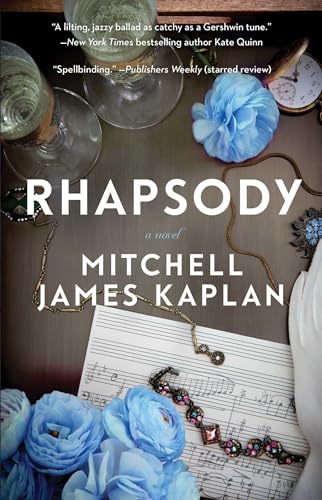
In the vein of the New York Times bestseller Loving Frank, this fascinating and compelling novel “will have you humming, toe-tapping, and singing along with every turn of the page” (Kate Quinn, New York Times bestselling author) as it explores the decade-long relationship between the celebrated composer George Gershwin and gifted musician Katharine “Kay” Swift.
When Katharine “Kay” Swift—the restless but loyal society wife of wealthy banker James Warburg and a serious pianist who longs for recognition—attends a performance of Rhapsody in Blue by a brilliant, elusive young musical genius named George Gershwin, her world is turned upside down. Transfixed, she’s helpless to resist the magnetic pull of George’s talent, charm, and swagger. Their ten-year love affair, complicated by her conflicted loyalty to her husband and the twists and turns of her own musical career, ends only with George’s death from a brain tumor at the age of thirty-eight.
Set in Jazz Age New York City, this stunning work of fiction explores the timeless bond between two brilliant, strong-willed artists. George Gershwin left behind not just a body of work unmatched in popular musical history, but a woman who loved him with all her heart, knowing all the while that he belonged not to her, but to the world.
Die Inhaltsangabe kann sich auf eine andere Ausgabe dieses Titels beziehen.
Über die Autorin bzw. den Autor
Mitchell James Kaplan is the award-winning author of the novels By Fire, By Water and Into the Unbounded Night. A graduate of Yale, he has lived in Paris and Los Angeles, and currently lives with his family in Roanoke, Virginia.
Auszug. © Genehmigter Nachdruck. Alle Rechte vorbehalten.
Chapter One
CHAPTER ONE
THIRTEEN YEARS EARLIER. WINTER 1924
The Aeolian Hall on the third floor of 29-33 West Forty-Second Street: a spacious room with a broad stage and fan-shaped lamps that supported the side balconies. Kay, or Katharine as she was then known, thought of it as the home of the New York Philharmonic, but Paul Whiteman, the P. T. Barnum of New York’s music scene, promised a different experience.
Whiteman was a big man in every way, with a basso cantante growl that he modulated as if riffing in the low range of a flügelhorn. He had telephoned her to insist that if there was one concert she and Jimmy could not avoid this year, it would be this one. “An experiment in modern music,” he drawled. “New sounds. New rhythms.”
“New pieces?” asked Katharine, sucking on a cigarette. “Or old pieces, newly arranged?” The former might interest her. The latter might upset her. Some modern arrangers, imagining themselves superior to composers, disregarded their intentions.
“Entirely new pieces, Katharine,” Whiteman assured her. “We open with a series of short works, sassy and moody and sweet to establish the mood. And then a big, spacious, exuberant piano concerto. The heart of the thing. George Gershwin.”
“Gershwin? The songwriter?” How could a songwriter compose a piano concerto? The idea seemed ludicrous.
“Yes, that Gershwin,” said Whiteman. “But no, not that vocation. We are not talking about a mere song, my dear Katharine. We’re talking about Brahmsian lyricism, Joplinesque ragtime, rip-roaring Souza band music, all stewed together in one luscious gumbo.”
Really? And just what does George Gershwin know about orchestration? Or counterpoint? The study of music, its intricate machinery, had been the focus of Katharine’s youth. Of her entire life. If a song was a hot-air balloon, a piano concerto was a locomotive. Ask a balloon maker to build a train engine, he will not have a clue.
Whiteman, meanwhile, was charging ahead. “What we are talking about, Katharine, is jazz. Clarinet smears, muted trumpets, blue notes, misplaced rhythmic accents, rubbing up against modern chords and Gershwin’s dizzying melodies. You of all people will appreciate this, with your perfect ears. Oh, and did I mention? Jascha will be there. And Sergei. And Igor. The warmth and good spirits of a family reunion. But even with these dear friends in attendance, what pleasure would there be without you and Jimmy? Where the gaiety, the wit, the sheer delight?”
“Oh, dry up, Paul,” Katharine chuckled.
That was how he did it, though. Paul Whiteman thrust people together the way he hammered sounds together, with a brashness that bordered on boorishness, delivered with a wink and a smirk. Heifetz, Rachmaninoff, Stravinsky—anything but a family. More like a zoo. The carnivore division. How could anyone herd a grizzly bear, a Siberian tiger, a Eurasian wolf, and a Tyrannosaurus rex into one cage? Together with a few feral cats and a brood of starving rodents. Somehow, though, Whiteman got away with it.
“I’ll have to check with Jimmy,” said Katharine. But she knew they would go, if only for the illustrious company. They always did.
The trouble began before it actually started. Or vice versa. It commenced with the preparations. She and Jimmy were running late. Her strap pumps were too tight. One of the hidden buttons at the side of her silk column gown flew across the room and burrowed into the rug. Olga, her chief domestic, squinted and fumbled as she tried to align the clasps of Katharine’s jet and crystal choker. Together they dug through hatboxes searching for her matching cloche. “You must have misplaced it,” Katharine snapped. But then regretted her tone. Olga deserved better. She was one in a million.
“Here we are, madam.” Like a magician Olga extracted the hat from a silver box. “And here is your velvet wrap.”
“Oh, what would I do without you?” Katharine pulled the hat low as Olga draped the cloak over her shoulders.
Wearing a bespoke worsted wool suit that he had picked up on Savile Row four months earlier, reclining into the back seat of their chauffeured car, Jimmy opened the window a slit. “What’s on the program?”
“Music.” Katharine dabbed her lipstick with a handkerchief. “Music that Paul Whiteman thinks terribly innovative and exciting.”
“Well that narrows it, doesn’t it,” said Jimmy.
“New music,” said Katharine, “brassy and lively, according to Paul. And finishing with a piano concerto that doubles as a New Orleans gumbo.” She replaced her lipstick in her clutch and stretched her legs. “George Gershwin.”
Jimmy frowned. “La La Lucille?”
“La La someone or other,” said Katharine. “As if I followed these things.” Which was misleading. She had seen the posters, if not the shows.
The theater doors were swinging shut when their driver released them. Jimmy escorted Katharine to their third-row places like a window dresser wheeling a mannequin. Katharine removed his hand from the small of her back and smiled as she waved to Jascha Heifetz’s sister, Pauline.
They took their seats two rows behind Igor Stravinsky. Such a large head for a man who stood five-three in elevator shoes. Thank heavens, though, it was Igor and not Sergei. Rachmaninoff was taller, with a fuller head of hair than his rhythmically and harmonically more adventurous compatriot. Katharine opened the program.
George Gershwin has written a “Rhapsody in Blue,” which he has consented to play accompanied by the orchestra. Delicacy, even dreaminess, is a quality he alone brings into Jazz music. His sense of variation in rhythms, of shifting accents, of emphases and color, is faultless.
Consented to play. She sniggered at Whiteman’s too-clever wording. She had never met George Gershwin; indeed, never set eyes on him. But one thing she knew even then: the fellow did not shy from the spotlight. During the last few years she had seen his name clambering higher and higher on broadsheets for George White’s Scandals, the long-running series of musical revues on Broadway.
Katharine did not care for popular music. She found it predictable and trite, boring really. She was certain Igor, Jascha, and the rest of Whiteman’s validators shared her feeling. By inviting so many serious musicians, financiers, and politicians—no, not inviting them, corralling them—Whiteman was pegging expectations skyscraper high. But what fresh notions could show-biz hacks like Irving Berlin and George Gershwin possibly plant in the febrile mind that had birthed The Rite of Spring? And to lecture about “dreaminess, shifting accents, emphases, and color” with Sergei Rachmaninoff sitting in the front row—now that was what one of Jimmy’s relatives might call chutzpah.
She closed her program as the audience lights dimmed and Whiteman waddled out to polite applause. She liked that word, chutzpah, probably because her husband loathed it, along with every other grimy expression his people had hauled through Ellis Island in their battered cardboard suitcases. (My people? Perhaps, Jimmy would grudgingly admit. But not my...
„Über diesen Titel“ kann sich auf eine andere Ausgabe dieses Titels beziehen.
Suchergebnisse für Rhapsody

Beispielbild für diese ISBN
Rhapsody
Verlag:
Gallery Books (edition ), 2021
ISBN 10: 1982104015
ISBN 13: 9781982104016
Gebraucht
Paperback
Anbieter: BooksRun, Philadelphia, PA, USA
Verkäuferbewertung 5 von 5 Sternen

Paperback. Zustand: Very Good. It's a well-cared-for item that has seen limited use. The item may show minor signs of wear. All the text is legible, with all pages included. It may have slight markings and/or highlighting. Artikel-Nr. 1982104015-11-1
Gebraucht kaufen
EUR 4,41
Versand gratis
Versand innerhalb von USA
Versand innerhalb von USA
Anzahl: 1 verfügbar
Beispielbild für diese ISBN
Rhapsody
Anbieter: Better World Books, Mishawaka, IN, USA
Verkäuferbewertung 5 von 5 Sternen
Zustand: Very Good. Pages intact with possible writing/highlighting. Binding strong with minor wear. Dust jackets/supplements may not be included. Stock photo provided. Product includes identifying sticker. Better World Books: Buy Books. Do Good. Artikel-Nr. 52791593-6
Gebraucht kaufen
EUR 6,09
Versand gratis
Versand innerhalb von USA
Versand innerhalb von USA
Anzahl: 1 verfügbar
Beispielbild für diese ISBN
Rhapsody
Anbieter: Better World Books, Mishawaka, IN, USA
Verkäuferbewertung 5 von 5 Sternen
Zustand: Good. Pages intact with minimal writing/highlighting. The binding may be loose and creased. Dust jackets/supplements are not included. Stock photo provided. Product includes identifying sticker. Better World Books: Buy Books. Do Good. Artikel-Nr. 50147473-6
Gebraucht kaufen
EUR 6,09
Versand gratis
Versand innerhalb von USA
Versand innerhalb von USA
Anzahl: 1 verfügbar
Beispielbild für diese ISBN
Rhapsody
Anbieter: Wonder Book, Frederick, MD, USA
Verkäuferbewertung 5 von 5 Sternen
Zustand: Good. Good condition. A copy that has been read but remains intact. May contain markings such as bookplates, stamps, limited notes and highlighting, or a few light stains. Artikel-Nr. P13B-02189
Gebraucht kaufen
EUR 6,33
Versand gratis
Versand innerhalb von USA
Versand innerhalb von USA
Anzahl: 1 verfügbar
Beispielbild für diese ISBN
Rhapsody
Anbieter: ThriftBooks-Dallas, Dallas, TX, USA
Verkäuferbewertung 5 von 5 Sternen
Paperback. Zustand: Very Good. No Jacket. May have limited writing in cover pages. Pages are unmarked. ~ ThriftBooks: Read More, Spend Less. Artikel-Nr. G1982104015I4N00
Gebraucht kaufen
EUR 6,37
Versand gratis
Versand innerhalb von USA
Versand innerhalb von USA
Anzahl: 1 verfügbar
Beispielbild für diese ISBN
Rhapsody
Anbieter: ThriftBooks-Atlanta, AUSTELL, GA, USA
Verkäuferbewertung 5 von 5 Sternen
Paperback. Zustand: Good. No Jacket. Pages can have notes/highlighting. Spine may show signs of wear. ~ ThriftBooks: Read More, Spend Less. Artikel-Nr. G1982104015I3N00
Gebraucht kaufen
EUR 6,37
Versand gratis
Versand innerhalb von USA
Versand innerhalb von USA
Anzahl: 1 verfügbar
Beispielbild für diese ISBN
Rhapsody
Anbieter: ThriftBooks-Dallas, Dallas, TX, USA
Verkäuferbewertung 5 von 5 Sternen
Paperback. Zustand: Fair. No Jacket. Readable copy. Pages may have considerable notes/highlighting. ~ ThriftBooks: Read More, Spend Less. Artikel-Nr. G1982104015I5N00
Gebraucht kaufen
EUR 6,37
Versand gratis
Versand innerhalb von USA
Versand innerhalb von USA
Anzahl: 1 verfügbar
Beispielbild für diese ISBN
Rhapsody
Anbieter: ThriftBooks-Atlanta, AUSTELL, GA, USA
Verkäuferbewertung 5 von 5 Sternen
Paperback. Zustand: Very Good. No Jacket. May have limited writing in cover pages. Pages are unmarked. ~ ThriftBooks: Read More, Spend Less. Artikel-Nr. G1982104015I4N00
Gebraucht kaufen
EUR 6,37
Versand gratis
Versand innerhalb von USA
Versand innerhalb von USA
Anzahl: 1 verfügbar
Beispielbild für diese ISBN
Rhapsody
Anbieter: ThriftBooks-Reno, Reno, NV, USA
Verkäuferbewertung 5 von 5 Sternen
Paperback. Zustand: Very Good. No Jacket. May have limited writing in cover pages. Pages are unmarked. ~ ThriftBooks: Read More, Spend Less. Artikel-Nr. G1982104015I4N00
Gebraucht kaufen
EUR 6,37
Versand gratis
Versand innerhalb von USA
Versand innerhalb von USA
Anzahl: 1 verfügbar
Beispielbild für diese ISBN
Rhapsody
Anbieter: ThriftBooks-Dallas, Dallas, TX, USA
Verkäuferbewertung 5 von 5 Sternen
Paperback. Zustand: As New. No Jacket. Pages are clean and are not marred by notes or folds of any kind. ~ ThriftBooks: Read More, Spend Less. Artikel-Nr. G1982104015I2N00
Gebraucht kaufen
EUR 6,37
Versand gratis
Versand innerhalb von USA
Versand innerhalb von USA
Anzahl: 1 verfügbar