
Verwandte Artikel zu Autism & You: Learning in Styles
Inhaltsangabe
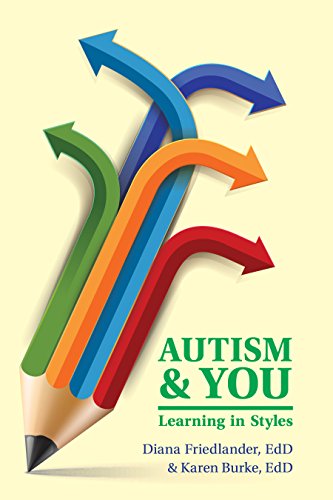
Everyone has different learning-style preferences, strengths, and challenges in the classroom. This book will give you information about your learning style and your type of autism so you can make a plan for success.Also available in this book:• Complete learning style descriptions• Fun learning games, images & instruction• A complete “Help Guide” to Learning Style: The Clue to You (LS:CY) Assessment
Die Inhaltsangabe kann sich auf eine andere Ausgabe dieses Titels beziehen.
Über die Autorinnen und Autoren
Diana Friedlander, EdD is an elementary special education teacher in Ridgefield, CT. She is also an adjunct professor at Western Connecticut State University (WCSU), Danbury, CT. where she teaches in both the undergraduate and graduate teacher education programs. Dr. Friedlander has taught students with autism for over 40 years in both private and public schools where she has been an advocate for the successful inclusion of students with special needs into the general education classroom. Her research investigated differences and similarities in learning styles of students with autism and their typical peers. A life-long student, Dr. Friedlander has just begun fencing, something she has always wanted to learn.
Karen Burke, CSJ, EdD is an Emeritus Professor at Western Connecticut State University (WCSU) in Danbury, Connecticut. She recently completed 10 years as a WCSU Instructional Leadership Doctoral Program Professor, recipient of the 2009 Connecticut State University Trustees Faculty Research Award. She is a former early childhood and middle school educator, and elementary school administrator. During the past 20 years, Dr. Burke dedicated her time researching the different styles of learning. She was co-creator of the Learning Style: The Clue to You (LS: CY) Assessment which helps determine individual's learning preferences and effects of using instructional strategies responsive to students' learning-style strengths. Her research has extended to conference presentations, professional development programs, and educational outreach in the United States and over 40 other countries in Central America, South America, the Middle East, Africa, and Asia. Although Karen has traveled the globe lecturing on innovative teaching and learning techniques, the most important lessons she has learned are in global awareness and understanding. As globalization changes the way we live, learn, and work; international education becomes important. "As a global citizen, she gets to see how similar we are to all people, how our cares and concerns and worries are all very similar. And the more we realize we are alike, the easier it will be to accept our differences." These insights and research projects subsequently lead to more than 40 publications in educational journals and edited books.
Auszug. © Genehmigter Nachdruck. Alle Rechte vorbehalten.
Autism & You: Learning in Styles
By Diana Friedlander, Karen BurkeFuture Horizons, Inc.
Copyright © 2017 Diana Friedlander, EdD & Karen Burke, EdD
All rights reserved.
ISBN: 978-1-941765-45-6All rights reserved.
Contents
1 So You Have Autism,
2 You Also Have a Learning Style,
3 Discovering Your Learning Style: Taking a Test You Can't Fail,
4 Where? Strategies to Help You Feel More Comfortable While You Are Learning,
5 What? Strategies for Using Hands-On Learning,
6 How? Strategies for Understanding Ways You Learn Best,
7 Who? When? Understanding with Whom You Learn Best and Managing Your Time,
8 Putting It All Together,
Appendix,
CHAPTER 1
So You Have Autism
So you have autism, what exactly does this mean for you? It is a fact that more than 1 in about 68 people in the United States has some form of autism. This means that other kids in your school have autism; baseball players, dancers, musicians, and teachers have autism. People in the grocery store, at the pool, and in the library have autism.
There are many things you can do about yourself; for instance, if you are heavy, you can lose weight or if you are slow at figuring out multiplication problems, you can practice your multiplication facts, or if you are particularly talented in art, perhaps you can take more classes. However, you cannot change the fact that you have autism. What you can do is learn more about autism and begin to understand how it affects you and your life. This book is designed to help you do just that, discover and use your strengths to reach your goals and better understand how you learn. Knowing yourself and speaking up for who you are and what you need is called self-advocacy. This book will give you information about your learning style and your autism so you can make a plan for success. Let's take a look at what the experts have to say about autism.
How It All Began
When you were young, your parents took you to your pediatrician for regular checkups. Most likely, during one of the checkups, your parents and the doctor discussed some of their concerns about your development. Autism is considered a developmental exceptionality, so somewhere along the line, your development was different from that of most kids your age and your brothers and sisters. Maybe you did not start speaking in sentences when most kids do (2 years or so). Maybe it was hard for you to look at people when they talked to you or to join in the large-group activities at preschool and maybe you felt uncomfortable when someone hugged or cuddled you. Does any of this sound familiar? These are just some of the things parents keep an eye on as their children grow. They are often called benchmarks or developmental milestones.
When your parents and your doctor began to talk about your development, they began to realize how unique you are. Your parents were probably concerned when they first became aware of your developmental differences. Possibly the doctor talked to them about autism and how people who have autism are sometimes different in some ways than people who do not have autism. A conversation about autism can be tricky because no two people are alike. People who have autism are sometimes said to be "quirky" or different because they do not always see the world like most people do. This is not to say they are wrong, only that they are different. Your parents may not have even heard of autism. They probably had to do some research to better understand what a diagnosis of autism really meant for you and the entire family. In addition to reading what the experts said, they may have talked to other parents of children who had received a similar diagnosis to get advice from them.
They probably also read books written by other parents who have children with autism, books written by someone like Eustacia Cutler, who has a famous daughter with autism, Temple Grandin. Although Temple had a hard time connecting with people and sometimes became very frustrated as a child, she grew up to be a college professor, engineer, and lecturer about autism. She was born in the 1950s when people knew very little about autism — some people even thought she was crazy and wantedher locked away, which is something we would never think or do today. Her mother felt alone and confused when she first learned her daughter had autism. She did not have the support of doctors or friends who understood Temple's differences.
In her book about being Temple's mother, she writes about Temple as a little girl: "Temple is causing storms from which there is no quick tidy-up and no immediate answer. This is a new experience for both of us...." Neither Temple nor her mother really understood why she was having these behavior problems. Once they both learned more about her autism, they worked together so Temple could find better ways to express herself. She learned that she could talk about her frustrations and set up schedules and reminders so she would not feel so overwhelmed or disoriented about her day. She also figured out ways to get the sensory input she needed to feel calmer (more about that later). Today, she speaks to people all over the world about her experiences as a mother of a child with autism.
Doug Flutie, a famous football player, also has a son who has autism. He and his wife started the Doug Flutie, Jr. Foundation to help people with autism by raising money to support research into what causes autism. He even created and sold cereal called "Fluties" to help raise money for his foundation.
When told that you had autism, your parents may have had similar experiences as these parents. They may have been uncertain and confused. They may have turned to the Internet to get information or to books or lectures offered by other parents of children with similar development and behavior patterns. Every family is different. Families are made up of people and each of them is unique. Some families move around a lot, some are skiers, some have red hair, and some have autism. Your family is as unique as all others. Now you are old enough to begin to try to understand yourself and to investigate what it is that makes you you. Everyone has strengths and challenges. You already know that some of yours are quirky or different from other kids your age or from your brothers and sisters. There are times when you just need to be you and cannot muster the interest or energy to figure out how to get things done - times when you might need to curl up inside yourself and take a break or speak out at someone to make your thoughts known. Sometimes those moments can be extra challenging for those who live with you, especially your parents, whose job it is to help mold you to grow up. All kids your age are challenging for parents; they are becoming more independent and do not always feel they need to follow the flow of the family, they keep their rooms messy and do not like to be reminded to do their homework. You can probably see yourself in these examples but your autism often requires even more understanding and patience from your family and more hard work from you. Taking a simple test to help you determine your learning style preferences can give you the tools you need to begin to advocate for yourself. For example, if you discover you learn best while working with others, maybe doing your homework alone in your room is not the best way to get it done or if you work best while snacking, perhaps you can make certain to take an extra snack to math class (of course, after discussing it with your math teacher). Anything you and your parents can do to help all of you...
„Über diesen Titel“ kann sich auf eine andere Ausgabe dieses Titels beziehen.
Suchergebnisse für Autism & You: Learning in Styles

Beispielbild für diese ISBN
Autism and You
Anbieter: PBShop.store UK, Fairford, GLOS, Vereinigtes Königreich
Verkäuferbewertung 5 von 5 Sternen

PAP. Zustand: New. New Book. Shipped from UK. Established seller since 2000. Artikel-Nr. FW-9781941765456
Neu kaufen
EUR 15,61
EUR 3,89 Versand
Versand von Vereinigtes Königreich nach USA
Versand von Vereinigtes Königreich nach USA
Anzahl: 1 verfügbar
Beispielbild für diese ISBN
Autism and You: Learning in Styles
Anbieter: Revaluation Books, Exeter, Vereinigtes Königreich
Verkäuferbewertung 5 von 5 Sternen
Paperback. Zustand: Brand New. 81 pages. 9.25x6.25x0.50 inches. In Stock. Artikel-Nr. __1941765459
Neu kaufen
EUR 11,18
EUR 11,82 Versand
Versand von Vereinigtes Königreich nach USA
Versand von Vereinigtes Königreich nach USA
Anzahl: 1 verfügbar
Beispielbild für diese ISBN
Autism & You: Learning in Styles
Anbieter: Kennys Bookstore, Olney, MD, USA
Verkäuferbewertung 5 von 5 Sternen
Zustand: New. 2018. Paperback. . . . . . Books ship from the US and Ireland. Artikel-Nr. V9781941765456
Neu kaufen
EUR 18,20
EUR 9,38 Versand
Versand innerhalb von USA
Versand innerhalb von USA
Anzahl: 1 verfügbar
Beispielbild für diese ISBN
Autism and You: Learning in Styles
Anbieter: Ria Christie Collections, Uxbridge, Vereinigtes Königreich
Verkäuferbewertung 5 von 5 Sternen
Zustand: New. In English. Artikel-Nr. ria9781941765456_new
Neu kaufen
EUR 19,82
EUR 11,07 Versand
Versand von Vereinigtes Königreich nach USA
Versand von Vereinigtes Königreich nach USA
Anzahl: Mehr als 20 verfügbar
Foto des Verkäufers
Autism & You
Anbieter: moluna, Greven, Deutschland
Verkäuferbewertung 5 von 5 Sternen
Zustand: New. Helps students with autism, parents and teachers and understanding of autism and of specific learning strategies such as alternative approaches to teaching that will accomplish more than merely increasing students standardized achievement test score and at. Artikel-Nr. 597282800
Neu kaufen
EUR 20,42
EUR 48,99 Versand
Versand von Deutschland nach USA
Versand von Deutschland nach USA
Anzahl: 1 verfügbar