
Verwandte Artikel zu Divorce in Michigan: The Legal Process, Your Rights,...
Divorce in Michigan: The Legal Process, Your Rights, and What to Expect - Softcover
Buch 17 von 27: Divorce In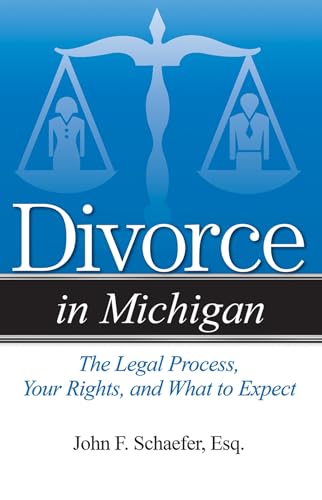
Inhaltsangabe
Providing accurate and objective information to help make the right decisions during a divorce in Michigan, this guide provides answers to 360 queries such as What is the mediation process in Michigan and is it required? How quickly can one get a divorce? Who decides who gets the cars, the pets, and the house? What actions might influence child custody? How are bills divided and paid during the divorce? How much will a divorce cost? and Will a spouse have to pay some or all attorney fees? Structured in a question-and-answer format, this divorce handbook provides clear and concise responses to help build confidence and give the peace of mind needed to meet the challenges of a divorce proceeding.
Die Inhaltsangabe kann sich auf eine andere Ausgabe dieses Titels beziehen.
Über die Autorin bzw. den Autor
John F. Schaefer, Esq., has been practicing matrimonial law for more than 35 years. He has served on the Board of Trustees and as an adjunct professor of law at the Michigan State University College of Law. He is listed in all editions of The Best Lawyers in America, and he regularly appears on radio and television programs discussing legal topics, including matrimonial law. He lives in Birmingham, Michigan.
Auszug. © Genehmigter Nachdruck. Alle Rechte vorbehalten.
Divorce in Michigan
The Legal Process, Your Rights, and What to Expect
By John F. SchaeferAddicus Books, Inc.
Copyright © 2016 John F. Schaefer
All rights reserved.
ISBN: 978-1-940495-29-3All rights reserved.
Contents
Acknowledgments,
Introduction,
1 Understanding the Divorce Process,
2 Coping with Stress during the Divorce Process,
3 Choosing and Working with Your Attorney,
4 Attorney Fees and Costs,
5 The Discovery Process,
6 Mediation, Arbitration, and Collaboration,
7 Emergency: When You Fear Your Spouse,
8 Child Custody,
9 Child Support,
10 Alimony,
11 Division of Property,
12 Benefits: Insurance, Retirement, and Pensions,
13 Division of Debts,
14 Taxes,
15 Going to Court,
16 The Appeals Process,
In Closing,
Appendix,
Resources,
Glossary,
About the Author,
CHAPTER 1
Understanding the Divorce Process
At a time when your life can feel like it's in utter chaos, sometimes the smallest bit of predictability can bring a sense of comfort. The outcome of many aspects of your divorce may be unknown, increasing your fear and anxiety. But there is one part of your divorce that does have some measure of predictability and that is the divorce process itself.
Most divorces proceed in a step-by-step manner. Despite the uniqueness of your divorce, you can generally count on one phase of your divorce following the next. Sometimes just realizing you are completing stages and moving forward with your divorce can reassure you that it won't go on forever.
Develop a basic understanding of the divorce process. This will lower your anxiety when your attorney starts talking about "depositions" or "going to trial," and you feel your heart start pounding in fear. It can reduce your frustration about the length of the process because you understand why each step is needed. It will support you to begin preparing for what comes next.
Most importantly, understanding the divorce process will make your experience of the entire divorce easier. Who wouldn't prefer that?
1.1 What is my first step in seeking a divorce?
Find a law firm that handles divorces as a regular part of its law practice. The best recommendations come from people who have knowledge of a lawyer's experience and reputation.
Even if you are not ready to file for divorce, call to schedule an appointment right away to obtain information about protecting yourself and your children. Even if you are not planning to file for divorce, your spouse might be.
Ask what documents you should take to your initial consultation. Make a list of your questions to bring to your first meeting. Start making plans for how you will pay your attorney to begin work on your case.
1.2 Must I have an attorney to get a divorce in Michigan?
You are not required to have an attorney to obtain a divorce in Michigan. However, if your case involves children, alimony, significant property, or debts, you should avoid proceeding on your own.
If your divorce does not involve any of these issues, contact the Legal Aid Clinic at a law school near you or your local Bar Association to request documents and instructions that are helpful in the simplest of cases. The court clerk or staff cannot provide legal advice and will not assist you other than to direct you to the appropriate court forms. A person who proceeds in a legal matter without a lawyer is referred to as being pro se, on one's own.
If you are considering proceeding without an attorney, at a minimum have an initial consultation with an attorney to discuss your rights and duties under the law. You may have certain rights or obligations of which you are unaware. Meeting with a lawyer can help you decide whether to proceed on your own.
1.3 What other steps are taken during the divorce process?
The divorce process in Michigan typically involves the steps listed below.
• Obtain a referral for a lawyer.
• Schedule an appointment with an attorney.
• Prepare questions and gather needed documents for initial consultation.
• Meet for initial consultation with attorney.
• Pay retainer to attorney and sign retainer agreement.
• Provide requested information and documents to your attorney.
• Take other actions as advised by attorney, such as opening or closing financial accounts.
• Attorney prepares complaint for divorce and affidavits for temporary matters for your review and signature.
• Attorney files complaint with clerk of the court. Attorney obtains ex parte restraining orders if appropriate. Attorney obtains hearing date for temporary matters.
• Mandatory sixty-day waiting period begins when filing the complaint.
• Negotiations begin regarding terms of temporary order on matters such as custody, support, and temporary possession of the family home. Attorneys prepare financial affidavits and child-support guidelines for temporary hearing.
• Parties reach agreement on temporary order.
OR
• Parties file motions relative to temporary matters.
• Temporary order is prepared by one attorney, approved as to form by other attorney, and submitted to the judge for signature.
• If there are minor children, parties may be required to attend a parent education class, depending on the county.
• Both sides conduct discovery to obtain information regarding all relevant facts. Obtain valuations of all assets, including expert opinions if needed.
• Ask your attorney for a litigation budget to help you anticipate and prepare for the overall cost of litigation.
• Confer with attorney to review facts, identify issues, assess strengths and weaknesses of case, review strategy, and develop proposal for settlement.
• Spouses, with support of attorneys, attempt to reach agreement through written proposals, mediation, settlement conferences, or other negotiation.
• Parties reach agreement on all issues.
• Attorney prepares judgment for divorce and court orders for the division of retirement plans for approval by spouses and attorneys.
OR
• Attorneys and parties prepare for trial and court sets a firm trial date.
• Trial preparations proceed including preparation of witnesses, trial exhibits, legal research on contested issues, pretrial motions, trial brief, preparation of direct and cross-examination of witnesses, preparation of opening statement, subpoena of witnesses, closing argument, and suggestions to the court.
• Meet with attorney for final trial preparation.
• Go to trial.
• Judge makes decision, which could take several months.
• Attorney prepares judgment.
• Other attorney approves it as to form.
• Judgment submitted to judge for signature.
• Judge signs decree of dissolution. Make payments and sign documents (deeds or titles) pursuant to judgment.
• Submit to the court documents required to divide retirement accounts and ensure the payment of child support.
• Pay any remaining balance due on attorney's fees.
1.4 Is Michigan a no-fault state, or do I need grounds for a divorce?
Michigan, like most states, is a no-fault divorce state. This means that neither you nor your spouse is required to prove that the other is "at fault" in order to be granted a divorce....
„Über diesen Titel“ kann sich auf eine andere Ausgabe dieses Titels beziehen.
Suchergebnisse für Divorce in Michigan: The Legal Process, Your Rights,...

Beispielbild für diese ISBN
Divorce in Michigan: The Legal Process, Your Rights, and What to Expect
Anbieter: ThriftBooks-Dallas, Dallas, TX, USA
Verkäuferbewertung 5 von 5 Sternen

Paperback. Zustand: As New. No Jacket. Pages are clean and are not marred by notes or folds of any kind. ~ ThriftBooks: Read More, Spend Less. Artikel-Nr. G1940495296I2N00
Gebraucht kaufen
EUR 7,81
Versand gratis
Versand innerhalb von USA
Versand innerhalb von USA
Anzahl: 1 verfügbar
Beispielbild für diese ISBN
Divorce in Michigan: The Legal Process, Your Rights, and What to Expect
Anbieter: ThriftBooks-Atlanta, AUSTELL, GA, USA
Verkäuferbewertung 5 von 5 Sternen
Paperback. Zustand: As New. No Jacket. Pages are clean and are not marred by notes or folds of any kind. ~ ThriftBooks: Read More, Spend Less. Artikel-Nr. G1940495296I2N00
Gebraucht kaufen
EUR 7,81
Versand gratis
Versand innerhalb von USA
Versand innerhalb von USA
Anzahl: 1 verfügbar
Beispielbild für diese ISBN
Divorce in Michigan The Legal
Anbieter: World of Books (was SecondSale), Montgomery, IL, USA
Verkäuferbewertung 5 von 5 Sternen
Zustand: Good. Item in good condition. Textbooks may not include supplemental items i.e. CDs, access codes etc. Artikel-Nr. 00103604520
Gebraucht kaufen
EUR 7,89
Versand gratis
Versand innerhalb von USA
Versand innerhalb von USA
Anzahl: 1 verfügbar
Beispielbild für diese ISBN
Divorce in Michigan: The Legal Process, Your Rights, and What to Expect
Anbieter: Revaluation Books, Exeter, Vereinigtes Königreich
Verkäuferbewertung 5 von 5 Sternen
Paperback. Zustand: Brand New. 226 pages. 6.00x4.00x0.50 inches. In Stock. Artikel-Nr. 1940495296
Neu kaufen
EUR 38,67
EUR 11,66 Versand
Versand von Vereinigtes Königreich nach USA
Versand von Vereinigtes Königreich nach USA
Anzahl: 1 verfügbar