
Verwandte Artikel zu RUMI - 53 Secrets from the Tavern of Love: Poems from...
RUMI - 53 Secrets from the Tavern of Love: Poems from the Rubiayat of Mevlana Rumi (Islamic Encounter Series) - Softcover
Buch 1 von 4: Islamic Encounter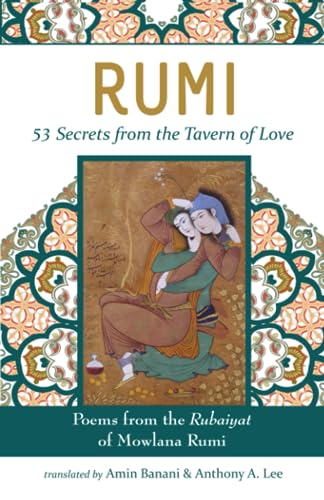
Inhaltsangabe
Rumi’s poetry has been published in various English editions since the 19th century. Thanks to the translations of Coleman Barks, he is the best-selling poet in the English language.
Still, in English, Rumi’s poems have often been rendered into literal and academic prose that is awkward and wooden — or into a New-Age idiom that bears little relationship to the author’s original text or context. Professors Amin Banani and Anthony A. Lee come to the rescue with a masterful translation that bridges the academic demand for fidelity to the original Persian text with a sensitive poetic translation that speaks to 21st-century readers.
The book has three sections: 1) a general introduction to Rumi’s poetry, 2) translations of 53 short poems and 3) a groundbreaking essay by Banani on the position of Rumi in Islamic poetry and in the world literature.
The poems are presented as lessons on love. The reader is encouraged to treat them as koans to inspire spiritual contemplation.
Die Inhaltsangabe kann sich auf eine andere Ausgabe dieses Titels beziehen.
Über die Autorin bzw. den Autor
Amin Banani is an emeritus professor of history and Persian literature at the University of California, Los Angeles. He is the author of Mysticism and Poetry in Islam: The Heritage of Rumi and Persian Literature. He has pioneered the literary translation of contemporary Iranian poets. Anthony A. Lee lives in the Los Angeles area. He teaches African American history at the University of California, Los Angeles, and at West Los Angeles College. He was awarded the Nat Turner Poetry Award (2003). He has received the Naomi Long Madgett Poetry Award (2005) and the Merton Institutes ?Poetry of the Sacred" award (2012).
Auszug. © Genehmigter Nachdruck. Alle Rechte vorbehalten.
From the Foreword
TRANSLATING RUMI
by Anthony A. Lee, Ph.D.
On Saturday, November 29, 1244 A.D. by our calendar, in the city of Konya in medieval Anatolia (now, southern Turkey), an event took place that would change the course of Islamic history, and eventually change the consciousness of humanity. Jalal al-Din Rumi, a Muslim cleric and legal scholar, fell in love. This was a strange and sudden, ecstatic, burning love that opened his heart and introduced new worlds to him. Even today, Sufi devotees around the world celebrate the legacy of that day in music and dance and poetry.
The focus of Rumi’s love was Shams-e Tabrizi (literally, Sun of Tabriz), a wanderer and fellow Muslim scholar. Legend tells us that this was almost love at first sight. In the marketplace of Konya, amid the cotton stalls, sugar vendors, and vegetable stands, Rumi rode through the street, surrounded by his students. Shams caught hold of the reins of his donkey and rudely challenged the master with two questions. “Who was the greater mystic, Bayazid [a Sufi saint] or Muhammad?” Shams demanded.
“What a strange question! Muhammad is greater than all the saints,” Rumi replied.
“So, why is it then that Muhammad said to God, ‘I didn’t know you as I should have,’ while Bayazid proclaimed, ‘Glory be to me! How exalted is my Glory!” [that is, he claimed the station of God himself]?
Rumi explained that Muhammad was the greater of the two, because Bayazid could be filled to capacity by a single experience of divine blessings. He lost himself completely and was filled with God. Muhammad’s capacity was unlimited and could never be filled. His desire was endless, and he was always thirsty. With every moment he came closer to God, and then regretted his former distant state. For that reason he said, “I have never known you as I should have.”
It is recorded that after this exchange of words, Rumi felt a window open at the top of his head and saw smoke rise to heaven. He cried out, fell to the ground, and lost consciousness for one hour. Shams, upon hearing these answers, realized that he was face to face with the object of his longing, the one he had prayed God to send him. When Rumi awoke, he took Shams’s hand, and the two of them returned to Rumi’s school together on foot. They secluded themselves for forty days, speaking to no one.
POEMS
Love
The candle inside your heart: Let it burn!
That gap keeps you from the Friend: Let it turn!
Hey! Don’t you know about pain and burning?
Love comes like that. It’s not something you learn.
You Are That
You’re looking for soul—but you are the soul.
You’re searching for crumbs—you are loaf and roll.
Learn this secret, then you’ll know: Whatever
you’re seeking—you are that. You are the goal.
##
TRANSLATING RUMI
by Anthony A. Lee, Ph.D.
On Saturday, November 29, 1244 A.D. by our calendar, in the city of Konya in medieval Anatolia (now, southern Turkey), an event took place that would change the course of Islamic history, and eventually change the consciousness of humanity. Jalal al-Din Rumi, a Muslim cleric and legal scholar, fell in love. This was a strange and sudden, ecstatic, burning love that opened his heart and introduced new worlds to him. Even today, Sufi devotees around the world celebrate the legacy of that day in music and dance and poetry.
The focus of Rumi’s love was Shams-e Tabrizi (literally, Sun of Tabriz), a wanderer and fellow Muslim scholar. Legend tells us that this was almost love at first sight. In the marketplace of Konya, amid the cotton stalls, sugar vendors, and vegetable stands, Rumi rode through the street, surrounded by his students. Shams caught hold of the reins of his donkey and rudely challenged the master with two questions. “Who was the greater mystic, Bayazid [a Sufi saint] or Muhammad?” Shams demanded.
“What a strange question! Muhammad is greater than all the saints,” Rumi replied.
“So, why is it then that Muhammad said to God, ‘I didn’t know you as I should have,’ while Bayazid proclaimed, ‘Glory be to me! How exalted is my Glory!” [that is, he claimed the station of God himself]?
Rumi explained that Muhammad was the greater of the two, because Bayazid could be filled to capacity by a single experience of divine blessings. He lost himself completely and was filled with God. Muhammad’s capacity was unlimited and could never be filled. His desire was endless, and he was always thirsty. With every moment he came closer to God, and then regretted his former distant state. For that reason he said, “I have never known you as I should have.”
It is recorded that after this exchange of words, Rumi felt a window open at the top of his head and saw smoke rise to heaven. He cried out, fell to the ground, and lost consciousness for one hour. Shams, upon hearing these answers, realized that he was face to face with the object of his longing, the one he had prayed God to send him. When Rumi awoke, he took Shams’s hand, and the two of them returned to Rumi’s school together on foot. They secluded themselves for forty days, speaking to no one.
POEMS
Love
The candle inside your heart: Let it burn!
That gap keeps you from the Friend: Let it turn!
Hey! Don’t you know about pain and burning?
Love comes like that. It’s not something you learn.
You Are That
You’re looking for soul—but you are the soul.
You’re searching for crumbs—you are loaf and roll.
Learn this secret, then you’ll know: Whatever
you’re seeking—you are that. You are the goal.
##
„Über diesen Titel“ kann sich auf eine andere Ausgabe dieses Titels beziehen.
Suchergebnisse für RUMI - 53 Secrets from the Tavern of Love: Poems from...

Beispielbild für diese ISBN
RUMI - 53 Secrets from the Tavern of Love: Poems from the Rubiayat of Mowlana Rumi (Islamic Encounter Series)
Verlag:
White Cloud Press (edition Bilingual), 2014
ISBN 10: 1940468000
ISBN 13: 9781940468006
Gebraucht
Paperback
Anbieter: BooksRun, Philadelphia, PA, USA
Verkäuferbewertung 5 von 5 Sternen

Paperback. Zustand: Very Good. Bilingual. It's a well-cared-for item that has seen limited use. The item may show minor signs of wear. All the text is legible, with all pages included. It may have slight markings and/or highlighting. Artikel-Nr. 1940468000-11-1
Gebraucht kaufen
EUR 4,86
Versand gratis
Versand innerhalb von USA
Versand innerhalb von USA
Anzahl: 1 verfügbar
Beispielbild für diese ISBN
Rumi: 53 Secrets from the Tavern of Love: Poems from the Rubiayat of Mowlana Rumi
Anbieter: ThriftBooks-Dallas, Dallas, TX, USA
Verkäuferbewertung 5 von 5 Sternen
Paperback. Zustand: Good. No Jacket. Pages can have notes/highlighting. Spine may show signs of wear. ~ ThriftBooks: Read More, Spend Less. Artikel-Nr. G1940468000I3N00
Gebraucht kaufen
EUR 6,50
Versand gratis
Versand innerhalb von USA
Versand innerhalb von USA
Anzahl: 1 verfügbar
Beispielbild für diese ISBN
RUMI - 53 Secrets from the Tavern of Love : Poems from the Rubiayat of Mowlana Rumi
Anbieter: Better World Books, Mishawaka, IN, USA
Verkäuferbewertung 5 von 5 Sternen
Zustand: Very Good. Former library copy. Pages intact with possible writing/highlighting. Binding strong with minor wear. Dust jackets/supplements may not be included. Includes library markings. Stock photo provided. Product includes identifying sticker. Better World Books: Buy Books. Do Good. Artikel-Nr. 19267640-6
Gebraucht kaufen
EUR 7,02
Versand gratis
Versand innerhalb von USA
Versand innerhalb von USA
Anzahl: 1 verfügbar
Beispielbild für diese ISBN
Rumi - 53 Secrets from the Tavern of Love: Poems from the Rubiayat of Mevlana Rumi
Anbieter: Revaluation Books, Exeter, Vereinigtes Königreich
Verkäuferbewertung 5 von 5 Sternen
Paperback. Zustand: Brand New. bilingual edition. 126 pages. 8.25x5.50x0.50 inches. In Stock. Artikel-Nr. zk1940468000
Neu kaufen
EUR 26,81
EUR 11,94 Versand
Versand von Vereinigtes Königreich nach USA
Versand von Vereinigtes Königreich nach USA
Anzahl: 1 verfügbar