
Verwandte Artikel zu Divorce in Virginia: The Legal Process, Your Rights,...
Divorce in Virginia: The Legal Process, Your Rights, and What to Expect - Softcover
Buch 11 von 27: Divorce In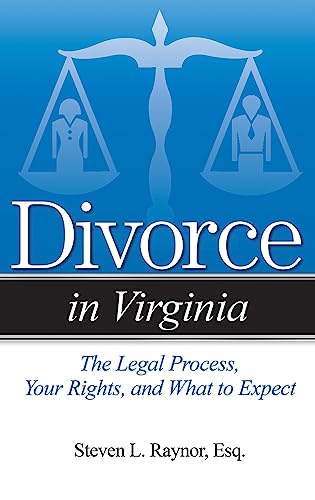
Inhaltsangabe
Providing accurate and objective information to help make the right decisions during a divorce in Virginia, this guide provides answers to 360 queries such as What is the mediation process in Virginia and is it required? How quickly can one get a divorce? Who decides who gets the cars, the pets, and the house? What actions might influence child custody? How are bills divided and paid during the divorce? How much will a divorce cost? and Will a spouse have to pay some or all attorney fees? Structured in a question-and-answer format, this divorce handbook provides clear and concise responses to help build confidence and give the peace of mind needed to meet the challenges of a divorce proceeding.
Die Inhaltsangabe kann sich auf eine andere Ausgabe dieses Titels beziehen.
Über die Autorin bzw. den Autor
Steven L. Raynor, Esq., is a family law attorney and has been listed by the Virginia Business magazine as one of the legal elite in the family/domestic relations practice area. He has also been selected to the 2013 Virginia Super Lawyers list in the family law practice area. He lives in Charlottesville, Virginia.
Auszug. © Genehmigter Nachdruck. Alle Rechte vorbehalten.
Divorce in Virginia
The Legal Process, Your Rights, and What to Expect
By Steven L. RaynorAddicus Books, Inc.
Copyright © 2015 Steven L. Raynor
All rights reserved.
ISBN: 978-1-938803-88-8All rights reserved.
Contents
Acknowledgments,
Introduction,
1 Understanding the Divorce Process,
2 Working with Your Attorney,
3 Attorney's Fees and Costs,
4 Initial Issues Associated with Separation,
5 Coping with Stress during the Divorce Process,
6 Emergency: When You Fear Your Spouse,
7 Grounds for Divorce,
8 Division of Assets and Debts,
9 Retirement and Other Benefits,
10 Spousal Support,
11 Custody and Visitation,
12 Child Support,
13 Tax Issues,
14 Name Change,
15 Settlement Issues, Options, and Strategy,
16 Documents Filed in Court,
17 Discovery,
18 Hearings and Trial,
19 Appeal,
20 What Happens after the Divorce?,
In Closing,
Appendix,
Resources,
Glossary,
Index,
About the Author,
CHAPTER 1
Understanding the Divorce Process
Divorces are complicated. There are a number of substantive issues, and there are a number of procedural options involved. The procedures in a divorce case vary greatly based upon whether there is agreement on issues, or whether there are issues in dispute to be resolved by the judge.
A person going through a divorce has to deal with all of the legal complexity at the same time he or she is typically having to deal with strong emotions, disruptions to the home and family life, and the strong emotions of his or her spouse. In short, this is the worst time in your life to have to deal with a very complicated, expensive, demanding legal process.
As you read this book, you will gain a working understanding of the divorce process, procedures, and issues. This chapter will address many of your initial questions regarding the divorce process.
1.1 What steps are taken during the divorce process?
A typical divorce involves a separation, the filing of a complaint for divorce, service of process, responsive pleadings by the other party, discovery, settlement or trial, and the entry of a divorce order. This sounds complicated, but it is made even more complicated by the fact that divorce cases develop in innumerable ways. Some parties settle all issues before they even separate, and then obtain an uncontested, no-fault divorce. At the other end of the spectrum, some parties go to court and have the judge decide all of the issues, such as:
• who is going to remain in the house during the separation
• what the children's schedule will be
• how much support will be paid
• how the property is to be divided
Most common are cases in which the parties are able to agree upon most or all of the issues at some point during the process, before trial.
1.2 Must I have an attorney to get a divorce in Virginia?
Your divorce can either be handled by you and your spouse acting pro se (which means without an attorney), or by an attorney. Many divorce cases are handled by attorneys because most divorcing parties are not familiar with the requirements for a divorce, and legal advice cannot be provided by court clerks or other nonlawyers.
1.3 What is my first step?
Most people first fully explore whether the marriage can be saved, especially if there are children. Once divorce appears to be a real possibility, the first step should be to become educated about the process and issues. Reading this book is a good first step. Although reading it can be very helpful, it is not a substitute for the advice provided by a good divorce attorney.
1.4 What is the process for divorce if my spouse and I settle all of our issues by agreement?
One of you will still have to file a complaint for divorce, the lawsuit requirements have to be met — including service or acceptance of process, and presentation of evidence — and a final order of divorce has to be presented to and signed by a circuit court judge.
1.5 Can I divorce my spouse in Virginia if he or she lives in another state?
It depends. Yes, if you last lived in Virginia as husband and wife. In other cases, you should consult with a divorce attorney. (This can be a complicated issue as a Virginia court may have jurisdiction to grant a divorce, but not to make other rulings such as property division.)
1.6 What is required to be legally separated?
You cannot be living as husband and wife, and at least one of you has to have the intent to end the marriage to meet the requirements of being legally separated. Separation in the same home can meet these requirements, provided you live like roommates rather than like husband and wife. For example, a sexual relationship, socializing together, carrying out other marital duties, and otherwise acting as a married couple would be inconsistent with a legal separation.
1.7 Is a signed document or a court filing required to establish a legal separation?
No.
1.8 If we both want a divorce, does it matter who files?
Either of you can file a complaint for divorce and obtain a divorce (though you may have different grounds of divorce with different waiting periods available to you). If you think your case may go to trial, there may be an advantage to being the first to file.
1.9 Is there a way to keep my divorce private?
As a general rule, lawsuits, including divorce cases, are public records. As a practical matter, unless you are a celebrity, it is unlikely that anyone is going to review your divorce file in the circuit court clerk's office. In rare cases, a motion is made and a judge enters an order to keep a divorce case private.
1.10 What does it mean to accept service of process?
Acceptance of service of process is one of the ways to avoid the need to have the sheriff serve the divorce papers. The defendant signs an acceptance of service form before a notary, and, once this form is filed with the court, the service of process requirement is satisfied.
1.11 Why should I contact an attorney if I have received divorce papers?
You need an attorney if your spouse has filed a divorce complaint against you. You need to understand the process, the issues, the possible outcomes, and your options. Once you have been served with a divorce complaint, you have only twenty-one days to respond, so time is of the essence.
1.12 How much notice will I receive if my spouse seeks a temporary order?
A temporary order, also known as a pendente lite order, governs issues such as custody, visitation, possession of the home, and support until the final divorce order is entered. You should receive at least a week's notice before a hearing on any motion, though in most cases the notice is considerably longer than one week.
1.13 During my divorce, what am I responsible for doing?
That depends upon the attorney you are working with. Some attorneys give extensive homework to clients at the beginning of the process. Other attorneys tailor their requests for information and assistance based upon the client and the case.
Some clients are very capable of and interested in helping, and other clients feel overwhelmed at the beginning of a divorce.
Some clients have access to documentation and information that is needed for the divorce, but...
„Über diesen Titel“ kann sich auf eine andere Ausgabe dieses Titels beziehen.
Suchergebnisse für Divorce in Virginia: The Legal Process, Your Rights,...

Beispielbild für diese ISBN
Divorce in Virginia: The Legal Process, Your Rights, and What to Expect
Anbieter: World of Books (was SecondSale), Montgomery, IL, USA
Verkäuferbewertung 5 von 5 Sternen

Zustand: Acceptable. Item in acceptable condition! Textbooks may not include supplemental items i.e. CDs, access codes etc. Artikel-Nr. 00105254594
Gebraucht kaufen
EUR 9,07
Versand gratis
Versand innerhalb von USA
Versand innerhalb von USA
Anzahl: 2 verfügbar
Beispielbild für diese ISBN
Divorce in Virginia : The Legal Process, Your Rights, and What to Expect
Anbieter: Better World Books, Mishawaka, IN, USA
Verkäuferbewertung 5 von 5 Sternen
Zustand: Good. Former library copy. Pages intact with minimal writing/highlighting. The binding may be loose and creased. Dust jackets/supplements are not included. Includes library markings. Stock photo provided. Product includes identifying sticker. Better World Books: Buy Books. Do Good. Artikel-Nr. 56421479-6
Gebraucht kaufen
EUR 9,75
Versand gratis
Versand innerhalb von USA
Versand innerhalb von USA
Anzahl: 1 verfügbar
Beispielbild für diese ISBN
Divorce in Virginia
Anbieter: PBShop.store US, Wood Dale, IL, USA
Verkäuferbewertung 5 von 5 Sternen
PAP. Zustand: New. New Book. Shipped from UK. Established seller since 2000. Artikel-Nr. L2-9781938803888
Neu kaufen
EUR 24,85
Versand gratis
Versand innerhalb von USA
Versand innerhalb von USA
Anzahl: Mehr als 20 verfügbar
Beispielbild für diese ISBN
Divorce in Virginia
Anbieter: PBShop.store UK, Fairford, GLOS, Vereinigtes Königreich
Verkäuferbewertung 5 von 5 Sternen
PAP. Zustand: New. New Book. Shipped from UK. Established seller since 2000. Artikel-Nr. L2-9781938803888
Neu kaufen
EUR 23,13
EUR 4,85 Versand
Versand von Vereinigtes Königreich nach USA
Versand von Vereinigtes Königreich nach USA
Anzahl: Mehr als 20 verfügbar