
Verwandte Artikel zu Lessons in Courage: Peruvian Shamanic Wisdom for Everyday...
Inhaltsangabe
Buckminster Fuller reminds us, “You never change things by fighting the existing reality. To change something, build a new model that makes the old model obsolete.” This book provides just that model, as well as concrete practices for living it. The model is derived from ancient wisdom traditions, modeled on the pulses, cycles, and seasons of our beloved Earth Mother. It deeply grounds the reader in a “this world” spirituality that blends indigenous cosmologies, earth-honoring ritual, and time-tested models for living with modern sensibilities. The proposed text presents the biography of an extraordinary man, who has awakened to his own purpose in life as a servant to conscious evolution for all humanity. His life story, full of adventure, cosmic “interventions,” and synchronicity is on par with that of the luminaries documented in these biographies and the time has come for his story to be told. don Oscar’s story is also the story of each one of us. The only reason his story has not been told until now is that he was first charged with creating opportunities for others to awaken to their higher purpose through his teachings as part of an oral tradition. Now, after completing his “compacto” (sacred contract) with his Andean teachers and mentors, he has been released from service to tell his story in writing. And it is an extraordinary story, dealing with nothing less than individual, spiritual, and planetary transformation. OSCAR MIRO-QUESADA originated the Pachakuti Mesa tradition of cross-cultural shamanism, and is the visionary founder of The Heart of the Healer (THOTH) Foundation. He is a respected kamasqa curandero and altomisayoq adept from Peru and has been guiding cross-cultural ethno-spiritual apprenticeship expeditions to sacred sites of the world since 1986, with special emphasis on Peru and Bolivia. He has been a popular faculty member at numerous U.S. educational centers. His work and programs have been featured on CNN, Univision, A&E, and the Discovery Channel. BONNIE GLASS-COFFIN, Ph.D., is an internationally recognized professor of anthropology at Utah State University. She has studied with Peruvian curanderos since 1982 and is author of The Gift of Life: Female Spirituality and Healing in Northern Peru. She began apprenticing with don Oscar in 2005, experiencing the transformative power of these wisdom teachings and integrating these deeply into her life. This deep apprenticeship has enabled her to take a leading role in presenting OMQ's life-work to a wide audience. She currently lives in Logan, Utah. "Oscar Miro-Quesada, my dear friend of over thirty years, is both a Western-educated psychologist and traditionally initiated shaman. His book, Lessons in Courage, is a profound, articulate, and gripping account of Oscar's deep-rooted apprenticeship with don Celso Rojas, a renowned curandero from Salas, Peru. Oscar is a true genius, a genuinely warm and loving individual, and these qualities shine through in the book. A compelling tale about our human quest for wholeness, Lessons in Courage openly chronicles Oscar's befriending of sacred and profane dimensions of life, giving us a brilliant rendition of the uncompromising light so often encountered at the end of the tunnel." — Raymond Moody, M.D., Ph.D., author of Life After Life "This is a great book that can attune the worlds of indigenous peoples with the rational scientific traditions of the modern world. It guides us toward incarnation of all levels of ourselves. Oscar embodies this wholeness and reveals the processes learned in his own epic journey through fields of reality from the Earth to the Star people, from contemporary academic knowledge to the depth and power of indigenous wisdom and ritual, most especially the Pachakuti Mesa Tradition of cross-cultural shamanism. ”Lessons in Courage” is an indispensable classic for our “generation . . ." — Barbara Marx Hubbard, Foundation for Conscious Evolution
Die Inhaltsangabe kann sich auf eine andere Ausgabe dieses Titels beziehen.
Über die Autorin bzw. den Autor
Bonnie Glass-Coffin, Ph.D., is an internationally recognized professor of anthropology at Utah State University. She has studied with Peruvian curanderos since 1982 and is author of The Gift of Life: Female Spirituality and Healing in Northern Peru as well as numerous scholarly and popular articles on the topics of shamanism and transformation. She began apprenticing with don Oscar in 2005, experiencing the transformative power of these wisdom teachings and integrating these deeply into her life. This deep apprenticeship has enabled her to take a leading role in presenting don OscarOMQ’s life-work to a wide audience. She is an endorsed teacher of the Pachakuti Mesa and an avid practitioner of earth-honoring traditions in her home community of Logan, Utah.
Oscar Miro-Quesada originated the Pachakuti Mesa tradition of cross-cultural shamanism, and is the visionary founder of The Heart of the Healer (THOTH) Foundation. He is a respected kamasqa curandero and altomisayoq adept from Peru and has been guiding cross-cultural ethno-spiritual apprenticeship expeditions to sacred sites of the world since 1986, with special emphasis on Peru and Bolivia. He has been a popular faculty member at numerous U.S. educational centers. His work and programs have been featured on CNN, Univision, A&E, and the Discovery Channel.
Auszug. © Genehmigter Nachdruck. Alle Rechte vorbehalten.
Prologue
I first met don Oscar Miro-Quesada in 2005, at the 5th Annual International Gathering of the Heart of the Healer Foundation. Don Oscar founded this non-profit service organization (www.heartofthehealer.org), with the vision that it might serve as an umbrella for teaching shamanic healing arts and preserving indigenous earth-honoring wisdom traditions. I had been invited to speak at that year's gathering, held at a church camp on the shores of Lake Michigan, because of my own history studying Peruvian shamanism. As an anthropologist, I had been living and working in Peru on and off since 1975. I had completed my dissertation working with female shamans on the north coast of Peru. I had written a book and published many articles about the magic and mystery of curanderismo as it is practiced there. In that context, shamanic healers use ground altars called mesas to restore their patients to health by calling on their spirit allies--from every kingdom of nature--to assist. Through a ceremonial process that involves song and spoken prayer, offering of sound and scent, pattern and color, these helping spirits fly from every corner of nature to inhabit the medicine pieces (called artes) that stand upon these altars. In my years studying shamanism on the north coast of Peru, I had witnessed many miracles of healing during these shamanic rituals. But, until meeting don Oscar, I never understood how it happens, nor had I been touched by the magic myself.
This gathering was the first time I saw a version of these altars in a North American context. In a beautiful, enclosed gazebo just up the hill from the large hall where the main events of the weekend were taking place, eight of his most advanced students had been asked to set up their own mesas. These radiated out like spokes from a central altar in the middle of the room. When I walked in, the aesthetic beauty of what I saw just overwhelmed me. The aroma of fragrant incense filled the space, its smoke wafting skyward toward the open-beamed ceiling. At each end of the sun-bathed room sat an attendant, one male and one female, in lotus position--both with blissful looks in their eyes. Artes were placed on each of the eight mesas, and although each mesa contained different objects, they were all laid out similarly, in mandala-like shapes, with perfect symmetry and grace. The feathers and flowers, crystals and smooth stones, conch shells and candles, framed photos and small statues that were set upon the ground cloths that made me think of the slightly wild beauty of an English garden. Each piece just seemed to grow right out of the ground cloth on which it sat. As I walked respectfully around the ouside of this gigantic three-dimensional patchwork quilt. I felt myself stepping more buoyantly. My heart grew warm, and I began to smile as I soaked in the beauty before me. This was my first exposure to the "Pachakuti Mesa Tradition," as don Oscar referred to it, and I was enchanted.
Back in the great hall, I delivered my remarks, and then I listened to don Oscar speak. He shared a message about how to live in harmony and respect with our Earth mother and with one another. What was needed, he insisted, was a return to a more respectful way of living--which was founded in the notion that we are all related and that we get what we give. Over the course of the weekend, all those gathered listened to these wisdoms in the great hall. We built sacred fires and shared prayers of gratitude to the great waters of the lake. As the weekend progressed, we also shared stories and broke bread together, and we began calling one another "brother" and "sister." The days were warm, and as the time passed, I found myself shedding layers of disdain and hopelessness, cynicism and loneliness, just as naturally as I was shedding my shoes. I found it easier and easier to smile. As I looked around the great hall whenever we gathered, I saw in the faces of all present in the same openess that I was feeling. I began to picture each person gathered there as "family."
The night before the last day of gathering, I remember feeling completely dejected that this event was ending. Like the proverbial kid who revels in the attentions received at her first birthday party only to find herself alone again when the party is over, a deep yearning for connection had been awakened somewhere deep inside of me. Although not religious, I remember uttering a desperate prayer as I dropped off to sleep that I might find a sense of meaning and belonging--somehow. And in my dreams that night, don Oscar appeared. I remember him looking deep into my eyes. I remember his smile. He said, "If you are sincere in your desire, and if you are truly open to change, when you awake in the morning, and you will begin to find what you seek."
Six months later, this extraordinary man invited me to his home in South Florida. Armed with a book proposal and a sabbatical project idea, I told him that I had been so touched by what I had experienced at Lake Michigan that I wanted to write a story about transformation. He listened intently as I explained. First, I wanted to explore how the shamanic healing traditions of north coastal Peru that I had studied had been transformed as he had brought this tradition north to the United States. I also wanted to explore how his life had changed in the process of his own apprenticeships. Additionally, I wanted to know about this transformation in the lives of the students who had studied the Pachakuti Mesa Tradition with him. Finally, I wanted to explore how anthropology as a discipline might transform through the kind of experiential writing that I hoped to do. After I finished pitching my proposal to him, he looked me deeply in the eyes, just as he had in my dream six months before, and he said simply, "Of course I'm willing to help you write your ethnography of transformation. But before I do, tell me this: Are you first willing to be transformed?"
Thus began my own journey of transformation. It was, as don Oscar is fond of saying, a long journey, because it involved that seventeen-inch transit from head to heart. In the seven years since that invitation, I have immersed myself completely in my own process of awakening. I have apprenticed deeply to don Oscar's teachings through attendance at weekend workshops and intensive trainings. I participated in a three-year apprenticeships in bio-energetic healing and have been endorsed as a teacher of the Pachakuti Mesa Tradition. I have volunteered in many positions with the Heart of the Healer Foundation.
When don Oscar asked me to help him to put some of his transformational life story and some of his teachigns into writing in the summer of 2012, I was deeply touched and honored because, until that time, he had mainly shared these stories, teachings, and traditions orally, according to the wishes of his first shamanic teacher. Yet we were approaching Decembrer 21, 2012, (and the beginning of all the prophesied transformation signified by its arrival). Don Oscar knew it was time to put some of his life story on paper to assist us. I am deeply honored to craft the manuscript that can assist him in this task.
Don Oscar's story is one of great courage. It is also a story that carries with it a great message. It is the story of a young man who awakened to its own beauty and wholeness while facing the same kinds of life challenges that test us all: we all struggle to find ourselves, to find meaning in our lives, and to recognize greater purpose, which is to serve others. His story shows us the way.
Born in Lima in 1951 to a very intellectual family, Oscar Miro-Quesada spent his early years in Peru. As a child, he struggled with chronic illness, he struggled in school, and he struggled with family dysfunction. When he was ten, he experienced what many would describe a miraculous healing...
„Über diesen Titel“ kann sich auf eine andere Ausgabe dieses Titels beziehen.
Suchergebnisse für Lessons in Courage: Peruvian Shamanic Wisdom for Everyday...

Beispielbild für diese ISBN
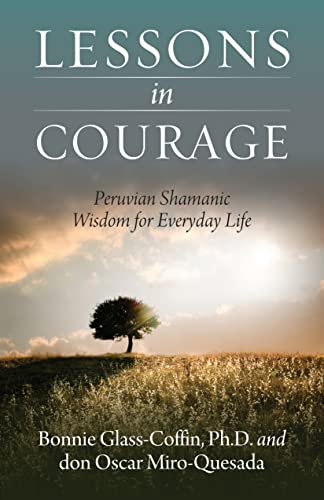
Lessons in Courage: Peruvian Shamanic Wisdom for Everyday Life
Verlag:
Rainbow Ridge Publishing, 2013
ISBN 10: 193790718X
ISBN 13: 9781937907181
Gebraucht
Paperback
Anbieter: World of Books (was SecondSale), Montgomery, IL, USA
Verkäuferbewertung 5 von 5 Sternen

Paperback. Zustand: Good. Buckminster Fuller reminds us, "You never change things by fighting the existing reality. To change something, build a new model that makes the old model obsolete." This book provides just that model, as well as concrete practices for living it. The model is derived from ancient wisdom traditions, modeled on the pulses, cycles, and seasons of our beloved Earth Mother. It deeply grounds the reader in a "this world" spirituality that blends indigenous cosmologies, earth-honoring ritual, and time-tested models for living with modern sensibilities. The proposed text presents the biography of an extraordinary man, who has awakened to his own purpose in life as a servant to conscious evolution for all humanity. His life story, full of adventure, cosmic "interventions," and synchronicity is on par with that of the luminaries documented in these biographies and the time has come for his story to be told. don Oscar's story is also the story of each one of us. The only reason his story has not been told until now is that he was first charged with creating opportunities for others to awaken to their higher purpose through his teachings as part of an oral tradition. Now, after completing his "compacto" (sacred contract) with his Andean teachers and mentors, he has been released from service to tell his story in writing. And it is an extraordinary story, dealing with nothing less than individual, spiritual, and planetary transformation. Artikel-Nr. 00104913500
Gebraucht kaufen
EUR 5,10
Versand gratis
Versand innerhalb von USA
Versand innerhalb von USA
Anzahl: 2 verfügbar
Beispielbild für diese ISBN
Lessons in Courage: Peruvian Shamanic Wisdom for Everyday Life
Verlag:
Rainbow Ridge Publishing, 2013
ISBN 10: 193790718X
ISBN 13: 9781937907181
Gebraucht
Paperback
Anbieter: World of Books (was SecondSale), Montgomery, IL, USA
Verkäuferbewertung 5 von 5 Sternen
Paperback. Zustand: Fair. Buckminster Fuller reminds us, "You never change things by fighting the existing reality. To change something, build a new model that makes the old model obsolete." This book provides just that model, as well as concrete practices for living it. The model is derived from ancient wisdom traditions, modeled on the pulses, cycles, and seasons of our beloved Earth Mother. It deeply grounds the reader in a "this world" spirituality that blends indigenous cosmologies, earth-honoring ritual, and time-tested models for living with modern sensibilities. The proposed text presents the biography of an extraordinary man, who has awakened to his own purpose in life as a servant to conscious evolution for all humanity. His life story, full of adventure, cosmic "interventions," and synchronicity is on par with that of the luminaries documented in these biographies and the time has come for his story to be told. don Oscar's story is also the story of each one of us. The only reason his story has not been told until now is that he was first charged with creating opportunities for others to awaken to their higher purpose through his teachings as part of an oral tradition. Now, after completing his "compacto" (sacred contract) with his Andean teachers and mentors, he has been released from service to tell his story in writing. And it is an extraordinary story, dealing with nothing less than individual, spiritual, and planetary transformation. Artikel-Nr. 00105314916
Gebraucht kaufen
EUR 5,10
Versand gratis
Versand innerhalb von USA
Versand innerhalb von USA
Anzahl: 1 verfügbar
Beispielbild für diese ISBN
Lessons in Courage: Peruvian Shamanic Wisdom for Everyday Life
Verlag:
Rainbow Ridge Publishing, 2025
ISBN 10: 193790718X
ISBN 13: 9781937907181
Gebraucht
Softcover
Anbieter: Wonder Book, Frederick, MD, USA
Verkäuferbewertung 5 von 5 Sternen
Zustand: Good. Good condition. A copy that has been read but remains intact. May contain markings such as bookplates, stamps, limited notes and highlighting, or a few light stains. Artikel-Nr. M03H-01630
Gebraucht kaufen
EUR 6,35
Versand gratis
Versand innerhalb von USA
Versand innerhalb von USA
Anzahl: 1 verfügbar
Beispielbild für diese ISBN
Lessons in Courage: Peruvian Shamanic Wisdom for Everyday Life
Verlag:
Rainbow Ridge Publishing, 2025
ISBN 10: 193790718X
ISBN 13: 9781937907181
Gebraucht
Softcover
Signiert
Anbieter: Wonder Book, Frederick, MD, USA
Verkäuferbewertung 5 von 5 Sternen
Zustand: Fair. Signed Copy . Inscribed by author Don Quesada on the reverse of the front cover. Writing inside. Highlighting inside. Artikel-Nr. W00C-01179
Gebraucht kaufen
EUR 6,35
Versand gratis
Versand innerhalb von USA
Versand innerhalb von USA
Anzahl: 1 verfügbar
Beispielbild für diese ISBN
Lessons in Courage : Peruvian Shamanic Wisdom for Everyday Life
Verlag:
Rainbow Ridge Publishing, 2013
ISBN 10: 193790718X
ISBN 13: 9781937907181
Gebraucht
Softcover
Anbieter: Better World Books, Mishawaka, IN, USA
Verkäuferbewertung 5 von 5 Sternen
Zustand: Good. Former library copy. Pages intact with minimal writing/highlighting. The binding may be loose and creased. Dust jackets/supplements are not included. Includes library markings. Stock photo provided. Product includes identifying sticker. Better World Books: Buy Books. Do Good. Artikel-Nr. 6492199-6
Gebraucht kaufen
EUR 6,49
Versand gratis
Versand innerhalb von USA
Versand innerhalb von USA
Anzahl: 2 verfügbar
Beispielbild für diese ISBN
Lessons in Courage : Peruvian Shamanic Wisdom for Everyday Life
Verlag:
Rainbow Ridge Publishing, 2013
ISBN 10: 193790718X
ISBN 13: 9781937907181
Gebraucht
Softcover
Anbieter: Better World Books: West, Reno, NV, USA
Verkäuferbewertung 5 von 5 Sternen
Zustand: Good. Pages intact with minimal writing/highlighting. The binding may be loose and creased. Dust jackets/supplements are not included. Stock photo provided. Product includes identifying sticker. Better World Books: Buy Books. Do Good. Artikel-Nr. 15763994-6
Gebraucht kaufen
EUR 6,49
Versand gratis
Versand innerhalb von USA
Versand innerhalb von USA
Anzahl: 1 verfügbar
Beispielbild für diese ISBN
Lessons in Courage: Peruvian Shamanic Wisdom for Everyday Life
Anbieter: ThriftBooks-Phoenix, Phoenix, AZ, USA
Verkäuferbewertung 5 von 5 Sternen
Paperback. Zustand: Good. No Jacket. Pages can have notes/highlighting. Spine may show signs of wear. ~ ThriftBooks: Read More, Spend Less. Artikel-Nr. G193790718XI3N00
Gebraucht kaufen
EUR 7,25
Versand gratis
Versand innerhalb von USA
Versand innerhalb von USA
Anzahl: 1 verfügbar
Beispielbild für diese ISBN
Lessons in Courage: Peruvian Shamanic Wisdom for Everyday Life
Anbieter: ThriftBooks-Dallas, Dallas, TX, USA
Verkäuferbewertung 5 von 5 Sternen
Paperback. Zustand: Good. No Jacket. Pages can have notes/highlighting. Spine may show signs of wear. ~ ThriftBooks: Read More, Spend Less. Artikel-Nr. G193790718XI3N00
Gebraucht kaufen
EUR 7,25
Versand gratis
Versand innerhalb von USA
Versand innerhalb von USA
Anzahl: 1 verfügbar
Beispielbild für diese ISBN
Lessons in Courage: Peruvian Shamanic Wisdom for Everyday Life
Anbieter: ThriftBooks-Atlanta, AUSTELL, GA, USA
Verkäuferbewertung 5 von 5 Sternen
Paperback. Zustand: Good. No Jacket. Former library book; Pages can have notes/highlighting. Spine may show signs of wear. ~ ThriftBooks: Read More, Spend Less. Artikel-Nr. G193790718XI3N10
Gebraucht kaufen
EUR 7,25
Versand gratis
Versand innerhalb von USA
Versand innerhalb von USA
Anzahl: 1 verfügbar
Beispielbild für diese ISBN
Lessons in Courage: Peruvian Shamanic Wisdom for Everyday Life
Verlag:
Rainbow Ridge Publishing, 2025
ISBN 10: 193790718X
ISBN 13: 9781937907181
Gebraucht
Paperback
Anbieter: WorldofBooks, Goring-By-Sea, WS, Vereinigtes Königreich
Verkäuferbewertung 5 von 5 Sternen
Paperback. Zustand: Very Good. The book has been read, but is in excellent condition. Pages are intact and not marred by notes or highlighting. The spine remains undamaged. Artikel-Nr. GOR007725406
Gebraucht kaufen
EUR 3,70
EUR 6,53 Versand
Versand von Vereinigtes Königreich nach USA
Versand von Vereinigtes Königreich nach USA
Anzahl: 1 verfügbar