
Verwandte Artikel zu Inside the Hotel Rwanda: The Surprising True Story...
Inhaltsangabe
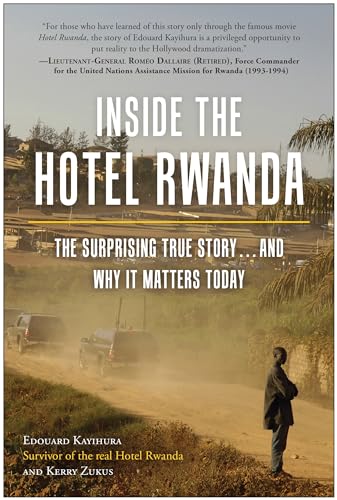
In 2004, the Academy Award–nominated movie Hotel Rwanda lionized hotel manager Paul Rusesabagina for single-handedly saving the lives of all who sought refuge in the Hotel des Mille Collines during Rwanda’s genocide against the Tutsi in 1994. Because of the film, the real-life Rusesabagina has been compared to Oskar Schindler, but unbeknownst to the public, the hotel’s refugees do not endorse Rusesabagina’s version of the events.
In the wake of Hotel Rwanda’s international success, Rusesabagina is one of the most well-known Rwandans and now the smiling face of the very Hutu Power groups who drove the genocide. He is accused by the Rwandan prosecutor general of being a genocide negationist and funding the terrorist group Democratic Forces for the Liberation of Rwanda (FDLR).
For the first time, learn what really happened inside the walls of Hotel des Mille Collines.
In Inside the Hotel Rwanda, survivor Edouard Kayihura tells his own personal story of what life was really like during those harrowing days within the walls of that infamous hotel and offers the testimonies of others who survived there, from Hutu and Tutsi to UN peacekeepers. Kayihura writes of a divided society and his journey to the place he believed would be safe from slaughter.
The book exposes the Hollywood hero of the film Hotel Rwanda, Paul Rusesabagina, as a profiteering and politically ambitious Hutu Power sympathizer who extorted money from those who sought refuge, threatening to send those who did not pay to the génocidaires, despite pleas from the hotel’s corporate ownership to stop.
Inside the Hotel Rwanda is at once a memoir, a critical deconstruction of a heralded Hollywood movie alleged to be factual, and a political analysis aimed at exposing a falsely created hero using his fame to be a political force, spouting the same ethnic apartheid that caused the genocide two decades ago.
Kayihura’s Inside the Hotel Rwanda offers an honest and unflinching first-hand account of the reality of life inside the hotel, exposing the man who exploited refugees and shedding much-needed light on the plight of his victims.
In the wake of Hotel Rwanda’s international success, Rusesabagina is one of the most well-known Rwandans and now the smiling face of the very Hutu Power groups who drove the genocide. He is accused by the Rwandan prosecutor general of being a genocide negationist and funding the terrorist group Democratic Forces for the Liberation of Rwanda (FDLR).
For the first time, learn what really happened inside the walls of Hotel des Mille Collines.
In Inside the Hotel Rwanda, survivor Edouard Kayihura tells his own personal story of what life was really like during those harrowing days within the walls of that infamous hotel and offers the testimonies of others who survived there, from Hutu and Tutsi to UN peacekeepers. Kayihura writes of a divided society and his journey to the place he believed would be safe from slaughter.
The book exposes the Hollywood hero of the film Hotel Rwanda, Paul Rusesabagina, as a profiteering and politically ambitious Hutu Power sympathizer who extorted money from those who sought refuge, threatening to send those who did not pay to the génocidaires, despite pleas from the hotel’s corporate ownership to stop.
Inside the Hotel Rwanda is at once a memoir, a critical deconstruction of a heralded Hollywood movie alleged to be factual, and a political analysis aimed at exposing a falsely created hero using his fame to be a political force, spouting the same ethnic apartheid that caused the genocide two decades ago.
Kayihura’s Inside the Hotel Rwanda offers an honest and unflinching first-hand account of the reality of life inside the hotel, exposing the man who exploited refugees and shedding much-needed light on the plight of his victims.
Die Inhaltsangabe kann sich auf eine andere Ausgabe dieses Titels beziehen.
Über die Autorin bzw. den Autor
Edouard Kayihura is a human rights activist and survivor of the genocide against the Tutsi in Rwanda, during which, he spent 100 days as a refugee in the Hotel des Mille Collines a.k.a. ”Hotel Rwanda." Before he moved to the United States, he was the prosecutor in charge of the department of the prosecutions of the genocide crime and crimes against humanity before the Tribunal of the First Instance of Kigali. He was also executive secretary and legal representative of Kanyarwanda Human Rights. He speaks at different schools and universities in the states about his experience; Transitional Justice and Reconciliation; and Genocide denial. He is the member of the International Association of Genocide Scholars.
Kerry Zukus’s debut novel, The Fourth House, was a Featured Selection of the Book of the Month Club®, the Doubleday Book Club©, and the Literary Guild©, divisions of Random House/Doubleday Entertainment, where it sold out its first two printings. The Fourth House had previously been named a finalist for the prestigious James Jones Award, annually given to the best first novel by an American author.
Zukus has worked invisibly behind the scenes for years, ghostwriting numerous books in a wide variety of genres. Zukus' short stories, essays and articles have graced a variety of magazines and periodicals. His plays have appeared at theatres across the country.
Kerry Zukus’s debut novel, The Fourth House, was a Featured Selection of the Book of the Month Club®, the Doubleday Book Club©, and the Literary Guild©, divisions of Random House/Doubleday Entertainment, where it sold out its first two printings. The Fourth House had previously been named a finalist for the prestigious James Jones Award, annually given to the best first novel by an American author.
Zukus has worked invisibly behind the scenes for years, ghostwriting numerous books in a wide variety of genres. Zukus' short stories, essays and articles have graced a variety of magazines and periodicals. His plays have appeared at theatres across the country.
Auszug. © Genehmigter Nachdruck. Alle Rechte vorbehalten.
Inside the Hotel Rwanda
The Surprising True Story ... and Why It Matters Today
By Edouard Kayihura, Kerry ZukusBenBella Books, Inc.
Copyright © 2014 Edouard Kayihura and Kerry Zukus
All rights reserved.
ISBN: 978-1-937856-74-8All rights reserved.
Contents
Foreword,
Glossary of Organizations and Terms,
Introduction,
1 Divide and Rule,
2 The Night the Fuse Was Lit,
3 Shelter Inside a Wall,
4 Dodging Machetes,
5 Thank God I Will Die with Other People,
6 Sanctuary,
7 Why??,
8 Brother Versus Brother,
9 Protectors in Baby-Blue Helmets,
10 And Then Everything Changed,
11 Cut Off,
12 Beer and Killers,
13 Like Nixon to China,
14 To Profit from the Walking Dead,
15 Names, Numbers, Collaborators, and Betrayers,
16 Hostages,
17 The Barter of Bodies,
18 Kabuga,
19 Return to the Moonscape,
20 Justice and Rebuilding,
21 Hollywood,
22 The Freedom to Become His Real Self,
23 President Rusesabagina?,
24 Rwanda Today,
Acknowledgments,
About the Authors,
Index,
CHAPTER 1
DIVIDE AND RULE
I WAS BORN IN 1965 and raised in Gitesi Commune, Kibuye Prefecture, which is today referred to as the district of Karongi in the Western Province of Rwanda. Gitesi is an attractive city on the eastern shore of Lake Kivu, well known because of the beauty of its landscape, the sparkles of its waves, and the lushness of its islands. I grew up in a family of seven children — three sisters, three brothers, and me. I was baby number six. My family lived much the same as the average Rwandan family of the day. We were subsistence farmers. Corn, beans, peas, and potatoes or sweet potatoes were our daily main meal.
There was never a time in my life when ethnicity was not a dominant part of my existence, or the existence of any Rwandan of my generation. All Rwandans were mandated to carry a national ID card with them at all times. The most important piece of data on the card consisted of three words: Hutu, Tutsi, or Twa — the three native ethnic groups of our land. Two of the three words were crossed out. The one word remaining defined your total experience in Rwanda, much like a caste system, though, during my lifetime, far more evil. This, I had no choice but to accept. The sorts of tactics Hitler had used, with his various colored cloth badges sewn onto the clothing of citizens his Third Reich viewed unfavorably, had always been a part of my daily living. I knew no other way.
The Twa were the first indigenous people of Rwanda. Better known to the world as "pygmies," they are the least numerous in terms of population, and politically, they have been dealt with indifferently on the whole.
It has been said that the Hutu and the Tutsi of Rwanda are different ethnic groups, yet even something as simple and basic as this is open to debate. The physical differences between the two are often negligible due to generations of intermarriage. They also share a common language. There are no significant or relevant religious differences. Gerald DeGroot, a professor of history at the University of St. Andrews, wrote in the April 28, 2008, Christian Science Monitor, "those labels, 'Tutsi' and 'Hutu,' were meant to define the number of cows a family owned" — nothing more, despite anthropological theories that they were, indeed, different tribes. "During [Rwanda's] colonial period [particularly after World War I], the Belgians turned those otherwise fluid divisions into rigid ethnic identities as part of a strategy of divide and rule." Unfortunately, the "divide and rule" attitude continued even after the Europeans were gone, but DeGroot's basic premise, repeated by many other Western academics, is questioned by us Rwandans. I asked people older than me about it and none confirmed this theory about cows. During much of Rwanda's history, Tutsi lived by their cows, while Hutu tended to farm. But no one ever said those who had cows were Tutsi and those without cows became Hutu. To be Tutsi or Hutu was a designation given at birth based on your father's ethnicity.
According to a 1991 census, Rwanda was 90 percent Hutu, 9 percent Tutsi, and 1 percent Twa. I am Tutsi. Thus, I spent my entire life as a minority; and worse yet, because of when I lived during my formative years in Rwanda, I was part of an oppressed minority.
During my lifetime, a culture of strategic disenfranchisement and dehumanization was entrenched among our nation's leaders, even down to our schoolteachers. As children in school, we Tutsi were asked to stand up separately, while the Hutu were sitting down. Or Hutu were asked to stand up while the Tutsi were told to stay down. While this did not cause anyone physical harm, it followed the classic pattern of how genocide breeds. Step one is classification: "us" versus "them." In my native Rwanda, I was "them."
In 1962, a few years prior to my birth, Rwanda became an independent nation, no longer a colony of Belgium. Just like in America, the 1960s were a time of social revolution in my country, though I was far too young to comprehend it. Beginning in 1959 and continuing throughout my lifetime, unrest between Hutu and Tutsi was a major part of our rebirth as a nation ruled solely by Rwandans. That year, 1959, marked the real beginning of upheaval, the throwing off of the shackles of Belgian colonialism, which finally culminated in full Rwandan independence in 1962. But a large portion of the rallying cry among the Hutu in our nation was that, in their opinion, the Tutsi were seen as an extension of the Belgians, and in freeing themselves of Belgium, Hutu had to take out their frustrations on all Tutsi. This was the wreckage of the Belgian-sponsored ethnic divisionism and its Indialike caste system imposed upon us. Belgians could return to their own nation unscathed, but we Tutsi unfairly bore the full brunt of Hutu fury.
We Tutsi suffered greatly during those days. Some Tutsi were killed, while others were driven out of the land of their birth. Still others left voluntarily, hoping to keep one step ahead of those who would mean them harm. Because I was so young, whatever I came to discover about this time I learned from schools or from what I was told by my parents. Some of my father's family was killed during those days, while others fled to Congo — later known as Zaire, and later still known as the Democratic Republic of the Congo — but I never got to know them.
I witnessed true violence against my family for the first time at the age of eight. It was in 1973 and I was in the third grade. We had early release from school, and our teachers didn't tell us why we had to leave early.
When we arrived home, all the Tutsi men had gathered together to protect their homes. Women and children were asked to go hide in the bushes. Some men gathered on the nearby hill of Gitwa to watch assailants coming from far away toward our neighborhood. That is one of the things that stuck in my childhood memory — that the really bad people who meant us the most harm were strangers to us, rather than the people we saw every day. Our closest neighbors, the Hutu who lived in the same village with us, were less violent toward us. Perhaps that is what happens once people actually get to know one another.
A group of Hutu armed with machetes and spears overran our village. The Tutsi men soon went into the bushes when they saw the attack was so overwhelming and cruel that they could not put up adequate resistance. All night we could only see the...
„Über diesen Titel“ kann sich auf eine andere Ausgabe dieses Titels beziehen.
Suchergebnisse für Inside the Hotel Rwanda: The Surprising True Story...

Beispielbild für diese ISBN
Inside the Hotel Rwanda: The Surprising True Story . and Why It Matters Today
Anbieter: World of Books (was SecondSale), Montgomery, IL, USA
Verkäuferbewertung 5 von 5 Sternen

Hardback. Zustand: Good. In 2004, the Academy Award-nominated movie Hotel Rwanda lionized hotel manager Paul Rusesabagina for single-handedly saving the lives of all who sought refuge in the Hotel des Mille Collines during Rwanda's genocide against the Tutsi in 1994. Because of the film, the real-life Rusesabagina has been compared to Oskar Schindler, but unbeknownst to the public, the hotel's refugees do not endorse Rusesabagina's version of the events. In the wake of Hotel Rwanda's international success, Rusesabagina is one of the most well-known Rwandans and now the smiling face of the very Hutu Power groups who drove the genocide. He is accused by the Rwandan prosecutor general of being a genocide negationist and funding the terrorist group Democratic Forces for the Liberation of Rwanda (FDLR). For the first time, learn what really happened inside the walls of Hotel des Mille Collines. In Inside the Hotel Rwanda, survivor Edouard Kayihura tells his own personal story of what life was really like during those harrowing days within the walls of that infamous hotel and offers the testimonies of others who survived there, from Hutu and Tutsi to UN peacekeepers. Kayihura writes of a divided society and his journey to the place he believed would be safe from slaughter. The book exposes the Hollywood hero of the film Hotel Rwanda, Paul Rusesabagina, as a profiteering and politically ambitious Hutu Power sympathizer who extorted money from those who sought refuge, threatening to send those who did not pay to the g nocidaires, despite pleas from the hotel's corporate ownership to stop. Inside the Hotel Rwanda is at once a memoir, a critical deconstruction of a heralded Hollywood movie alleged to be factual, and a political analysis aimed at exposing a falsely created hero using his fame to be a political force, spouting the same ethnic apartheid that caused the genocide two decades ago. Kayihura's Inside the Hotel Rwanda offers an honest and unflinching first-hand account of the reality of life inside the hotel, exposing the man who exploited refugees and shedding much-needed light on the plight of his victims. Artikel-Nr. 00110529586
Gebraucht kaufen
EUR 5,78
Versand gratis
Versand innerhalb von USA
Versand innerhalb von USA
Anzahl: 1 verfügbar
Beispielbild für diese ISBN
Inside the Hotel Rwanda: The Surprising True Story . and Why It Matters Today
Anbieter: ThriftBooks-Dallas, Dallas, TX, USA
Verkäuferbewertung 5 von 5 Sternen
Hardcover. Zustand: Very Good. No Jacket. Former library book; May have limited writing in cover pages. Pages are unmarked. ~ ThriftBooks: Read More, Spend Less. Artikel-Nr. G1937856747I4N10
Gebraucht kaufen
EUR 9,42
Versand gratis
Versand innerhalb von USA
Versand innerhalb von USA
Anzahl: 1 verfügbar
Beispielbild für diese ISBN
Inside the Hotel Rwanda: The Surprising True Story . and Why It Matters Today
Anbieter: ThriftBooks-Atlanta, AUSTELL, GA, USA
Verkäuferbewertung 5 von 5 Sternen
Hardcover. Zustand: Good. No Jacket. Missing dust jacket; Pages can have notes/highlighting. Spine may show signs of wear. ~ ThriftBooks: Read More, Spend Less. Artikel-Nr. G1937856747I3N01
Gebraucht kaufen
EUR 9,42
Versand gratis
Versand innerhalb von USA
Versand innerhalb von USA
Anzahl: 1 verfügbar
Foto des Verkäufers
Inside the Hotel Rwanda: The Surprising True Story . and Why It Matters Today
Verlag:
Benbella Books, 2014
ISBN 10: 1937856747
ISBN 13: 9781937856748
Gebraucht
Hardcover
Signiert
Anbieter: ThriftBooksVintage, Tukwila, WA, USA
Verkäuferbewertung 5 von 5 Sternen
Hardcover. Zustand: Very Good. No Jacket. SIGNED and inscribed by the author. Minor shelf and handling wear, overall a clean solid copy with minimal signs of use. Secure packaging for safe delivery. signed and inscribed by author. Artikel-Nr. 3576807407
Gebraucht kaufen
EUR 20,89
Versand gratis
Versand innerhalb von USA
Versand innerhalb von USA
Anzahl: 1 verfügbar
Beispielbild für diese ISBN
Inside the Hotel Rwanda: The Surprising True Story . and Why It Matters Today
Anbieter: WorldofBooks, Goring-By-Sea, WS, Vereinigtes Königreich
Verkäuferbewertung 5 von 5 Sternen
Paperback. Zustand: Very Good. The book has been read, but is in excellent condition. Pages are intact and not marred by notes or highlighting. The spine remains undamaged. Artikel-Nr. GOR008663389
Gebraucht kaufen
EUR 18,39
EUR 6,53 Versand
Versand von Vereinigtes Königreich nach USA
Versand von Vereinigtes Königreich nach USA
Anzahl: 1 verfügbar
Beispielbild für diese ISBN
Inside the Hotel Rwanda: The Surprising True Story . and Why It Matters Today
Anbieter: Revaluation Books, Exeter, Vereinigtes Königreich
Verkäuferbewertung 5 von 5 Sternen
Hardcover. Zustand: Brand New. 240 pages. 8.50x5.75x1.25 inches. In Stock. Artikel-Nr. 1937856747
Neu kaufen
EUR 72,67
EUR 11,67 Versand
Versand von Vereinigtes Königreich nach USA
Versand von Vereinigtes Königreich nach USA
Anzahl: 1 verfügbar