
Verwandte Artikel zu Math for Life: Crucial Ideas You Didn't Learn in...
Inhaltsangabe
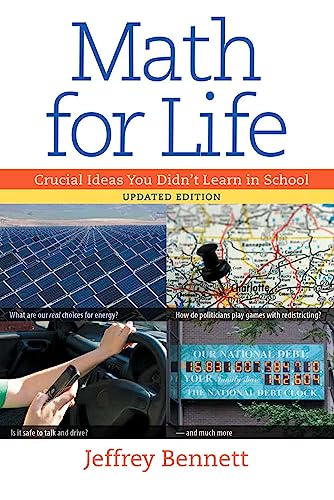
How can we solve the national debt crisis? Should you or your child take on a student loan? Is it safe to talk on a cell phone while driving? Are there viable energy alternatives to fossil fuels? What could you do with a billion dollars? Could simple policy changes reduce political polarization? These questions may all seem very different, but they share two things in common. First, they are all questions with important implications for either personal success or our success as a nation. Second, they all concern topics that we can fully understand only with the aid of clear quantitative or mathematical thinking. In other words, they are topics for which we need math for life'a kind of math that looks quite different from most of the math that we learn in school, but that is just as (and often more) important. In Math for Life, award-winning author Jeffrey Bennett simply and clearly explains the key ideas of quantitative reasoning and applies them to all the above questions and many more. He also uses these questions to analyze our current education system, identifying both shortfalls in the teaching of mathematics and solutions for our educational future. No matter what your own level of mathematical ability, and no matter whether you approach the book as an educator, student, or interested adult, you are sure to find something new and thought-provoking in Math for Life.
Die Inhaltsangabe kann sich auf eine andere Ausgabe dieses Titels beziehen.
Über die Autorin bzw. den Autor
Jeffrey Bennett is an astrophysicist and educator who proposed the idea for and helped develop the Voyage Scale Model Solar System'the first science-oriented exhibit approved for permanent installation on the National Mall in Washington, DC. He is the lead author of college textbooks in four subjects'astronomy, astrobiology, mathematics, and statistics'and has written critically acclaimed books for the general public including Beyond UFOs and On the Cosmic Horizon. He is also the author of children's books, including those in the Science Adventures with Max the Dog series and The Wizard Who Saved the World. He lives in Boulder, Colorado.
Auszug. © Genehmigter Nachdruck. Alle Rechte vorbehalten.
Math for Life
Crucial Ideas You Didn't Learn in School
By Jeffrey Bennett, Joan Marsh, Lynn GolbetzBig Kid Science
Copyright © 2014 Jeffrey Bennett
All rights reserved.
ISBN: 978-1-937548-36-0All rights reserved.
Contents
Preface,
1 (Don't Be) "Bad at Math",
2 Thinking with Numbers,
3 Statistical Thinking,
4 Managing Your Money,
5 Understanding Taxes,
6 The U.S. Deficit and Debt,
7 Energy Math,
8 The Math of Political Polarization,
9 The Mathematics of Growth,
Epilogue: Getting "Good at Math",
To Learn More,
Acknowledgments,
Also by Jeffrey Bennett,
Index,
Index of Examples,
CHAPTER 1
(Don't Be) "Bad at Math"
Nothing in life is to be feared. It is only to be understood.
— Marie Curie
Equations are just the boring part of mathematics.
— Stephen Hawking
Let's start with a multiple-choice question.
Question: Imagine that you're at a party, and you've just struck up a conversation with a dynamic, successful businesswoman. Which of the following are you most likely to hear her say during the course of your conversation?
Answer choices:
a. "I really don't know how to read very well."
b. "I can't write a grammatically correct sentence."
c. "I'm awful at dealing with people."
d. "I've never been able to think logically."
e. "I'm bad at math."
We all know that the answer is E, because we've heard it so many times. Not just from businesswomen and businessmen, but from actors and athletes, construction workers and sales clerks, and sometimes even teachers and CEOs. Somehow, we have come to live in a society in which many otherwise successful people not only have a problem with mathematics but are unafraid to admit it. In fact, it's sometimes stated almost as a point of pride, with little hint of embarrassment.
It doesn't take a lot of thought to realize that this creates major problems. Mathematics underlies nearly everything in modern society, from the daily financial decisions that all of us must make to the way in which we understand and approach global issues of the economy, politics, and science. We cannot possibly hope to act wisely if we don't have the ability to think critically about mathematical ideas.
This fact takes us immediately to one of the main themes of this book. Look again at our opening multiple-choice question. It would be difficult to imagine the successful businesswoman admitting to any of choices A through D, even if they were true, because all would be considered marks of ignorance and shame. I hope to convince you that choice E should be equally unacceptable. Through numerous examples, I will show you ways in which being "bad at math" is exacting a high toll on individuals, on our nation, and on our world. Along the way, I'll try to offer insights into how we can learn to make better decisions about mathematically based issues. I hope the book will thereby be of use to everyone, but it's especially directed at those of you who might currently think of yourselves as "bad at math." With luck, by the time you finish reading, you'll have a very different perspective both on the importance of mathematics and on your own ability to understand it.
Of course, I can't turn you into a mathematician in a couple hundred pages, and a quick scan of the book should relieve you of any fear that I'm expecting you to repeat the kinds of equation solving that you may remember from past math classes. Instead, this book contains a type of math that you actually need for life in the modern world, but which you probably were never taught before.
Best of all, this is a type of mathematics that anyone can learn. You don't have to be a whiz at calculations, or know how to solve calculus equations. You don't need to remember the quadratic formula, or most of the other facts that you were expected to memorize in high school algebra. All you need to do is open your mind to new ways of thinking that will enable you to reason as clearly with numbers and ideas of mathematics as you do without them.
The Math Recession
For our first example, let's consider the recent Great Recession, which left millions of people unemployed, stripped millions of others of much of their life savings, and pushed the global financial system so close to collapse that governments came in with hundreds of billions of dollars in bailout funds. The clear trigger for the recession was the popping of the real estate bubble, which ignited a mortgage crisis. But what created the bubble that popped? I believe a large part of the answer can be traced to poor mathematical thinking.
Take a look at Figure 1, which shows one way of looking at home prices during the past few decades. The bump starting in 2001 represents the housing price bubble. Let's use some quantitative reasoning to see why it should have been obvious that the bubble was not sustainable.
Here's how to think about it. As its title indicates, the graph shows the ratio of the average (median) home price to the average income. For example, if the average household income were $50,000 per year, then a ratio of 3.0 would mean that the average home price was three times the average income, or $150,000. The graph shows that the average ratio for the three decades prior to the start of the bubble was actually about 3.2, which means someone with an income of $50,000 typically purchased a house costing about $160,000 (which you find by multiplying 3.2 by $50,000).
Now look at what happened during the housing bubble. After increasing modestly in the 1990s, the ratio began shooting upward in 2001, reaching a peak of about 4.7 in 2005. This was nearly a 50% increase from the historical average of 3.2, which means that relative to income, the average home was about 50% more expensive in 2005 than it was before the bubble. In other words, a family that previously would have bought a house costing $160,000 was instead buying one that cost nearly $240,000.
With homes so much more expensive relative to income, families had to spend a higher percentage of their income on them. In general, a family can spend a higher percentage of its income on housing only if some combination of the following three things happens: (1) its income increases; (2) it cuts expenses in other areas; or (3) it borrows more money. Other statistics showed clearly that average income was not rising significantly, and that while homeowners gained some benefit from relatively low mortgage interest rates, overall consumer spending actually increased. We are therefore left with the third possibility: that the housing bubble was fueled primarily by borrowing. With little prospect that incomes would rise dramatically in the future, it was inevitable that this borrowing would be unaffordable and that loan defaults and foreclosures would follow. The only way to restore equilibrium to the system was for home prices to fall dramatically.
Lest you think that this is a case of hindsight being 20/20, keep in mind that these kinds of data were available throughout the growth of the bubble. Anyone willing to think about it should therefore have known that the bubble would inevitably pop, and, indeed, you can find many articles from the time that pointed out this obvious fact. So how did everyone else manage to miss it?
Although it's tempting to blame the problem on a failure of "the system," it was ultimately the result of millions of...
„Über diesen Titel“ kann sich auf eine andere Ausgabe dieses Titels beziehen.
Weitere beliebte Ausgaben desselben Titels

Suchergebnisse für Math for Life: Crucial Ideas You Didn't Learn in...

Beispielbild für diese ISBN
Math for Life: Crucial Ideas You Didn't Learn in School
Verlag:
Big Kid Science (edition Updated), 2013
ISBN 10: 1937548368
ISBN 13: 9781937548360
Gebraucht
Hardcover
Anbieter: BooksRun, Philadelphia, PA, USA
Verkäuferbewertung 5 von 5 Sternen

Hardcover. Zustand: Very Good. Updated. With dust jacket. It's a well-cared-for item that has seen limited use. The item may show minor signs of wear. All the text is legible, with all pages included. It may have slight markings and/or highlighting. Artikel-Nr. 1937548368-11-1-29
Gebraucht kaufen
EUR 10,31
Versand gratis
Versand innerhalb von USA
Versand innerhalb von USA
Anzahl: 1 verfügbar
Beispielbild für diese ISBN
Math for Life: Crucial Ideas You Didn't Learn in School
Anbieter: ThriftBooks-Atlanta, AUSTELL, GA, USA
Verkäuferbewertung 5 von 5 Sternen
Hardcover. Zustand: Good. No Jacket. Pages can have notes/highlighting. Spine may show signs of wear. ~ ThriftBooks: Read More, Spend Less. Artikel-Nr. G1937548368I3N00
Gebraucht kaufen
EUR 14,82
Versand gratis
Versand innerhalb von USA
Versand innerhalb von USA
Anzahl: 1 verfügbar
Beispielbild für diese ISBN
Math for Life: Crucial Ideas You Didn't Learn in School
Anbieter: ThriftBooks-Dallas, Dallas, TX, USA
Verkäuferbewertung 5 von 5 Sternen
Hardcover. Zustand: Good. No Jacket. Pages can have notes/highlighting. Spine may show signs of wear. ~ ThriftBooks: Read More, Spend Less. Artikel-Nr. G1937548368I3N00
Gebraucht kaufen
EUR 14,82
Versand gratis
Versand innerhalb von USA
Versand innerhalb von USA
Anzahl: 1 verfügbar
Beispielbild für diese ISBN
Math for Life: Crucial Ideas You Didn't Learn in School
Anbieter: ThriftBooks-Dallas, Dallas, TX, USA
Verkäuferbewertung 5 von 5 Sternen
Hardcover. Zustand: Good. No Jacket. Former library book; Pages can have notes/highlighting. Spine may show signs of wear. ~ ThriftBooks: Read More, Spend Less. Artikel-Nr. G1937548368I3N10
Gebraucht kaufen
EUR 14,82
Versand gratis
Versand innerhalb von USA
Versand innerhalb von USA
Anzahl: 1 verfügbar
Beispielbild für diese ISBN
Math for Life: Crucial Ideas You Didn't Learn in School
Anbieter: ThriftBooks-Atlanta, AUSTELL, GA, USA
Verkäuferbewertung 5 von 5 Sternen
Hardcover. Zustand: Very Good. No Jacket. Missing dust jacket; May have limited writing in cover pages. Pages are unmarked. ~ ThriftBooks: Read More, Spend Less. Artikel-Nr. G1937548368I4N01
Gebraucht kaufen
EUR 14,82
Versand gratis
Versand innerhalb von USA
Versand innerhalb von USA
Anzahl: 1 verfügbar
Beispielbild für diese ISBN
Math for Life: Crucial Ideas You Didn't Learn in School
Anbieter: ThriftBooks-Dallas, Dallas, TX, USA
Verkäuferbewertung 5 von 5 Sternen
Hardcover. Zustand: Fair. No Jacket. Readable copy. Pages may have considerable notes/highlighting. ~ ThriftBooks: Read More, Spend Less. Artikel-Nr. G1937548368I5N00
Gebraucht kaufen
EUR 14,82
Versand gratis
Versand innerhalb von USA
Versand innerhalb von USA
Anzahl: 1 verfügbar
Beispielbild für diese ISBN
Math for Life
Anbieter: Majestic Books, Hounslow, Vereinigtes Königreich
Verkäuferbewertung 4 von 5 Sternen

Zustand: New. pp. 216. Artikel-Nr. 53949468
Neu kaufen
EUR 21,58
EUR 7,61 Versand
Versand von Vereinigtes Königreich nach USA
Versand von Vereinigtes Königreich nach USA
Anzahl: 1 verfügbar
Beispielbild für diese ISBN
Math for Life: Crucial Ideas You Didn t Learn in School
Anbieter: Kennys Bookstore, Olney, MD, USA
Verkäuferbewertung 5 von 5 Sternen
Zustand: New. Num Pages: 216 pages. BIC Classification: PB. Category: (G) General (US: Trade). Dimension: 237 x 151 x 19. Weight in Grams: 452. . 2013. Updated. Hardcover. . . . . Books ship from the US and Ireland. Artikel-Nr. V9781937548360
Neu kaufen
EUR 32,64
EUR 9,09 Versand
Versand innerhalb von USA
Versand innerhalb von USA
Anzahl: Mehr als 20 verfügbar
Beispielbild für diese ISBN
Math for Life: Crucial Ideas You Didn't Learn in School
Anbieter: Revaluation Books, Exeter, Vereinigtes Königreich
Verkäuferbewertung 5 von 5 Sternen
Hardcover. Zustand: Brand New. updated edition. 211 pages. 9.00x6.25x1.00 inches. In Stock. Artikel-Nr. 1937548368
Neu kaufen
EUR 43,17
EUR 11,70 Versand
Versand von Vereinigtes Königreich nach USA
Versand von Vereinigtes Königreich nach USA
Anzahl: 1 verfügbar
Foto des Verkäufers
Math for Life
Anbieter: moluna, Greven, Deutschland
Verkäuferbewertung 5 von 5 Sternen
Gebunden. Zustand: New. KlappentextrnrnHow can we solve the national debt crisis? Should you or your child take on a student loan? Is it safe to talk on a cell phone while driving? Are there viable energy alternatives to fossil fuels? What could you do with a billion d. Artikel-Nr. 597269561
Neu kaufen
EUR 29,21
EUR 48,99 Versand
Versand von Deutschland nach USA
Versand von Deutschland nach USA
Anzahl: Mehr als 20 verfügbar