
Verwandte Artikel zu Lederer on Language: A Celebration of English, Good...
Inhaltsangabe
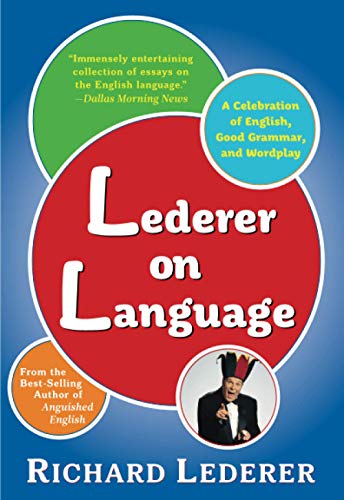
In this wide-ranging collection of essays, Richard Lederer offers readers more of the irrepressible wordplay and linguistic high jinks his fans can't get enough of, along with observations on a life in letters. From an inner-city classroom to a wordy weekend retreat, from centuries-old etymological legacies to the latest in slang, dialects, and fadspeak, these essays transport, inform, and entertain as only Lederer can. The book includes more than 30 chapters, such as A Declaration of Linguistic Independence, Our Uppity English Language, Etymological Snapshots, and Jest for the Pun of It.
Die Inhaltsangabe kann sich auf eine andere Ausgabe dieses Titels beziehen.
Über die Autorin bzw. den Autor
Richard Lederer is a former teacher who taught English and media for 27 years and has been named International Punster of the Year and Toastmasters International's Golden Gavel winner. He is the author of more than 35 books, including Anguished English, Crazy English, Get Thee to a Punnery, The Gift of Age, and More Anguished English. He lives in San Diego.
Auszug. © Genehmigter Nachdruck. Alle Rechte vorbehalten.
Lederer on Language
A Celebration of English, Good Grammar, and Wordplay
By Richard LedererMarion Street Press
Copyright © 2013 Richard Lederer
All rights reserved.
ISBN: 978-1-936863-13-6All rights reserved.
Contents
Acknowledgments,
Introduction: Confessions of a Verbivore,
A CELEBRATION OF ENGLISH,
Our Abounding English Language,
Doing a Number on English,
A Guide to Britspeak, A to Zed,
THIS AMERICAN LANGUAGE,
A Declaration of Language Independence,
Talking Turkey,
All-American Dialects,
Slang As It Is Slung,
A Circus of Words,
Words from Our Presidents,
Stamp Out Fadspeak!,
Like, What's Happening to Our Language?,
THE GLAMOUR OF GRAMMAR,
Conan the Grammarian,
Laying Down the Law — Without Lying Down on the Job,
Sex and the Singular Pronoun,
An Open Letter to Ann Landers,
SPELLBOUND,
Under a Spell,
I Before E, Except? ...,
Fairly Familiar Phrases,
GETTING THE WORD OUT,
Writing Is ...,
How I Write,
Plane Talk,
Radio Days,
English with a Russian Dressing,
THE COLLIDE-O-SCOPE OF LANGUAGE,
How Wise Is Proverbial Wisdom?,
Words That Never Stray,
Heads Without Tails,
Our Uppity English Language,
On Palindromes,
The Long and the Short of English,
THE ROMANCE OF WORDS,
Toothsome Etymologies,
Haunted Words,
My Kids the Poker Players,
On Paradox,
A Primer of Political Words,
The True Meanings of Christmas,
Literature Lives!,
IT'S A PUNDERFUL LIFE,
Jest for the Pun of It,
Pun Your Way to Success,
Nothing Works for Me,
A Bilingual Pun is Twice the Fun,
My Favorite Monsters,
Answers to Quizzes and Games,
CHAPTER 1
Our Abounding English Language
The other day I went to the bookstore to buy a dictionary. The clerk showed me a really cheap one. I couldn't find the words to thank her.
Then she directed me to a thesaurus. I thought that was an accommodating, altruistic, benevolent, caring, compassionate, considerate, courteous, decent, empathic, gracious, kind, magnanimous, nice, obliging, outreaching, solicitous, sweet, sympathetic, and thoughtful thing to do.
The multitudinous choice of words in English offers both a delightful and daunting challenge to native and nonnative speakers. In William Styron's Sophie's Choice, the heroine, Polish-born Sophie, expresses mock horror at the infinite variety of English words:
"Such a language! ... Too many words. I mean just the word for velocite. I mean fast. Rapid. Quick. All the same thing! A scandal!"
"Swift?" I added.
"How about speedy?" Nathan asked.
"Hasty?" I went on.
"And fleet?" Nathan said. "Though that's a bit fancy."
"Stop it!" Sophie said, laughing." Too much! Too many words, this English. In French it is so simple. You just say vite."
You should not be aghast, amazed, appalled, astonished, astounded, bewildered, blown away, boggled, bowled over, bumfuzzled, caught off base, confounded, dumbfounded, electrified, flabbergasted, floored, flummoxed, overwhelmed, shocked, startled, stunned, stupefied, surprised, taken aback, thrown, or thunderstruck by this o'erflowing cornucopia of synonyms in our marvelous language.
English boasts by far the largest number of words of all languages, 616,500 officially enshrined in the Oxford English Dictionary. That's almost four times the vocabulary size of its nearest competitor, German; five times the size of Russian, in third place; and six times the size of Spanish and French, tied for fourth. As a result, English possesses a plethora of synonyms that allow greater nuances of meaning than are available in other tongues.
A much-lauded-and-applauded New Yorker cartoon puckishly celebrated our linguistic treasure trove. The cartoon's caption read: "Roget's Brontosaurus," and pictured was a big dinosaur in whose thought bubble appeared: "Large, great, huge, considerable, bulky, voluminous, ample, massive, capacious, spacious, mighty, towering, monstrous . ..." If not for the finite capacity of thought bubbles, the artist could have added: "big, Brobdingnagian, colossal, enormous, gargantuan, gigantic, grand, hefty, hulking, humongous, husky, immense, jumbo, leviathan, looming, lumbering, mammoth, mountainous, ponderous, prodigious, sizable, substantial, tremendous, vast, weighty, whopping."
Such a cartoon would be far less likely to appear in a magazine printed in a language other than English. Books like Roget's Thesaurus are foreign to speakers of most other languages. Given the scope of their vocabularies, they have little need of them.
I hesitate to conclude this song of praise to the glories of English with dark news. But I regret to inform you that yesterday, a senior editor of Roget's Thesaurus assumed room temperature, bit the dust, bought the farm, breathed his last, came to the end of the road, cashed in his chips, cooled off, croaked, deep sixed, expired, gave up the ghost, headed for the hearse, headed for the last roundup, kicked off, kicked the bucket, lay down one last time, lay with the lilies, left this mortal plain, met his maker, met Mr. Jordan, passed away, passed in his checks, passed on, perished, permanently changed his address, pulled the plug, pushed up daisies, returned to dust, slipped his cable, slipped his mortal coil, sprouted wings, took the dirt nap, took the long count, pegged out, traveled to kingdom come, turned up his toes, went across the creek, went belly up, went to glory, went the way of all flesh, went to his final reward, went west — and, of course, he died.
CHAPTER 2Doing a Number on English
For those who think that our civilization is obsessed with time, the Concise Oxford English Dictionary recently added support to that theory by announcing that the word time is the most often-used noun in the English language. The dictionary relied on the Oxford English Corpus — a research project into English in the twenty-first century — to come up with the lists.
The Oxford English Corpus gives us the fullest, most accurate picture of the language today. It represents all types of English, from literary novels and specialist journals to everyday newspapers and magazines to the language of chatrooms, e-mails, and Weblogs. And, as English is a global language, used by an estimated one third of the world's population, the Oxford Corpus contains language from all parts of the world — not only from the United Kingdom and the United States, but also from Australia, the Caribbean, Canada, India, Singapore, and South Africa. It is the largest English corpus of its type — the most representative slice of the English language available.
According to the Corpus, the is the most commonly used word overall, followed by be, to, of, and, a, in, that, have, and I. Typical of such frequency lists, the most used words are hardworking function words that hold sentences together. The study also reveals that these ten words and their variations account for 25 percent of all written content.
These top ten are all single-syllable words. In fact, the sixty most frequently used words on the list are monosyllabic, as are ninety-four of the first one hundred. That's because Anglo Saxon concision and simplicity are the heart and soul of our language.
English is the most democratically hospitable...
„Über diesen Titel“ kann sich auf eine andere Ausgabe dieses Titels beziehen.
Suchergebnisse für Lederer on Language: A Celebration of English, Good...

Beispielbild für diese ISBN
Lederer on Language: A Celebration of English, Good Grammar, and Wordplay
Verlag:
Marion Street Press, LLC, 2012
ISBN 10: 1936863138
ISBN 13: 9781936863136
Gebraucht
Softcover
Anbieter: World of Books (was SecondSale), Montgomery, IL, USA
Verkäuferbewertung 5 von 5 Sternen

Zustand: Good. Item in good condition. Textbooks may not include supplemental items i.e. CDs, access codes etc. Artikel-Nr. 00104679671
Gebraucht kaufen
EUR 4,59
Versand gratis
Versand innerhalb von USA
Versand innerhalb von USA
Anzahl: 1 verfügbar
Beispielbild für diese ISBN
Lederer on Language: A Celebration of English, Good Grammar, and Wordplay
Verlag:
Marion Street Press, LLC, 2012
ISBN 10: 1936863138
ISBN 13: 9781936863136
Gebraucht
Softcover
Anbieter: World of Books (was SecondSale), Montgomery, IL, USA
Verkäuferbewertung 5 von 5 Sternen
Zustand: Very Good. Item in very good condition! Textbooks may not include supplemental items i.e. CDs, access codes etc. Artikel-Nr. 00105060596
Gebraucht kaufen
EUR 4,59
Versand gratis
Versand innerhalb von USA
Versand innerhalb von USA
Anzahl: 1 verfügbar
Beispielbild für diese ISBN
Lederer on Language
Anbieter: ThriftBooks-Atlanta, AUSTELL, GA, USA
Verkäuferbewertung 5 von 5 Sternen
Paperback. Zustand: Very Good. No Jacket. May have limited writing in cover pages. Pages are unmarked. ~ ThriftBooks: Read More, Spend Less. Artikel-Nr. G1936863138I4N00
Gebraucht kaufen
EUR 6,40
Versand gratis
Versand innerhalb von USA
Versand innerhalb von USA
Anzahl: 1 verfügbar
Beispielbild für diese ISBN
Lederer on Language
Anbieter: ThriftBooks-Dallas, Dallas, TX, USA
Verkäuferbewertung 5 von 5 Sternen
Paperback. Zustand: Very Good. No Jacket. May have limited writing in cover pages. Pages are unmarked. ~ ThriftBooks: Read More, Spend Less. Artikel-Nr. G1936863138I4N00
Gebraucht kaufen
EUR 6,40
Versand gratis
Versand innerhalb von USA
Versand innerhalb von USA
Anzahl: 1 verfügbar
Beispielbild für diese ISBN
Lederer on Language
Anbieter: ThriftBooks-Atlanta, AUSTELL, GA, USA
Verkäuferbewertung 5 von 5 Sternen
Paperback. Zustand: Good. No Jacket. Pages can have notes/highlighting. Spine may show signs of wear. ~ ThriftBooks: Read More, Spend Less. Artikel-Nr. G1936863138I3N00
Gebraucht kaufen
EUR 6,40
Versand gratis
Versand innerhalb von USA
Versand innerhalb von USA
Anzahl: 1 verfügbar
Beispielbild für diese ISBN
Lederer on Language : A Celebration of English, Good Grammar, and Wordplay
Anbieter: Better World Books, Mishawaka, IN, USA
Verkäuferbewertung 5 von 5 Sternen
Zustand: Good. Pages intact with minimal writing/highlighting. The binding may be loose and creased. Dust jackets/supplements are not included. Stock photo provided. Product includes identifying sticker. Better World Books: Buy Books. Do Good. Artikel-Nr. 51906695-6
Gebraucht kaufen
EUR 6,57
Versand gratis
Versand innerhalb von USA
Versand innerhalb von USA
Anzahl: 1 verfügbar
Beispielbild für diese ISBN
Lederer on Language : A Celebration of English, Good Grammar, and Wordplay
Anbieter: Better World Books: West, Reno, NV, USA
Verkäuferbewertung 5 von 5 Sternen
Zustand: Very Good. Pages intact with possible writing/highlighting. Binding strong with minor wear. Dust jackets/supplements may not be included. Stock photo provided. Product includes identifying sticker. Better World Books: Buy Books. Do Good. Artikel-Nr. 55504713-75
Gebraucht kaufen
EUR 6,57
Versand gratis
Versand innerhalb von USA
Versand innerhalb von USA
Anzahl: 2 verfügbar