
Verwandte Artikel zu This Ain't No Holiday Inn: Down and Out at the...
Inhaltsangabe
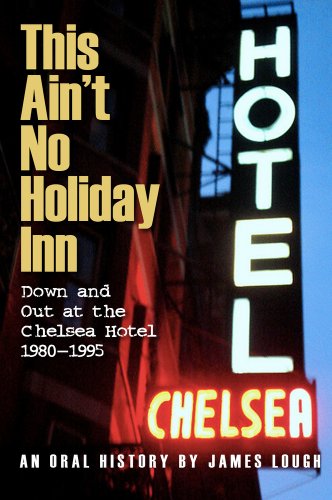
<p style="MARGIN: 0in 0in 0pt" class="MsoNormal">During its heyday, the Chelsea Hotel in New York City was a home and safe haven for Bohemian artists, poets, and musicians such as Bob Dylan, Gregory Corso, Alan Ginsberg, Janis Joplin, and Dee Dee Ramone. This oral history of the famed hotel peers behind the iconic façade and delves into the mayhem, madness, and brilliance that stemmed from the hotel in the 1980s and 1990s. Providing a window into the late Bohemia of New York during that time, countless interviews and firsthand accounts adorn this social history of one of the most celebrated and culturally significant landmarks in New York City.</p>
Die Inhaltsangabe kann sich auf eine andere Ausgabe dieses Titels beziehen.
Über die Autorinnen und Autoren
<p style="MARGIN: 0in 0in 0pt" class="MsoNormal"><b>James Lough </b>is the former director of the creative writing program at Savannah College of Art and Design, where he currently teaches full-time. He is the author of <i>Sites of Insight</i>, which won the Colorado Endowment of Humanities Award. He is also the winner of the Frank Waters Southwestern Writing Award for short fiction. He lives in Savannah, Georgia.</p>
James Lough is the former director of the creative writing program at Savannah College of Art and Design, where he currently teaches full-time. He is the author of Sites of Insight, which won the Colorado Endowment of Humanities Award. He is also the winner of the Frank Waters Southwestern Writing Award for short fiction. He lives in Savannah, Georgia.
Auszug. © Genehmigter Nachdruck. Alle Rechte vorbehalten.
This Ain't No Holiday Inn
Down and Out at the Chelsea Hotel 1980-1995
By James LoughSchaffner Press
Copyright © 2013 James Lough and Robert Campbell
All rights reserved.
ISBN: 978-1-936182-52-7All rights reserved.
Contents
INTRODUCTION,
Chapter 1 : CHECKING IN,
Chapter 2 : CHELSEA WILDNESS,
Chapter 3 : THE THREE WISE MEN OF DOPE: Beat Writers Huncke, Corso, and Matz,
Chapter 4 : THREE CHORDS AND A GRUDGE: Dee Dee Ramone and the Chelsea Hotel Blues,
Chapter 5 : GETTING BY,
Chapter 6 : STANLEY BARD: Steel Fist in Velvet Glove,
Chapter 7 : CHELSEA PORTRAITS,
Chapter 8 : CHECKING OUT,
Chapter 9 : 21ST CENTURY AFTERMATH,
Epilogue : FAUXHEMIA: Does the Death of Bohemia Matter?,
WHERE ARE THEY NOW?,
ACKNOWLEDGMENTS,
ENDNOTES,
CHAPTER 1
Checking In
It is strange how people seem to belong to places — especially to places where they were not born.
— CHRISTOPHER ISHERWOOD, The Berlin Stories
THE LOBBY: A ROGUE'S GALLERY
When the spiky-haired tourist had taken his photograph and proceeded out the big glass front door, I hurriedly grabbed my bags and stepped out from under the candy-striped awning and inside the Chelsea's famous lobby.
The place was stone quiet and more cramped than I'd envisioned. Artwork was ubiquitous, paintings crammed up and down the yellow walls. There was the ornate Victorian fireplace, its mantelpiece sporting Rene Shapshack's bust of Harry Truman.
Of all people to honor on the mantel of the anti-establishment Chelsea Hotel! The little bullet of a president from Missouri who dropped the atom bomb on Japan. The symbol of true blue America fair-and-square, showcased prominently here at Bohemian Central. No doubt the hotel's manager and part-owner Stanley Bard had long-since transcended the irony. No doubt he could wax on about how, back in the day, he had bartered X amount of Shapshack's rent for the statue and how much its value had multiplied over the years.
The quality of the Chelsea's lobby art is up for dispute. Its placement on the walls didn't seem to follow any organizing principle. Larry Rivers' pop-art masterpiece "The Dutch Masters" hangs prominently in all its glory, but what's with the huge, goofy, amateurish painting of a black flowerpot? To the right of the fireplace, there's a nice Phillip Taaffe pin-wheel abstraction, but over there, above the display case full of travel brochures, there's a tinsel metallic curly-cue contrivance that hurts the eyes.
My brother-in-law Robert Campbell states it more plainly.
ROBERT CAMPBELL
In the lobby, you've got some of the crappiest artwork you ever saw in your life. Some of it looks like artwork you'd see in the waiting room of a doctor's office. But there's some stuff that's good.
The real reason for the art's spotty quality may be simpler.
MARY ANNE ROSE
Stanley took the best paintings home.
Stanley Bard, the hotel's manager and part owner for over fifty years, has denied accepting artworks in lieu of rent payments (the hotel's co-owners would have probably disapproved). But the residents know better. Not only was the lobby chock full, but every hallway on every floor was lined with paintings, prints, and drawings. Every stairway was plastered with artwork strung up in diagonal rows. Mobiles hung from the ceilings — sculptures rose from the floors. Did the artists just donate their work out of adoration for Bard and the hotel?
The Chelsea's abundant art may not be worth all that much. In a recent legal dispute between the hotel's owners, the artwork — so much that if they pulled it all off the walls you'd think the building would collapse — was appraised at a total of only around $900,000. More evidence that Bard took the best stuff home.
As I carried my bags through the lobby, I recognized, to my left, the cubby-like room I'd seen in movies, the iconic little space with the payphones and the marble floors. In the 1980s, cell phones were almost nonexistent. And despite the fact that two-thirds of the residents were not transients, but "permanent," living there indefinitely, the Chelsea was still, after all, a hotel. As with any hotel, outgoing phone calls made from your room were outrageously expensive. So residents plodded down to the lobby's payphones.
JULIE EAKIN
In the middle of the night or whenever, we'd always be going down there in pajamas. Calls cost a dime. You'd pull the doors shut — it was one of those glass jobs, so you could see all the business going on in the lobby as you were sitting in there talking.
What made the little phone room iconic wasn't the marble floors or the phone booths themselves, but what happened there over the phone, from the ordinary to the sublime: lovers arranging rendezvous, having knockdown drag outs, ordering pizzas or pot. Actor Ethan Hawke, understanding the payphones' symbolic resonance as the counterculture's Communications Central, featured them in his movie Chelsea Walls.
Architecture is Frozen Music
You can't talk about Chelsea culture or people without talking about the building itself. A building's character, after all, shapes the characters inside.
DIMITRI MUGIANIS
The Chelsea is almost like a beautiful fortress. Architecturally, it was gorgeous! There were balconies I liked to sit outside on. In addition, inside, the staircase is beautiful, and there were working fireplaces in the rooms. I know they've fixed the hotel up now, but the state of disrepair it was in when we lived there, was so charming, like a beautiful old whore whose beauty was fading.
JULIE EAKIN
The building was a little macabre — it was much disheveled when I lived there with Dimitri. It was not kept well, nothing like it is now. It was much dingier — it wasn't cleaned as often. Almost anybody could easily sneak up the back stairway into the hallways.
It cost five hundred dollars a month for a big, square room with a beautiful fireplace that didn't work. There were the two bays with the front doors and the balcony, and it had beautiful parquet floors and tall ceilings that must have been twelve feet high. The bathroom was outside in the hall and was shared by two other apartments, one on either side.
The Hotel Chelsea has an ugly-duckling sort of stateliness. Built during the transition between Victorian and Edwardian periods, it shows the influence of both. Call it Awkwardian. If you were to show an innocent bystander a picture of the building, they might guess it was an old insane asylum, back when straitjackets were in vogue. With its high gables, skinny chimneys, its homely-ornate brick façade, and florid wrought-iron balconies, the Hotel Chelsea is gothic, at least in the literary sense of the word.
The hotel's fortress-like construction had its advantages, especially when it housed a bunch of hard-living libertines. Its builders made the interior walls extra-thick for two reasons, the first being so residents wouldn't be bothered by their neighbors' noise; the second was to prevent fires from spreading from room to room. In fact, the builders poured sand, a dependable fire retardant, between the building's steel girders to prevent this from occurring and risk engulfing the whole hotel. When Chelsea rooms have caught fire, they may have burned themselves bare, smoke and flames surging outside through the windows, but the adjoining rooms were not...
„Über diesen Titel“ kann sich auf eine andere Ausgabe dieses Titels beziehen.
Suchergebnisse für This Ain't No Holiday Inn: Down and Out at the...

Beispielbild für diese ISBN
This Ain't No Holiday Inn: Down and Out at the Chelsea Hotel 1980-1995
Anbieter: World of Books (was SecondSale), Montgomery, IL, USA
Verkäuferbewertung 5 von 5 Sternen

Zustand: Good. Item in good condition. Textbooks may not include supplemental items i.e. CDs, access codes etc. Artikel-Nr. 00110705065
Gebraucht kaufen
EUR 6,22
Versand gratis
Versand innerhalb von USA
Versand innerhalb von USA
Anzahl: 2 verfügbar
Beispielbild für diese ISBN
This Ain't No Holiday Inn: Down and Out at the Chelsea Hotel 1980â"1995
Verlag:
Schaffner Press (edition ), 2013
ISBN 10: 1936182521
ISBN 13: 9781936182527
Gebraucht
Paperback
Anbieter: BooksRun, Philadelphia, PA, USA
Verkäuferbewertung 5 von 5 Sternen
Paperback. Zustand: Very Good. It's a well-cared-for item that has seen limited use. The item may show minor signs of wear. All the text is legible, with all pages included. It may have slight markings and/or highlighting. Artikel-Nr. 1936182521-11-1
Gebraucht kaufen
EUR 7,50
Versand gratis
Versand innerhalb von USA
Versand innerhalb von USA
Anzahl: 1 verfügbar
Beispielbild für diese ISBN
This Ain't No Holiday Inn: Down and Out at the Chelsea Hotel 1980-1995
Anbieter: ThriftBooks-Atlanta, AUSTELL, GA, USA
Verkäuferbewertung 5 von 5 Sternen
Paperback. Zustand: Very Good. No Jacket. Former library book; May have limited writing in cover pages. Pages are unmarked. ~ ThriftBooks: Read More, Spend Less. Artikel-Nr. G1936182521I4N10
Gebraucht kaufen
EUR 9,49
Versand gratis
Versand innerhalb von USA
Versand innerhalb von USA
Anzahl: 1 verfügbar
Foto des Verkäufers
This Ain't No Holiday Inn Down and out At the Chelsea Hotel 1980-1995
Anbieter: True Oak Books, Highland, NY, USA
Verkäuferbewertung 5 von 5 Sternen
Paperback. Zustand: Very Good. The book looks new but smells VERY LIGHTLY of smoke. Great overall condition. Minor cosmetic wear. No noteworthy blemishes. No writing.; - We offer free returns for any reason and respond promptly to all inquiries. Your order will be packaged with care and ship on the same or next business day. Buy with confidence. Artikel-Nr. HVD-27708-A-0
Gebraucht kaufen
EUR 15,21
Versand gratis
Versand innerhalb von USA
Versand innerhalb von USA
Anzahl: 1 verfügbar
Beispielbild für diese ISBN
This Ain't No Holiday Inn
Anbieter: Kennys Bookstore, Olney, MD, USA
Verkäuferbewertung 5 von 5 Sternen
Zustand: New. 2013. Paperback. Num Pages: 320 pages, illustrations. BIC Classification: 1KBBEY; 3JJPN; 3JJPR; HBJK; HBLW3; HBTB; JFCA. Category: (G) General (US: Trade). Dimension: 229 x 153 x 18. Weight in Grams: 464. . . . . . Books ship from the US and Ireland. Artikel-Nr. V9781936182527
Neu kaufen
EUR 24,45
EUR 9,15 Versand
Versand innerhalb von USA
Versand innerhalb von USA
Anzahl: Mehr als 20 verfügbar