
Verwandte Artikel zu Please Don't Bomb the Suburbs: A Midterm Report...
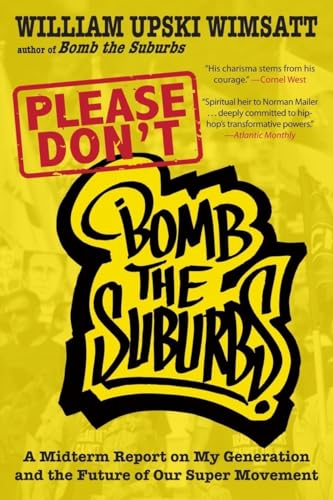
Please Don't Bomb the Suburbs: A Midterm Report on My Generation and the Future of Our Super Movement - Softcover
Inhaltsangabe
"[A] sober and funny assessment of where activism is and where it needs to go." --In These Times
"Wimsatt's level of sincerity and enthusiasm is refreshing and bracing, and the book stands as a reminder that anybody who wants to help improve the world can find plenty of ways to get busy, and also have a great time doing it." --Literary Kicks
As a potty-mouth graffiti writer from the Southside of Chicago, William "Upski" Wimsatt electrified the literary and hip-hop world with two of the most successful underground classic books in a generation, Bomb the Suburbs (1994) and No More Prisons (1999), which sold more than 90,000 copies combined.
In Please Don't Bomb the Suburbs, Wimsatt weaves a first-person tour of America's cultural and political movements from 1985-2010. It's a story about love, growing up, a generation coming of age, and a vision for the movement young people will create in the new decade. With humor, storytelling, and historical insight, Wimsatt lays out a provocative vision for the next twenty-five years of personal and historical transformation. Never heard of Billy Wimsatt before? Your life just got better.
Die Inhaltsangabe kann sich auf eine andere Ausgabe dieses Titels beziehen.
Über die Autorin bzw. den Autor
WILLIAM UPSKI WIMSATT is the author of Bomb the Suburbs and No More Prisons (more than 90,000 combined sales). A maverick graffiti artist, journalist, political and philanthropic organizer, Wimsatt has appeared in hundreds of publications and is a popular speaker at colleges and conferences. He founded the League of Young Voters, worked for Barack Obama in Ohio, and co-organized the first ever briefing of social justice artists with the White House. He was honored as a "Visionary" by Utne Reader, and included in The Source's "Power 30" list. Please Don't Bomb the Suburbs is his latest book.
Auszug. © Genehmigter Nachdruck. Alle Rechte vorbehalten.
Please Don't Bomb the Suburbs
A Midterm Report on My Generation and the Future of Our Super MovementBy William Upski WimsattAkashic Books
Copyright © 2010 William Upski WimsattAll right reserved.
ISBN: 978-1-936070-59-6
Contents
Introductions......................................................................5Part I: The Hip-hop Generation Comes of Age (1984–1996)......................33Part II: Building the Movement (1997–September 11, 2001).....................59Part III: Dawn of a New Progressive Era (2002–2008)..........................78Part IV: We Elected Obama. Now What?...............................................111Part V: What Does It Mean to Be a Grown-up?........................................146Part VI: Management for the Movement...............................................158Part VII: Future of the Movement...................................................183Afterword: More than a Book........................................................198
Introduction
Harlem After DarkI got off the bus just before midnight on 125th and Lenox—the picture of a white traveler lost in Harlem. Except I wasn't lost. I had lived and worked in Harlem for the past six years. Despite its wide, impersonal avenues, it was starting to feel like home. Struggling to carry four bags from three weeks of travel, I lumbered down Lenox to 121st and made a right onto my block. As soon as I turned the corner I got a bad feeling.
Most of the streetlights were out, and I could see outlines of figures in the shadows. My house was at the far end of the block. On the way, I had to pass a darkened schoolyard and a remote section of pavement shrouded behind a row of trees. I could see a big group of guys walking toward me. They took up the whole sidewalk. I could hear their voices. I could feel their energy. In a moment they would see me cross underneath the faded orange streetlamp. I imagined them seeing me—a white guy dressed in rumpled business clothes, pulling a suitcase on wheels, with a laptop case and two other bags slung over my aching shoulders and back.
Normally I would feel comfortable. I have been living in urban neighborhoods for most of my life. I often walk home at two or three a.m., by the projects, the hot corners, down dark alleys and side streets. I show respect for everyone. I expect respect. And I never think twice about my safety. But for some reason, in this moment, with my bags and my laptop, an animal fight-or-flight instinct took hold of me. I felt utterly vulnerable and defenseless. I considered crossing the street. Pride stopped me. I will not be afraid in my own neighborhood. I will not be afraid of young men on my own block.
That's what I told myself. But my imagination was racing. The tension toward white people moving into Harlem was strong enough to taste. Rents were tripling and quadrupling. Black Harlem families who'd been here for generations were being forced out. White babies could be seen in local parks, pushed in strollers by black nannies. Normally the white and black residents of Harlem just stayed out of each other's way, walking past each other on the sidewalks without acknowledgment. But anger boiled beneath the surface. Lines at the local food bank stretched down the block, young and old waiting for hours to get a bag of groceries. Under circumstances like this, could a band of rowdy, possibly drunk, neighborhood guys on a Friday night simply walk past me on an isolated, dark street? Wasn't this the perfect opportunity for revenge?
They were coming closer. We would meet in the middle of the darkest stretch of pavement, underneath the trees. I should have crossed the street when I had the chance. Why did I have to take my laptop with me? What if it got smashed on the sidewalk? Damn, I forgot to back up the files. I have to remember to back up the damn files! The thoughts I have at times like this. And then they were upon me. Seven or eight of them. Midtwenties. Swaggering, some with their shirts off. Slowly their faces came into focus.
"Up-ski!!!"
It was my roommate Jameel and his friends, calling me by my graffiti name from the old days. "What up, West Rok?"
He introduced me around to his friends, mostly B-boys visiting from Chicago. They had just finished a barbecue at our house, and were headed out to a party. Did I want to come with? Naw, I need to get home and get my life together. We gave each other dap, talked for a while, and parted ways. "I left you some barbecued chicken in the fridge," Jameel called as we were walking away.
I shuffled along the sidewalk feeling so many things: relief, humiliation, joy.
Barbecued chicken sounded good. I looked up at the sky and started laughing.
How did this happen? I was always the white hip-hop kid. When did I grow up into the tourist-looking white guy fearing his own friends in his own neighborhood?
Adulthood Hits You Like Whoa
At its heart, this book asks a simple question: What does it mean to be a grown-up at this pivotal moment in history? How do you embrace the good aspects of growing up and leave the bad ones alone? And how do each of us as adults find our calling, live up to our potential, and meet the challenges of our time?
This is a coming-of-age story about me and my generation, Generation X (born 1961–79), and the generation after mine, the Millennials (born 1980–2000). We both grew up on hip-hop. My generation grew up on raw political hip-hop. Y'all grew up on guns-and-bubblegum hip-hop. But that's okay. We both got slapped out of our faces by September 11. We were profoundly shaped by the Bush and Obama years, Iraq and Afghanistan, climate crisis, financial crisis, student loans, the BP oil mess, and Hurricane Katrina. We began to flex our political muscle against Bush in 2004. We swept Republicans out of Congress in 2006. And in 2008 we elected a black community organizer from the South Side of Chicago as president of the United States of America.
Overall, the Millennials are light-years more politically and professionally astute than we ever were. They are growing up in the worst economy since the Great Depression. Sixteen-year-olds, without blinking, will send you a resume and a PowerPoint presentation from their phone. And still can't get a job! They are growing up with the existence of a strange new phenomenon: an organized and strategic progressive political movement. In fact, Millennials are statistically the most progressive generation in U.S. history. I am proud of them. And I'm scared they're going to take my job.
(Note: I use "my generation" to refer to both Generation X and the Millennials, together.)
The Most Progressive Generation in History
So yeah. Young people are the most progressive generation in history. Look at the preceding chart of voting patterns from young people over the past twenty- five years.
In the 1960s and '70s, young people were halfway decent politically. In the '80s, we fell for Reagan's charm. In the '90s, we started to be semi-okay again. But then in 2000, we voted at only 41 percent. And we voted in equal numbers for George W. Bush and Al Gore. What were we thinking?
By 2004, things began to change. A lot of us realized we could no longer afford to ignore the whole voting/electoral politics game, or take it for granted. On November 2, 2004, we voted for Kerry over Bush by 9 points. In the 2006 midterm elections, we voted for Democrats over Republicans in Congress by 22 points. In 2008, we voted for...
„Über diesen Titel“ kann sich auf eine andere Ausgabe dieses Titels beziehen.
Suchergebnisse für Please Don't Bomb the Suburbs: A Midterm Report...

Beispielbild für diese ISBN
Please Don't Bomb the Suburbs : A Midterm Report on My Generation and the Future of Our Super Movement
Anbieter: Better World Books, Mishawaka, IN, USA
Verkäuferbewertung 5 von 5 Sternen

Zustand: Good. Pages intact with minimal writing/highlighting. The binding may be loose and creased. Dust jackets/supplements are not included. Stock photo provided. Product includes identifying sticker. Better World Books: Buy Books. Do Good. Artikel-Nr. 1659532-6
Gebraucht kaufen
EUR 8,35
Versand gratis
Versand innerhalb von USA
Versand innerhalb von USA
Anzahl: 3 verfügbar
Beispielbild für diese ISBN
Please Don't Bomb the Suburbs: A Midterm Report on My Generation and the Future of Our Super Movement
Anbieter: ThriftBooks-Phoenix, Phoenix, AZ, USA
Verkäuferbewertung 5 von 5 Sternen
Paperback. Zustand: Very Good. No Jacket. May have limited writing in cover pages. Pages are unmarked. ~ ThriftBooks: Read More, Spend Less. Artikel-Nr. G1936070596I4N00
Gebraucht kaufen
EUR 10,20
Versand gratis
Versand innerhalb von USA
Versand innerhalb von USA
Anzahl: 1 verfügbar
Beispielbild für diese ISBN
Please Don't Bomb the Suburbs: A Midterm Report on My Generation and the Future of Our Super Movement
Anbieter: ThriftBooks-Atlanta, AUSTELL, GA, USA
Verkäuferbewertung 5 von 5 Sternen
Paperback. Zustand: Very Good. No Jacket. May have limited writing in cover pages. Pages are unmarked. ~ ThriftBooks: Read More, Spend Less. Artikel-Nr. G1936070596I4N00
Gebraucht kaufen
EUR 10,20
Versand gratis
Versand innerhalb von USA
Versand innerhalb von USA
Anzahl: 1 verfügbar
Beispielbild für diese ISBN
Please Don't Bomb the Suburbs: A Midterm Report on My Generation and the Future of Our Super Movement
Anbieter: ThriftBooks-Reno, Reno, NV, USA
Verkäuferbewertung 5 von 5 Sternen
Paperback. Zustand: Very Good. No Jacket. May have limited writing in cover pages. Pages are unmarked. ~ ThriftBooks: Read More, Spend Less. Artikel-Nr. G1936070596I4N00
Gebraucht kaufen
EUR 10,20
Versand gratis
Versand innerhalb von USA
Versand innerhalb von USA
Anzahl: 1 verfügbar
Beispielbild für diese ISBN
Please Don't Bomb the Suburbs: A Midterm Report on My Generation and the Future of Our Super Movement
Anbieter: ThriftBooks-Dallas, Dallas, TX, USA
Verkäuferbewertung 5 von 5 Sternen
Paperback. Zustand: Very Good. No Jacket. May have limited writing in cover pages. Pages are unmarked. ~ ThriftBooks: Read More, Spend Less. Artikel-Nr. G1936070596I4N00
Gebraucht kaufen
EUR 10,20
Versand gratis
Versand innerhalb von USA
Versand innerhalb von USA
Anzahl: 1 verfügbar
Beispielbild für diese ISBN
Please Don't Bomb the Suburbs: A Midterm Report on My Generation and the Future of Our Super Movement
Anbieter: ThriftBooks-Dallas, Dallas, TX, USA
Verkäuferbewertung 5 von 5 Sternen
Paperback. Zustand: Very Good. No Jacket. Former library book; May have limited writing in cover pages. Pages are unmarked. ~ ThriftBooks: Read More, Spend Less. Artikel-Nr. G1936070596I4N10
Gebraucht kaufen
EUR 10,20
Versand gratis
Versand innerhalb von USA
Versand innerhalb von USA
Anzahl: 1 verfügbar
Beispielbild für diese ISBN
Please Don't Bomb the Suburbs: A Midterm Report on My Generation and the Future of Our Super Movement
Anbieter: Revaluation Books, Exeter, Vereinigtes Königreich
Verkäuferbewertung 5 von 5 Sternen
Paperback. Zustand: Brand New. 216 pages. 9.25x6.25x0.75 inches. In Stock. Artikel-Nr. 1936070596
Neu kaufen
EUR 29,85
EUR 11,84 Versand
Versand von Vereinigtes Königreich nach USA
Versand von Vereinigtes Königreich nach USA
Anzahl: 1 verfügbar