
Verwandte Artikel zu The Parent's Guide to the Medical World of Autism:...
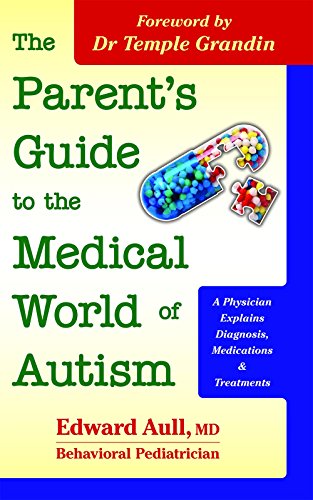
The Parent's Guide to the Medical World of Autism: A Physician Explains Diagnosis, Medications and Treatments: A Physician Explains Diagnosis, Medications & Treatments - Softcover
Inhaltsangabe
"This is the first book I have read where a wise, highly experienced doctor has discussed his use of medications on many different types of individuals on the autism spectrum. This book is essential reading for every parent who has a child who is either taking medication or thinking about the use of medication."- Dr. Temple Grandin
When families are faced with a diagnosis of autism, they find themselves swimming in a vast sea of new terms and treatment options. It can be hard to know what to try or how to proceed. In this book, Dr. Aull identifies the best and safest treatment strategies for your child’s particular diagnosis.
Dr. Aull explains how he assigns an autism diagnosis and presents the medical treatments available to children and young adults on the spectrum. He offers invaluable information on the results you can expect with all types of medications and what can be done to create a successful treatment regimen.
Die Inhaltsangabe kann sich auf eine andere Ausgabe dieses Titels beziehen.
Über die Autorin bzw. den Autor
Dr. Aull is a behavioral pediatrician who has been diagnosing autism spectrum disorders and treating patients on the spectrum for more than 30 years. He practices in Carmel, Indiana, a suburb of Indianapolis, where he resides with his wife. Dr Aull spent 24 years in a general pediatric practice, which aided him in being able to distinguish normal behavior from abnormal behavior in children and young adults. For many years, Dr Aull has spoken at ADHD and autism conferences about the milder forms of autism spectrum disorders and how they may be diagnosed and treated.
Auszug. © Genehmigter Nachdruck. Alle Rechte vorbehalten.
Foreword
By Temple Grandin
By Temple Grandin
This is the first book I have read where a wise, highly experienced doctor has discussed his use of medications on many different types of individuals on the autism spectrum. Medications, when they are used with a careful conservative approach, can help many individuals. A low dose of an antidepressant started in my early thirties stopped my non-stop anxiety and panic attacks. During my twenties my anxiety had become progressively worse. My nervous system was on high alert and vigilant for non-existent dangers. I was like a vigilant antelope on the African plains constantly on the lookout for lions. The constant stress was destroying me and I was wracked with headaches and colitis. Within three days after taking an antidepressant my pounding heart, sweaty palms, and colitis almost completely stopped. Antidepressants, when they are prescribed correctly, can work wonders for anxiety. It is important not to give too high a dose. Too high a dose may cause a person who has high anxiety to have insomnia and agitation. They will feel like they drank 20 cups of coffee.
In 2010, I learned why I had been so anxious. A brain scan done by Jason Cooperrider at the University of Utah showed that my amygdala was three times larger than normal. The amygdala is the brain’s fear center. My nervous system had been in a constant state of fear. I have been on dasipramine 50 mg/day for 35 years. Since I am stable, I think the best thing to do is keep taking it. Autism is highly variable some individuals will have severe anxiety problems and others do not.
I have several friends who are not autistic who work in design and a low dose of Prozac (fluoxetine) has controlled their anxiety and helped to prevent a return to an addiction to drugs and alcohol. I do not have scientific evidence for this, but conversations at many autism meetings indicate that people on the autism spectrum, who are good at art or math, tend to have more anxiety than more verbal word based thinkers who often love history.
Dr. Aull's Diagnostic Continuum
Dr. Aull has an autism continuum that does not follow the DSM diagnostic criteria. It is based on his many years of clinical practices. He discusses low, moderate, and high functioning autism and low, moderate, and high functioning Aspergers. It is best to view this as a continuum that ranges from the mildest autism traits to more severe. Dr. Aull created his own autism continuum because it helped him prescribe the right medications. When you read this book, it is best to look at his different cases and see which ones are most similar to your child or student. When I read the cases he presented, he had relatively few cases on the most severe end of the autism spectrum. This would include older individuals who are non-verbal and may have other serious conditions such as epilepsy. This book provides very little discussion of anticonvulsant mood stabilizer drugs, which are often useful for anger attacks that “come out of the blue” with no stressful event preceding them. This is another indicator that this book maybe most helpful for individuals who are either verbal or partially verbal. A doctor in Canada named Joe Huggens, has worked with the most severe non-verbal clients who have been kicked out of many programs due to severe meltdowns. In this population, he found it was often best to avoid the antidepressants and use anti-convulsants, atypical antipsychotics and the beta-blocker propranolol which is a blood pressure medication. This book is essential reading for every parent who has a child who is either taking medication or thinking about the use of medication. Tips For Using Medication
- A medication should have an OBVIOUS BENEFICIAL effect. When I took anti-depressants, it was like “wow!” I’m a believer biochemistry. The use of powerful antipsychotics such as Risperdal (risperidone) or Abilify (aripiprazole) as sleep aids or to make a child a tiny bit less hyper is a bad idea due to severe side effects. If the drug makes it possible to engage in more normal activities, then it is worth the risk.
- Try one thing at a time. Do not start a drug at the same time you start a new school or a special diet. Space them apart by a few weeks so you can see what works.
- Do not increase the dose or add another medication every time there is a meltdown or a problem. Medication is only one tool in the toolbox for behavior problems. In most cases, but there are some exceptions – one to three medications is usually sufficient for anxiety, depression, aggression, irritability or staying on task.
- Be careful changing brands of generics. This is especially important with time-release products. Doses may have to be changed when the drug is obtained form a different vendor.
- Too many powerful medications are being given to very young children who are under six. A good basic principle is to be more conservative with medication in very young children.
„Über diesen Titel“ kann sich auf eine andere Ausgabe dieses Titels beziehen.
Suchergebnisse für The Parent's Guide to the Medical World of Autism:...

Beispielbild für diese ISBN
The Parent's Guide to the Medical World of Autism: A Physician Explains Diagnosis, Medications and Treatments
Verlag:
Future Horizons Incorporated, 2014
ISBN 10: 1935274899
ISBN 13: 9781935274896
Gebraucht
Paperback
Anbieter: World of Books (was SecondSale), Montgomery, IL, USA
Verkäuferbewertung 5 von 5 Sternen

Paperback. Zustand: Very Good. This is the first book I have read where a wise, highly experienced doctor has discussed his use of medications on many different types of individuals on the autism spectrum. This book is essential reading for every parent who has a child who is either taking medication or thinking about the use of medication. ""- from the Foreword by Dr Temple GrandinWhen families are faced with a diagnosis of autism, they find themselves swimming in a vast sea of new terms and treatment options. It can be hard to know what to try or how to proceed. In this book, Dr Aull identifies the best and safest treatment strategies for your child?s particular diagnosis.Dr Aull explains how he assigns an autism diagnosis and presents the medical treatments available to children and young adults on the spectrum. He offers invaluable information on the results you can expect with all types of medications and what can be done to create a successful treatment regimen. Artikel-Nr. 00097442642
Gebraucht kaufen
EUR 5,10
Versand gratis
Versand innerhalb von USA
Versand innerhalb von USA
Anzahl: 1 verfügbar
Beispielbild für diese ISBN
The Parent's Guide to the Medical World of Autism: A Physician Explains Diagnosis, Medications and Treatments
Verlag:
Future Horizons (edition ), 2014
ISBN 10: 1935274899
ISBN 13: 9781935274896
Gebraucht
Paperback
Anbieter: BooksRun, Philadelphia, PA, USA
Verkäuferbewertung 5 von 5 Sternen
Paperback. Zustand: Very Good. It's a well-cared-for item that has seen limited use. The item may show minor signs of wear. All the text is legible, with all pages included. It may have slight markings and/or highlighting. Artikel-Nr. 1935274899-11-1
Gebraucht kaufen
EUR 5,11
Versand gratis
Versand innerhalb von USA
Versand innerhalb von USA
Anzahl: 1 verfügbar
Beispielbild für diese ISBN
The Parent's Guide to the Medical World of Autism : A Physician Explains Diagnosis, Medications & Treatments
Verlag:
Future Horizons, Incorporated, 2014
ISBN 10: 1935274899
ISBN 13: 9781935274896
Gebraucht
Softcover
Anbieter: Better World Books, Mishawaka, IN, USA
Verkäuferbewertung 5 von 5 Sternen
Zustand: Good. Former library copy. Pages intact with minimal writing/highlighting. The binding may be loose and creased. Dust jackets/supplements are not included. Includes library markings. Stock photo provided. Product includes identifying sticker. Better World Books: Buy Books. Do Good. Artikel-Nr. 5649152-6
Gebraucht kaufen
EUR 6,17
Versand gratis
Versand innerhalb von USA
Versand innerhalb von USA
Anzahl: 3 verfügbar
Beispielbild für diese ISBN
The Parent's Guide to the Medical World of Autism: A Physician Explains Diagnosis, Medications and Treatments
Anbieter: ThriftBooks-Atlanta, AUSTELL, GA, USA
Verkäuferbewertung 5 von 5 Sternen
Paperback. Zustand: Very Good. No Jacket. May have limited writing in cover pages. Pages are unmarked. ~ ThriftBooks: Read More, Spend Less. Artikel-Nr. G1935274899I4N00
Gebraucht kaufen
EUR 6,58
Versand gratis
Versand innerhalb von USA
Versand innerhalb von USA
Anzahl: 1 verfügbar
Foto des Verkäufers
The Parent's Guide to the Medical World of Autism: A Physician Explains Diagnosis Medications and Treatments
Anbieter: WeBuyBooks, Rossendale, LANCS, Vereinigtes Königreich
Verkäuferbewertung 5 von 5 Sternen
Paperback. Zustand: Good. Most items will be dispatched the same or the next working day. A copy that has been read but remains in clean condition. All of the pages are intact and the cover is intact and the spine may show signs of wear. The book may have minor markings which are not specifically mentioned. Ex library copy with usual stamps & stickers. Artikel-Nr. rev5302466033
Gebraucht kaufen
EUR 6,05
EUR 6,40 Versand
Versand von Vereinigtes Königreich nach USA
Versand von Vereinigtes Königreich nach USA
Anzahl: 1 verfügbar
Beispielbild für diese ISBN
The Parent's Guide to the Medical World of Autism: A Physician Explains Diagnosis, Medications and Treatments
Anbieter: Revaluation Books, Exeter, Vereinigtes Königreich
Verkäuferbewertung 5 von 5 Sternen
Paperback. Zustand: Brand New. 216 pages. 8.00x5.00x0.50 inches. In Stock. Artikel-Nr. 1935274899
Neu kaufen
EUR 27,76
EUR 11,92 Versand
Versand von Vereinigtes Königreich nach USA
Versand von Vereinigtes Königreich nach USA
Anzahl: 1 verfügbar