
Verwandte Artikel zu The Quest for Community: A Study in the Ethics of Order...
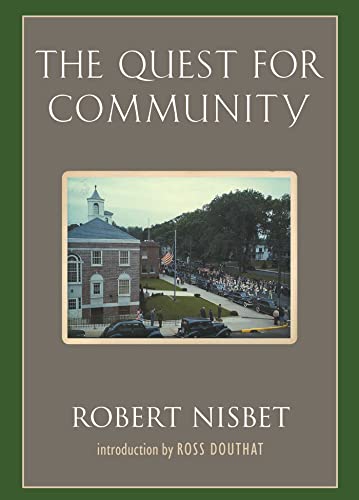
The Quest for Community: A Study in the Ethics of Order and Freedom (Background: Essential Texts for the Conservative Mind) - Softcover
Inhaltsangabe
One of the leading thinkers to emerge in the postwar conservative intellectual revival was the sociologist Robert Nisbet. His book The Quest for Community, published in 1953, stands as one of the most persuasive accounts of the dilemmas confronting modern society. Nearly a half century before Robert Putnam documented the atomization of society in Bowling Alone, Nisbet argued that the rise of the powerful modern state had eroded the sources of community—the family, the neighborhood, the church, the guild. Alienation and loneliness inevitably resulted. But as the traditional ties that bind fell away, the human impulse toward community led people to turn even more to the government itself, allowing statism—even totalitarianism—to flourish.
This edition of Nisbet’s magnum opus features a brilliant introduction by New York Times columnist Ross Douthat and three critical essays. Published at a time when our communal life has only grown weaker and when many Americans display cultish enthusiasm for a charismatic president, this new edition of The Quest for Community shows that Nisbet’s insights are as relevant today as ever.
Die Inhaltsangabe kann sich auf eine andere Ausgabe dieses Titels beziehen.
Über die Autorin bzw. den Autor
Robert Nisbet (1913–1996) was a professor at Columbia University and the author of The Quest for Community, The Sociological Tradition, The Social Bond, The Present Age, and other books.
Auszug. © Genehmigter Nachdruck. Alle Rechte vorbehalten.
The Quest for Community
A Study in the Ethics of Order and FreedomBy Robert NisbetISI BOOKS
Copyright © 1981 Robert A. NisbetAll right reserved.
ISBN: 978-1-935191-50-6
Contents
Introduction to the Background Edition Ross Douthat...........................................................viiPreface to the First Edition...................................................................................xviiPreface to the 1970 edition....................................................................................xxi1 The Loss of Community........................................................................................12 The Image of Community.......................................................................................193 The Problem of Community.....................................................................................394 History as the Decline of Community..........................................................................695 The State as Revolution......................................................................................916 Sovereignty and Association..................................................................................1137 The Political Community......................................................................................1418 The Total Community..........................................................................................1739 The Problem of Liberalism....................................................................................19510 The Contexts of Individuality...............................................................................20711 The Contexts of Democracy...................................................................................229Conclusion.....................................................................................................259The State and Fading Community John Carroll...................................................................263Modernity's New World Dangers David Bosworth..................................................................273The Enduring Achievement and Unfinished Work of Robert Nisbet Jeanne Heffernan Schindler.....................289References and Notes...........................................................................................305Index..........................................................................................................321
Chapter One
The Loss of Community
One may paraphrase the famous words of Karl Marx and say that a specter is haunting the modern mind, the specter of insecurity. Surely the outstanding characteristic of contemporary thought on man and society is the preoccupation with personal alienation and cultural disintegration. The fears of the nineteenth-century conservatives in Western Europe, expressed against a background of increasing individualism, secularism, and social dislocation, have become, to an extraordinary degree, the insights and hypotheses of present-day students of man in society. The widening concern with insecurity and disintegration is accompanied by a profound regard for the values of status, membership, and community.
In every age there are certain key words which by their repetitive use and redefinition mark the distinctive channels of faith and thought. Such words have symbolic values which exert greater influence upon the nature and direction of men's thinking than the techniques used in the study or laboratory or the immediate empirical problems chosen for research. In the nineteenth century, the age of individualism and rationalism, such words as individual, change, progress, reason, and freedom were notable not merely for their wide use as linguistic tools in books, essays, and lectures but for their symbolic value in convictions of immense numbers of men. These words were both the outcome of thought and the elicitors of thought. Men were fascinated by their referents and properties.
All of these words reflected a temper of mind that found the essence of society to lie in the solid fact of the discrete individual-autonomous, self-sufficing, and stable-and the essence of history to lie in the progressive emancipation of the individual from the tyrannous and irrational statuses handed down from the past. Competition, individuation, dislocation of status and custom, impersonality, and moral anonymity were hailed by the rationalist because these were the forces that would be most instrumental in emancipating man from the dead hand of the past and because through them the naturally stable and rational individual would be given an environment in which he could develop illimitably his inherent potentialities. Man was the primary and solid fact; relationships were purely derivative. All that was necessary was a scene cleared of the debris of the past.
If there were some, like TaMe, Ruskin, and William Morris, who called attention to the cultural and moral costs involved-the uprooting of family ties, the disintegration of villages, the displacement of craftsmen, and the atomization of ancient securities-the apostles of rationalism could reply that these were the inevitable costs of Progress. After all, it was argued-argued by liberals and radicals alike-in all great ages of achievement there is a degree of disorder, a snapping of the ties of tradition and security. How else can the creative individual find release for his pent-up powers of discovery and reason if the chains of tradition are not forcibly struck off?
This was the age of optimism, of faith in the abstract individual and in the harmonies of nature. In Mark Twain's Huckleberry Finn, what we are given, as Parrington points out in his great study of American thought, is the matchless picture of a child of nature revolting against the tyrannies of village, family, and conventional morality. It is a revolt characterized, not by apprehensiveness and insecurity, but by all the confidence of the frontier. In the felicities and equalities of nature Huck finds joyous release from the cloistering prejudices and conventions of old morality. Truth, justice, and happiness lie in man alone.
In many areas of thought and imagination we find like perspectives. The eradication of old restraints, together with the prospect of new and more natural relationships in society, relationships arising directly from the innate resources of individuals, prompted a glowing vision of society in which there would be forever abolished the parochialisms and animosities of a world founded upon kinship, village, and church. Reason, founded upon natural interest, would replace the wisdom Burke and his fellow conservatives had claimed to find in historical processes of use and wont, of habit and prejudice.
"The psychological process which social relations were undergoing," Ostrogorski has written of the nineteenth century, "led to the same conclusions as rationalism and by the same logical path-abstraction and generalization." Henceforth, man's social relations "were bound to be guided not so much by sentiment, which expressed the perception of the particular, as by general principles, less intense in their nature perhaps, but sufficiently comprehensive to take in the shifting multitudes of which the abstract social groups were henceforth composed, groups continually subject to expansion by reason of their continual motion.'"
Between philosophers as far removed as Spencer and Marx there was a common faith in the organizational powers of history and in the self-sufficiency of the individual. All that was needed...
„Über diesen Titel“ kann sich auf eine andere Ausgabe dieses Titels beziehen.
Suchergebnisse für The Quest for Community: A Study in the Ethics of Order...

Beispielbild für diese ISBN
The Quest for Community: A Study in the Ethics of Order and Freedom
Anbieter: World of Books (was SecondSale), Montgomery, IL, USA
Verkäuferbewertung 5 von 5 Sternen

Paperback. Zustand: Good. A new edition of sociologist Robert Nisbet's magnum opus, first published in 1953. It argues that the rise of the powerful modern state had eroded the sources of communitythe family, the neighbourhood, the church, the guild -- and that alienation and loneliness have inevitably resulted. This edition includes an introduction by New York Times columnist Ross Douthat and three critical essays. Artikel-Nr. CIN1935191500G
Gebraucht kaufen
EUR 15,34
Versand gratis
Versand innerhalb von USA
Versand innerhalb von USA
Anzahl: 1 verfügbar
Beispielbild für diese ISBN
The Quest for Community: A Study in the Ethics of Order and Freedom
Anbieter: World of Books (was SecondSale), Montgomery, IL, USA
Verkäuferbewertung 5 von 5 Sternen
Paperback. Zustand: Very Good. A new edition of sociologist Robert Nisbet's magnum opus, first published in 1953. It argues that the rise of the powerful modern state had eroded the sources of communitythe family, the neighbourhood, the church, the guild -- and that alienation and loneliness have inevitably resulted. This edition includes an introduction by New York Times columnist Ross Douthat and three critical essays. Artikel-Nr. CIN1935191500VG
Gebraucht kaufen
EUR 15,34
Versand gratis
Versand innerhalb von USA
Versand innerhalb von USA
Anzahl: 1 verfügbar
Beispielbild für diese ISBN
Nisbet, R: Quest for Community
Anbieter: PBShop.store UK, Fairford, GLOS, Vereinigtes Königreich
Verkäuferbewertung 5 von 5 Sternen
PAP. Zustand: New. New Book. Delivered from our UK warehouse in 4 to 14 business days. Established seller since 2000. Artikel-Nr. WB-9781935191506
Neu kaufen
EUR 23,84
EUR 5,92 Versand
Versand von Vereinigtes Königreich nach USA
Versand von Vereinigtes Königreich nach USA
Anzahl: 14 verfügbar
Beispielbild für diese ISBN
The Quest for Community
Verlag:
Intercollegiate Studies Institute, Inc., 2010
ISBN 10: 1935191500
ISBN 13: 9781935191506
Neu
Softcover
Anbieter: Majestic Books, Hounslow, Vereinigtes Königreich
Verkäuferbewertung 4 von 5 Sternen

Zustand: New. pp. xxxiii + 330. Artikel-Nr. 6512985
Neu kaufen
EUR 33,44
EUR 7,67 Versand
Versand von Vereinigtes Königreich nach USA
Versand von Vereinigtes Königreich nach USA
Anzahl: 3 verfügbar
Beispielbild für diese ISBN
The Quest for Community: A Study in the Ethics of Order and Freedom (Background: Essential Texts for the Conservative Mind)
Verlag:
Intercollegiate Studies Institute, 2010
ISBN 10: 1935191500
ISBN 13: 9781935191506
Neu
Softcover
Anbieter: Kennys Bookstore, Olney, MD, USA
Verkäuferbewertung 5 von 5 Sternen
Zustand: New. Num Pages: 304 pages. BIC Classification: JFSL. Category: (G) General (US: Trade); (P) Professional & Vocational. Dimension: 220 x 163 x 27. Weight in Grams: 542. . 2010. 1st Edition. Paperback. . . . . Books ship from the US and Ireland. Artikel-Nr. V9781935191506
Neu kaufen
EUR 32,62
EUR 9,36 Versand
Versand innerhalb von USA
Versand innerhalb von USA
Anzahl: 14 verfügbar
Beispielbild für diese ISBN
The Quest for Community: A Study in the Ethics of Order and Freedom
Anbieter: Revaluation Books, Exeter, Vereinigtes Königreich
Verkäuferbewertung 5 von 5 Sternen
Paperback. Zustand: Brand New. 304 pages. 8.40x8.40x1.10 inches. In Stock. Artikel-Nr. 1935191500
Neu kaufen
EUR 44,23
EUR 11,80 Versand
Versand von Vereinigtes Königreich nach USA
Versand von Vereinigtes Königreich nach USA
Anzahl: 1 verfügbar
Foto des Verkäufers
The Quest for Community : A Study in the Ethics of Order and Freedom
Verlag:
Skyhorse Publishing Jul 2010, 2010
ISBN 10: 1935191500
ISBN 13: 9781935191506
Neu
Taschenbuch
Anbieter: AHA-BUCH GmbH, Einbeck, Deutschland
Verkäuferbewertung 5 von 5 Sternen
Taschenbuch. Zustand: Neu. Neuware - One of the leading thinkers to emerge in the postwar conservative intellectual revival was the sociologist Robert Nisbet. His book The Quest for Community, published in 1953, stands as one of the most persuasive accounts of the dilemmas confronting modern society. Nearly a half century before Robert Putnam documented the atomization of society in Bowling Alone, Nisbet argued that the rise of the powerful modern state had eroded the sources of communitythe family, the neighborhood, the church, the guild. Alienation and loneliness inevitably resulted. But as the traditional ties that bind fell away, the human impulse toward community led people to turn even more to the government itself, allowing statismeven totalitarianismto flourish. This edition of Nisbet's magnum opus features a brilliant introduction by New York Times columnist Ross Douthat and three critical essays. Published at a time when our communal life has only grown weaker and when many Americans display cultish enthusiasm for a charismatic president, this new edition of The Quest for Community shows that Nisbet's insights are as relevant today as ever. Artikel-Nr. 9781935191506
Neu kaufen
EUR 39,60
EUR 35,00 Versand
Versand von Deutschland nach USA
Versand von Deutschland nach USA
Anzahl: 2 verfügbar
Foto des Verkäufers
The Quest for Community
Anbieter: moluna, Greven, Deutschland
Verkäuferbewertung 5 von 5 Sternen
Zustand: New. A new edition of sociologist Robert Nisbet s magnum opus, first published in 1953. It argues that the rise of the powerful modern state had eroded the sources of community-the family, the neighbourhood, the church, the guild -- and that alienation and lonel. Artikel-Nr. 597260888
Neu kaufen
EUR 29,59
EUR 48,99 Versand
Versand von Deutschland nach USA
Versand von Deutschland nach USA
Anzahl: Mehr als 20 verfügbar