
Verwandte Artikel zu Istanbul Noir (Akashic Noir)
Inhaltsangabe
"Istanbul straddles the divide of Europe and Asia, and its polyglot population of 12 million seethes with political, religious, and sexual tensions, as shown in the 16 stories in this strong entry in Akashic's noir anthology series . . . a welcome complement to the mostly historical mysteries set in Istanbul." --Publishers Weekly
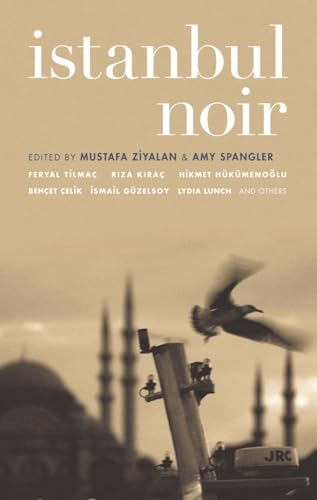
Akashic Books continues its groundbreaking series of original noir anthologies, launched in 2004 with Brooklyn Noir. Each story is set in a distinct neighborhood or location within the city of the book.
Brand-new stories by: Müge Iplikçi, Behçet Çelik, Ismail Güzelsoy, Lydia Lunch, Hikmet Hükümenoglu, Riza Kiraç, Sadik Yemni, Baris Müstecaplioglu, Yasemin Aydinoglu, Feryal Tilmaç, Mehmet Bilâl, Inan Çetin, Mustafa Ziyalan, Jessica Lutz, Tarkan Barlas, and Algan Sezgintüredi.
From the introduction by Mustafa Ziyalan & Amy Spangler:
"As submissions for Istanbul Noir started to come in, it became increasingly clear to us that what was taking shape was not just some collection of dark stories set in old Stamboul, but a rich portrait of the city itself--or, at the very least, a particularly revealing series of snapshots. Mind you, it is a city shaped largely by the often vicious ebb and tide of the nation's politics. Although Ankara may be the capital of the Republic of Turkey, the truth of the matter is, with a good twelve million people and thus a fifth of its population, Istanbul is the throbbing, often bleeding, heart of the country's politics. And it shows . . .
Lying at the crossroads of East and West, Istanbul belongs to neither and to both, and it is precisely this elusive in-betweenness upon which the city thrives. No matter how much blood is spilled trying to conform to Western standards, they just don't stick in this slippery city. Here, you don't break the rules, you forge a loophole through them . . . A den of sin and a bastion of virtue, Istanbul is a fog-covered playground of power and resistance, denial and repression, and if you don't know the tricks of the game, you'll likely feel the urge to abandon your marbles and go."
Die Inhaltsangabe kann sich auf eine andere Ausgabe dieses Titels beziehen.
Über die Autorinnen und Autoren
MUSTAFA ZIYALAN was born in Zonguldak, on the Black Sea coast of Turkey. He worked as a general practitioner and coroner in a rural Anatolian village, and now lives and practices psychiatry in Brooklyn, NY. His poetry, short fiction, and essays have appeared in many literary periodicals, anthologies, and in book form. He is the author of the poetry book Kizil Kanca Siirleri, Yakilacak Kentlerden, a collection of travel writing and essays, and Su Kedileri, a collection of short fiction. He is the coeditor of Istanbul Noir.
AMY SPANGLER, a native of small-town Ohio, first landed in Turkey as a high school exchange student in 1994-95. She continued to foster her ties with the country and her keen interest in its literature throughout her college years, promptly moving to Istanbul upon graduation in 1999. She still lives in the elusive and amorphous Istanbul, where she works as translator, agent, and editor. She is the translator of Asli Erdogan's novel, The City in Crimson Cloak, co-owner of AnatoliaLit Literary and Copyright Agency (www.anatolialit.com), and coeditor of Istanbul Noir.
Auszug. © Genehmigter Nachdruck. Alle Rechte vorbehalten.
Istanbul Noir
Akashic Books
Copyright © 2008 Akashic BooksAll right reserved.
ISBN: 978-1-933354-62-0
Contents
IntroductionPART I: LUST & VENGEANCE.......................................................21ISMAIL GZELSOY Bykada The Tongue of the Flames............................39FERYAL TILMA Bebek Hitching in the Lodos....................................56MEHMET BILL Sirkeci The Stepson.............................................75BARIS MSTECAPLIOGLU Altunizade An Extra BodyPART II: PUSHING LIMITS, CROSSING LINES........................................97HIKMET HKMENOGLU Rumelihisari The Smell of Fish............................115JESSICA LUTZ Fatih All Quiet.................................................126ALGAN SEZGINTREDI Saskinbakkal Around Here, Somewhere.......................144LYDIA LUNCH Tepebasi The Spirit of Philosophical VitriolPART III: IN THE DARK RECESSES.................................................157YASEMIN AYDINOGLU Sagmalcilar One Among Us...................................171MUSTAFA ZIYALAN Aksaray Black Palace.........................................191BEHET ELIK Fikirtepe So Very Familiar......................................199INAN ETIN Fener The Bloody Horn.............................................214TARKAN BARLAS Yenikapi A Woman, Any WomanPART IV: GRIEF & GRIEVANCES....................................................227RIZA KIRA 4th Levent Ordinary Facts.........................................246SADIK YEMNI Kurtulus Burn and Go..............................................264MGE IPLIKI Moda The Hand...................................................274Turkish Pronunciaton Guide & Glossary..........................................278About the Contributors
Introduction
Transgression and the Strait: Politics, Passion, and Pain
Istanbul is the place where East meets West, literally. It is, as convention would have it, a meeting point, a crossroads. At the same time, it marks the spot where geography is irreparably rent in two; it is a fissure in the continuum, a seething rupture, so to speak. The only city in the world to lie smack dab at the junction of two continents, Europe and Asia, Istanbul is split down the middle by the Bosphorus Strait, pierced by the Golden Horn, and caressed by the Black and Marmara seas. In short, with her "tough love," Mother Nature has pummeled and groomed this place into one of the most stunning geographical locations on earth.
Indeed, Istanbul has been the site of the collision and collusion, of the fracturing and the fusion of cultures, for millennia. Capital of the Eastern Roman (Byzantine) and Ottoman empires, the city formerly known as Byzantium and then Constantinople became Istanbul (incidentally, a word derived from the Greek term for "in the city") after being conquered by the Ottomans in 1453. Many Christian Greeks remained and even flourished in Istanbul following Byzantium's defeat at the hands of the Muslim Ottomans. Under Ottoman rule, Istanbul became known as alem-penah-"refuge of the universe," a haven for myriad religious and ethnic groups. When the Jews were expelled during the Spanish Inquisition in 1492 by the Spanish king, the Ottoman Sultan welcomed them with open arms. As the capital of the Ottoman Empire, Istanbul attracted hundreds of thousands of people for centuries from within the empire's vast territories and beyond. In the wake of the empire's demise, the Turkish Republic (founded in 1923) has served this legacy well. Waves of immigration, especially since the 1950s, have increased the city's population by more than tenfold: Turks, Kurds, Laz, Alevis, Circassians, Bosnians, Albanians, Macedonians, etc. You get the picture. A mosaic, a melting pot, a vat of oil and water-call it what you will, there is no denying that Istanbul has always been ethnically, socially, and religiously cosmopolitan to the core.
As submissions for Istanbul Noir started to come in, it became increasingly clear to us that what was taking shape was not just some collection of dark stories set in old Stamboul, but a rich portrait of the city itself-or, at the very least, a particularly revealing series of snapshots. Mind you, it is a city shaped largely by the often vicious ebb and tide of the nation's politics. Although Ankara may be the capital of the Republic of Turkey, the truth of the matter is, with a good twelve million people and thus a fifth of its population, Istanbul is the throbbing, often bleeding, heart of the country's politics. And it shows.
In a tumultuous and notoriously unreliable city where the only constant is instability, one often seeks solace in humor. You will get a dose of that in at least a couple of the stories in this collection. The humor is, we hope, appropriately dark. Rather (but not entirely) antithetical to this humor is a mood that also predominates in several of the pieces: hzn. Like many of the terms you'll find in the glossary at the end of this book, hzn is one of those difficult-to-translate concepts integral to the culture of Turkey and the Turkish language, and as a characteristic mood of the inhabitants of this city, several of the stories in this collection are imbued with it. Hzn is a kind of melancholy, a heaviness or a sadness of heart. It is a world pervaded by gray, a state of weariness and hopelessness and lethargy. It is a word for which, arguably, there is no equivalent in English. It is an indescribable mood that you can describe for hours. And in that respect, it is a lot like Istanbul.
A sadomasochistic metropolis in equal measures self-important and self-loathing, Istanbul is rife with contradiction. It is a living conundrum: impossible to pin down and moody as hell. It is raw and human, vibrant and pulsating. It is a city of blood and concrete, a palimpsest of memorials and scars that will not be erased.
Istanbul's history has been marked by the clashing of wills, battling sometimes for life, sometimes for power, often, ultimately, for both. The last several violence-riddled decades in particular have left an indelible mark on the contemporary fabric of the city, not to mention on the minds, bodies, and souls of its people. The knife has cut deep, and the wounds may never completely heal.
This holds true especially for the coup of 1980, which marked a violent and painful rupture in the history of the Turkish Republic. In its efforts to squelch the political left, the state effectively crushed the spirit of an entire generation, extinguishing hope and erecting on its ashes an apolitical society, shaped to the mold of consumerism. An inexhaustible source of heartache and melancholy, bitterness and rage, the involuntary transition from a society fermenting with dissidence to one numbed to the point of docility has had a pervasive impact upon the Turkish people, palpable in many of the stories in this volume.
The political vacuum created by the subjugation of the left was soon filled by the emergence of new forms of nationalism and Islamism. While the history of the Republic is fraught with efforts to galvanize Turkish identity at the expense of others-such as the incitement of the "Riots of September 6-7" in 1955, during which Greeks and other non-Muslims and their property in Istanbul suffered widespread attacks, the banning of the Kurdish language, and myriad other discriminatory practices and policies targeting "non-Turks"-in its most recent guise, hysterical ultra-nationalism has become normalized. The Turkish state continues to wage a nearly twenty-five-year war against Kurdish rebels in the southeast, and a psychological war throughout...
„Über diesen Titel“ kann sich auf eine andere Ausgabe dieses Titels beziehen.
Suchergebnisse für Istanbul Noir (Akashic Noir)

Beispielbild für diese ISBN
Istanbul Noir
Anbieter: Better World Books, Mishawaka, IN, USA
Verkäuferbewertung 5 von 5 Sternen

Zustand: Good. 1st Printing. Former library copy. Pages intact with minimal writing/highlighting. The binding may be loose and creased. Dust jackets/supplements are not included. Includes library markings. Stock photo provided. Product includes identifying sticker. Better World Books: Buy Books. Do Good. Artikel-Nr. GRP13742067
Gebraucht kaufen
EUR 6,60
Versand gratis
Versand innerhalb von USA
Versand innerhalb von USA
Anzahl: 1 verfügbar
Beispielbild für diese ISBN
Istanbul Noir
Anbieter: Better World Books, Mishawaka, IN, USA
Verkäuferbewertung 5 von 5 Sternen
Zustand: Very Good. 1st Printing. Pages intact with possible writing/highlighting. Binding strong with minor wear. Dust jackets/supplements may not be included. Stock photo provided. Product includes identifying sticker. Better World Books: Buy Books. Do Good. Artikel-Nr. 5514712-6
Gebraucht kaufen
EUR 8,76
Versand gratis
Versand innerhalb von USA
Versand innerhalb von USA
Anzahl: 1 verfügbar
Foto des Verkäufers
Istanbul Noir.
Verlag:
Akashic Books, New York, 2008
ISBN 10: 1933354623
ISBN 13: 9781933354620
Gebraucht
Softcover.
Anbieter: Monkey House Books, Miller Place, NY, USA
Verkäuferbewertung 5 von 5 Sternen
Softcover. Zustand: Fine. Includes works by Feryal Tilmac, Riza Kirac, Hikmet Hukumenoglu, and others. Part of a series of noir story anthologies, each set in a different city. 277 pages, trade paperback. Artikel-Nr. 7813
Gebraucht kaufen
EUR 4,16
EUR 4,70 Versand
Versand innerhalb von USA
Versand innerhalb von USA
Anzahl: 1 verfügbar
Beispielbild für diese ISBN
Istanbul Noir
Anbieter: ThriftBooks-Dallas, Dallas, TX, USA
Verkäuferbewertung 5 von 5 Sternen
Paperback. Zustand: Fair. No Jacket. Readable copy. Pages may have considerable notes/highlighting. ~ ThriftBooks: Read More, Spend Less. Artikel-Nr. G1933354623I5N00
Gebraucht kaufen
EUR 8,97
Versand gratis
Versand innerhalb von USA
Versand innerhalb von USA
Anzahl: 1 verfügbar
Beispielbild für diese ISBN
Istanbul Noir (Akashic Noir): 0 (Akashic Noir Series)
Anbieter: WorldofBooks, Goring-By-Sea, WS, Vereinigtes Königreich
Verkäuferbewertung 5 von 5 Sternen
Paperback. Zustand: Very Good. The book has been read, but is in excellent condition. Pages are intact and not marred by notes or highlighting. The spine remains undamaged. Artikel-Nr. GOR002137162
Gebraucht kaufen
EUR 4,62
EUR 6,72 Versand
Versand von Vereinigtes Königreich nach USA
Versand von Vereinigtes Königreich nach USA
Anzahl: 2 verfügbar
Foto des Verkäufers
Istanbul Noir (Akashic Noir): 0 (Akashic Noir Series)
Anbieter: WeBuyBooks, Rossendale, LANCS, Vereinigtes Königreich
Verkäuferbewertung 5 von 5 Sternen
paperback. Zustand: Good. Most items will be dispatched the same or the next working day. A copy that has been read but remains in clean condition. All of the pages are intact and the cover is intact and the spine may show signs of wear. The book may have minor markings which are not specifically mentioned. Artikel-Nr. rev4416743418
Gebraucht kaufen
EUR 6,80
EUR 6,44 Versand
Versand von Vereinigtes Königreich nach USA
Versand von Vereinigtes Königreich nach USA
Anzahl: 1 verfügbar
Beispielbild für diese ISBN
Istanbul Noir
Anbieter: Better World Books Ltd, Dunfermline, Vereinigtes Königreich
Verkäuferbewertung 5 von 5 Sternen
Zustand: Good. 1st Printing. Pages intact with minimal writing/highlighting. The binding may be loose and creased. Dust jackets/supplements are not included. Stock photo provided. Product includes identifying sticker. Better World Books: Buy Books. Do Good. Artikel-Nr. 4688177-6
Gebraucht kaufen
EUR 8,00
EUR 6,00 Versand
Versand von Vereinigtes Königreich nach USA
Versand von Vereinigtes Königreich nach USA
Anzahl: 1 verfügbar
Beispielbild für diese ISBN
Istanbul Noir
Anbieter: medimops, Berlin, Deutschland
Verkäuferbewertung 5 von 5 Sternen
Zustand: good. Befriedigend/Good: Durchschnittlich erhaltenes Buch bzw. Schutzumschlag mit Gebrauchsspuren, aber vollständigen Seiten. / Describes the average WORN book or dust jacket that has all the pages present. Artikel-Nr. M01933354623-G
Gebraucht kaufen
EUR 16,45
EUR 10,00 Versand
Versand von Deutschland nach USA
Versand von Deutschland nach USA
Anzahl: 2 verfügbar
Beispielbild für diese ISBN
Istanbul Noir
Anbieter: Revaluation Books, Exeter, Vereinigtes Königreich
Verkäuferbewertung 5 von 5 Sternen
Paperback. Zustand: Brand New. 300 pages. 8.25x5.25x1.00 inches. In Stock. Artikel-Nr. x-1933354623
Neu kaufen
EUR 25,27
EUR 12,00 Versand
Versand von Vereinigtes Königreich nach USA
Versand von Vereinigtes Königreich nach USA
Anzahl: 2 verfügbar
Foto des Verkäufers
Istanbul Noir
Anbieter: GreatBookPricesUK, Woodford Green, Vereinigtes Königreich
Verkäuferbewertung 5 von 5 Sternen
Zustand: As New. Unread book in perfect condition. Artikel-Nr. 5707663
Gebraucht kaufen
EUR 21,74
EUR 18,00 Versand
Versand von Vereinigtes Königreich nach USA
Versand von Vereinigtes Königreich nach USA
Anzahl: 7 verfügbar