
Inhaltsangabe
Whether with friends, lovers, neighbors, family members or business associates, the bedrock of healthy relationships is always the same: honest, clear communication. Drawing on her years of experience as a relationship coach and a teamwork consultant to Fortune 500 companies, Susan Campbell shows readers how to drastically improve the quality of their everyday interations by relying on a simple, straight-forward approach to communication and letting go of their need to control the outcome. Practical techniques for dropping one's defenses are offered, as well as a fresh new perspective on using intimate relationships as a form of spiritual practice. Other useful tools include seven statements designed to bring the reader's awareness into the present moment, as well as handy communication-enhancing phrases and Campbell's insights on the most commonly encountered problems.
Die Inhaltsangabe kann sich auf eine andere Ausgabe dieses Titels beziehen.
Auszug. © Genehmigter Nachdruck. Alle Rechte vorbehalten.
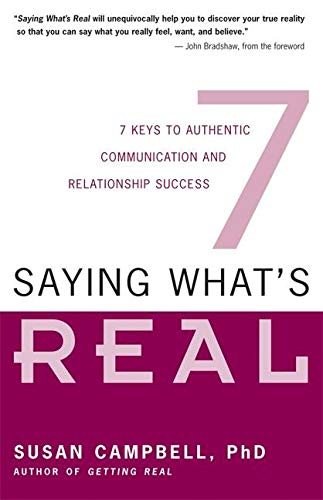
Saying What's Real
7 Keys to Authentic Communication and Relationship Success
By Susan CampbellH J Kramer and New World Library
Copyright © 2005 Susan M. Campbell
All rights reserved.
ISBN: 978-1-932073-12-6All rights reserved.
Contents
Foreword By John Bradshaw,
Introduction,
Chapter 1 Hearing You Say That, I Feel ...,
Chapter 2 I Want ...,
Chapter 3 I Have Some Feelings to Clear,
Chapter 4 I'm Getting Triggered,
Chapter 5 I Appreciate You For ...,
Chapter 6 I Hear You, and I Have a Different Perspective,
Chapter 7 Can We Talk about How We're Feeling?,
Chapter 8 Working with the Seven Keys,
Appendix A Resources to Support Present-Centered Communication,
Appendix B The Seven Keys at a Glance,
Acknowledgments,
Index,
About the Author,
CHAPTER 1
HEARING YOU SAY THAT, I FEEL ...
Hearing you say that, I feel hurt. Hearing you say you want me to come over tonight, I'm feeling afraid to disappoint you. Hearing you say you felt neglected, I'm thinking, "I wish I'd been there when you got home from the emergency room."
Telling someone how you feel after he or she expresses something important builds intimacy and connection. Most of us have a somewhat limited vocabulary when it comes to expressing our in-the-moment feelings, so we are more likely to offer an automatic or habitual response than to connect heart-to-heart. We're more likely to explain or defend ourselves when someone expresses anger, rather than letting the other know how we feel hearing her displeasure with us. Or when someone gives us a compliment, we're more apt to reply with a quick comeback, rather than openly receiving and registering that person's words.
Your mate tells you he's going to a meeting tonight when you'd been hoping for an intimate evening together. You feel disappointed, but instead of revealing this in a way that allows him to see you and feel you, you come back with, "You always need to be on the go, don't you?" Then you complain about "not feeling heard" or "not being seen."
Most of us have a somewhat limited vocabulary when it comes to expressing our in-the-moment feelings, so we are more likely to offer an automatic or habitual response than to connect heart-to-heart.
Your son comes home from school bragging about how well he did on an exam. You continue doing whatever you had been doing and, without looking up, reply: "That's great," or some other stereotypical response. What if instead you connected with him on a feeling level? "Hearing that you scored at the 90th percentile, I feel so proud of you!"
Your mate tells you about a tough interaction she had at work. In an attempt to be supportive, you automatically go into "fix it" mode, offering ideas about how she might have handled it differently. What if instead, you simply responded, "Hearing you say your coworker went over your head again, I feel upset. I'm really glad you're talking to me about it"?
Revealing feelings the moment they are occurring is a rather advanced communication practice. It's an option that simply does not occur to most people because most of us grew up in families where people ignored one another's essential humanness. Most of us long to be seen, heard, and felt by those closest to us, but we learned a long time ago to settle for less, suffer in silence, and carry around a lot of unhealed pain and resentment. If we could all learn how to respond on a feeling level to each other, our adult relationships could be a source of tremendous healing. Couples who have worked with me, for example, report that learning how to connect with feelings using the seven keys has shown them how to satisfy each other's unmet childhood longings in their current relationship.
Healing Childhood Wounds
As a longtime couples counselor, I have found that most couples enter marriage with the unconscious agenda of healing themselves through their relationship. At some level we know we have been emotionally wounded due to the insensitivity of our early caregivers. Most of these caregivers were well-intentioned but had little training or guidance in responding to human emotions.
It's not too late to transform our adult relationships into vehicles for healing the past. The way to do this is to practice the language of feelings. To assist you in identifying your feelings, take a look at the list of feelings and sensations below — noting which ones you have an easy time expressing and which are difficult or foreign to you. As you read through the feelings list, imagine yourself using the phrase "Hearing you say that, I feel ..." followed by each emotion or sensation on the list. Notice how your body feels as you express these various feeling words. Notice your emotional tone as you report various sensations.
Most couples enter marriage with the unconscious agenda of healing themselves through their relationship.
FEELINGS
I feel anger or I'm angry at you for ... (something specific that the other said or did)
I feel sad
I feel disappointed
I feel happy
I feel appreciative
I feel resentful
I feel hurt
I feel upset
I feel numb, frozen, shut down
I feel anxious, uneasy, nervous
I feel expansive
I feel furious
I feel awed
I feel afraid
I feel shocked, stunned
I feel curious, open
SENSATIONS
I feel heat, cold
I sense tension (in my eyes, face, jaw, hands)
I sense contraction in my body
I sense relaxation in my body
I feel warm (in my belly, my heart, my face)
I feel agitation
I feel excitement
I feel nauseated
How We Learn to Ignore Feelings
People experience sensations and feelings all the time, but they may have learned not to pay attention to their inner world. As a youngster Jim felt pain when his mother directed or corrected him using a harsh tone of voice. He learned that it was less painful to simply tune her out and turn off his feelings, so he got into the habit of saying "Okeydokey" as his automatic response. Now as an adult married to Janine, when his wife asks him to do something that he has not already thought of, he takes it as a criticism, goes on automatic, and replies, "Okeydokey." Such a response communicates to Janine that he is not paying attention, and she gets louder and more strident in an attempt to connect. Jim feels resentful, but appears stoic.
What if he could let her know that her tone bothered him? What if he told her, "Hearing you say I need to paint the door in that tone of voice, I feel irritated"? This statement might not be pleasant for Janine to hear, but she would know that he was paying attention. She'd feel more connected and less abandoned, and she might even become more aware of her tone of voice.
Dealing with Unconscious Reactions
Some people feel hurt or angry and don't even realize it. Mary's husband Bruce tells her, "I'm going to bed now." Mary feels disappointed. She was hoping for a longer evening together. But does she tell Bruce this? No, her fear-of-rejection button has been triggered so she goes on automatic: "You're always so tired! We need to get you to a doctor." She avoids her own feelings and instead makes it his problem ("You're always so tired"). Instead of saying "I want ...," she uses the more impersonal and safe form, "we need to." And she creates even more distance from him and from her own truth by generalizing about him ("you're always...
„Über diesen Titel“ kann sich auf eine andere Ausgabe dieses Titels beziehen.
Suchergebnisse für Saying What's Real: 7 Keys to Authentic Communication...

Beispielbild für diese ISBN
Saying What's Real: 7 Keys to Authentic Communication and Relationship Success
Anbieter: World of Books (was SecondSale), Montgomery, IL, USA
Verkäuferbewertung 5 von 5 Sternen

Zustand: Very Good. Item in very good condition! Textbooks may not include supplemental items i.e. CDs, access codes etc. Artikel-Nr. 00104485475
Gebraucht kaufen
EUR 5,40
Versand gratis
Versand innerhalb von USA
Versand innerhalb von USA
Anzahl: 2 verfügbar
Beispielbild für diese ISBN
Saying What's Real: 7 Keys to Authentic Communication and Relationship Success
Anbieter: World of Books (was SecondSale), Montgomery, IL, USA
Verkäuferbewertung 5 von 5 Sternen
Zustand: Good. Item in good condition. Textbooks may not include supplemental items i.e. CDs, access codes etc. Artikel-Nr. 00105186003
Gebraucht kaufen
EUR 5,40
Versand gratis
Versand innerhalb von USA
Versand innerhalb von USA
Anzahl: 1 verfügbar
Beispielbild für diese ISBN
Saying What's Real: 7 Keys to Authentic Communication and Relationship Success
Anbieter: ThriftBooks-Atlanta, AUSTELL, GA, USA
Verkäuferbewertung 5 von 5 Sternen
Paperback. Zustand: Good. No Jacket. Pages can have notes/highlighting. Spine may show signs of wear. ~ ThriftBooks: Read More, Spend Less. Artikel-Nr. G1932073124I3N00
Gebraucht kaufen
EUR 5,87
Versand gratis
Versand innerhalb von USA
Versand innerhalb von USA
Anzahl: 1 verfügbar
Beispielbild für diese ISBN
Saying What's Real: 7 Keys to Authentic Communication and Relationship Success
Anbieter: ThriftBooks-Dallas, Dallas, TX, USA
Verkäuferbewertung 5 von 5 Sternen
Paperback. Zustand: Good. No Jacket. Pages can have notes/highlighting. Spine may show signs of wear. ~ ThriftBooks: Read More, Spend Less. Artikel-Nr. G1932073124I3N00
Gebraucht kaufen
EUR 5,87
Versand gratis
Versand innerhalb von USA
Versand innerhalb von USA
Anzahl: 1 verfügbar
Beispielbild für diese ISBN
Saying What's Real: 7 Keys to Authentic Communication and Relationship Success
Anbieter: ThriftBooks-Atlanta, AUSTELL, GA, USA
Verkäuferbewertung 5 von 5 Sternen
Paperback. Zustand: Very Good. No Jacket. May have limited writing in cover pages. Pages are unmarked. ~ ThriftBooks: Read More, Spend Less. Artikel-Nr. G1932073124I4N00
Gebraucht kaufen
EUR 5,87
Versand gratis
Versand innerhalb von USA
Versand innerhalb von USA
Anzahl: 1 verfügbar
Beispielbild für diese ISBN
Saying What's Real: 7 Keys to Authentic Communication and Relationship Success
Anbieter: ThriftBooks-Dallas, Dallas, TX, USA
Verkäuferbewertung 5 von 5 Sternen
Paperback. Zustand: Good. No Jacket. Former library book; Pages can have notes/highlighting. Spine may show signs of wear. ~ ThriftBooks: Read More, Spend Less. Artikel-Nr. G1932073124I3N10
Gebraucht kaufen
EUR 5,87
Versand gratis
Versand innerhalb von USA
Versand innerhalb von USA
Anzahl: 1 verfügbar
Beispielbild für diese ISBN
Saying What's Real: 7 Keys to Authentic Communication and Relationship Success
Anbieter: ThriftBooks-Reno, Reno, NV, USA
Verkäuferbewertung 5 von 5 Sternen
Paperback. Zustand: Good. No Jacket. Pages can have notes/highlighting. Spine may show signs of wear. ~ ThriftBooks: Read More, Spend Less. Artikel-Nr. G1932073124I3N00
Gebraucht kaufen
EUR 5,87
Versand gratis
Versand innerhalb von USA
Versand innerhalb von USA
Anzahl: 1 verfügbar
Foto des Verkäufers
Saying What's Real: 7 Keys to Authentic Communication and Relationship Success
Anbieter: Dream Books Co., Denver, CO, USA
Verkäuferbewertung 5 von 5 Sternen
Zustand: acceptable. This copy has clearly been enjoyedâ"expect noticeable shelf wear and some minor creases to the cover. Binding is strong, and all pages are legible. May contain previous library markings or stamps. Artikel-Nr. DBV.1932073124.A
Gebraucht kaufen
EUR 6,05
Versand gratis
Versand innerhalb von USA
Versand innerhalb von USA
Anzahl: 1 verfügbar
Beispielbild für diese ISBN
Saying What's Real : 7 Keys to Authentic Communication and Relationship Success
Verlag:
Kramer Incorporated, H. J., 2005
ISBN 10: 1932073124
ISBN 13: 9781932073126
Gebraucht
Softcover
Anbieter: Better World Books, Mishawaka, IN, USA
Verkäuferbewertung 5 von 5 Sternen
Zustand: Good. Former library copy. Pages intact with minimal writing/highlighting. The binding may be loose and creased. Dust jackets/supplements are not included. Includes library markings. Stock photo provided. Product includes identifying sticker. Better World Books: Buy Books. Do Good. Artikel-Nr. 4427193-6
Gebraucht kaufen
EUR 6,45
Versand gratis
Versand innerhalb von USA
Versand innerhalb von USA
Anzahl: 1 verfügbar
Beispielbild für diese ISBN
Saying What's Real : 7 Keys to Authentic Communication and Relationship Success
Verlag:
Kramer Incorporated, H. J., 2005
ISBN 10: 1932073124
ISBN 13: 9781932073126
Gebraucht
Softcover
Anbieter: Better World Books, Mishawaka, IN, USA
Verkäuferbewertung 5 von 5 Sternen
Zustand: Good. Pages intact with minimal writing/highlighting. The binding may be loose and creased. Dust jackets/supplements are not included. Stock photo provided. Product includes identifying sticker. Better World Books: Buy Books. Do Good. Artikel-Nr. 1648292-75
Gebraucht kaufen
EUR 6,45
Versand gratis
Versand innerhalb von USA
Versand innerhalb von USA
Anzahl: 2 verfügbar