
Verwandte Artikel zu Exiting Iraq: Why the U.S. Must End the Military Occupation...
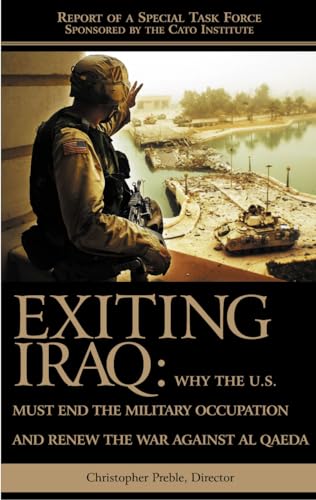
Exiting Iraq: Why the U.S. Must End the Military Occupation and Renew the War Against Al Qaeda - Softcover
Inhaltsangabe
With the continuing U.S. occupation of Iraq, a special task force of scholars and policy experts calls into question the Bush administration's intention to stay as long as necessary. In this joint statement, the members argue that the presence of troops in Iraq distracts attention from fighting Al Qaeda and emboldens a new class of terrorists to take up arms against the United States. The task force's findings are essential reading for anyone concerned with the ongoing conflict and the war on terrorism
Die Inhaltsangabe kann sich auf eine andere Ausgabe dieses Titels beziehen.
Über die Autorin bzw. den Autor
By Chris Preble
Auszug. © Genehmigter Nachdruck. Alle Rechte vorbehalten.
EXITING IRAQ
WHY THE U.S. MUST END THE MILITARY OCCUPATION AND RENEW THE WAR AGAINST AL QAEDABy CHRISTOPHER PREBLECATO INSTITUTE
Copyright © 2004 Cato InstituteAll right reserved.
ISBN: 978-1-930865-64-8
Contents
Foreword.........................................................................................................ixExecutive Summary................................................................................................1Introduction.....................................................................................................51. A Long-Term Military Occupation of Iraq Is Not in the Best Interests of the United States.....................112. The Occupation of Iraq Is Counterproductive to Addressing The Terror Threat...................................193. A Long-Term Military Occupation Is Burdensome, Risky, and Ultimately Unsustainable............................354. A Democratic Middle East Is a Chimera.........................................................................455. How We Get Out................................................................................................53Conclusion.......................................................................................................69Notes............................................................................................................73Task Force Members...............................................................................................81
Chapter One
A Long-Term Military Occupation of Iraq Is Not in the Best Interests of the United States
The American military's swift victory over the Baathist regime in Iraq in April 2003 set the stage for a shift in U.S. military deployments in the region. The shift began with Defense Secretary Donald Rumsfeld's announcement on April 29, 2003, less than three weeks after the fall of Baghdad, that U.S. troops would be removed from Saudi Arabia, where they had been stationed since late 1990. "It is now a safer region because of the change of regime in Iraq," the secretary said. The withdrawal was implemented in short order, and all U.S. military personnel were out of the kingdom by the end of August. Drawing on the early lessons learned from the just-concluded war, Rumsfeld's announcement represented a significant change in U.S. policy in the Persian Gulf, and it was entirely appropriate given the nature of the threats in the region. But that beneficial change will mean little if we merely replace a U.S. military presence in Saudi Arabia with an equally provocative and draining long-term presence in Iraq.
Before the start of the war, many people in the U.S. foreign policy community argued against an extended occupation of Iraq, recognizing that such a presence would be resented both by the Iraqis themselves and in the wider Arab and Muslim world. As a candidate for the presidency, George Bush, concerned about the United States being seen as an arrogant nation, questioned America's right to "go around the world and say, 'This is the way it's got to be.'" And, yet, that is precisely the message conveyed by a U.S. military presence in Iraq.
Unfortunately, many political leaders and opinion makers, on both the left and the right, believe that the United States must "stay the course" and maintain the U.S. occupation for an extended period of time-although many of those people are vague about just how long that might be. Sen. John Kerry (D-MA) asserted that "extremists" in Iraq could not force a "premature withdrawal of U.S. troops" and could not shake the U.S. commitment "to help the Iraqis build a stable, peaceful and pluralistic society." Noting President Bush's similar pledge to "complete the mission," the editors of USA Today opined that the "tricky dance" for both men involved "devising a revised exit plan that doesn't bog down U.S. forces in Iraq indefinitely or result in a premature pullout.... The challenge for Bush and Kerry is to head off pressure for an early pullout by finding a steady path for completing the job."
A vocal minority goes one step further, arguing that U.S. troops must remain in Iraq indefinitely. Tom Donnelly of the American Enterprise Institute maintained that U.S. interests at stake in Iraq increased following Saddam Hussein's ouster. "The liberation of Iraq adds to the substantial list of U.S. interests in the region," wrote Donnelly in the Weekly Standard in May 2003, and he called for a "quasi-permanent American garrison in Iraq" to protect those interests. When Rumsfeld asserted that the Pentagon was not planning to keep permanent bases in Iraq, avowed imperialist Max Boot of the Council on Foreign Relations exclaimed, "If they're not, they should be." Indeed, Boot called on USA Today readers to "get used to U.S. troops being deployed [in Iraq] for years, possibly decades, to come."
Some people have used the rhetoric of democratization and political liberalization to justify a continued military occupation of Iraq. That sentiment flows from the belief that the creation of an Iraqi democracy is America's primary duty even after the fall of Saddam and the failure to find WMD. The general reasons for the support of Iraqi democracy are twofold: first, the humanitarian idea of democracy for democracy's sake and, second, the notion that democratic regimes tend not to threaten U.S. national security interests. According to AEI's Donnelly, the goal of the U.S. military presence in Iraq is "to secure a complete victory that will provide a foundation for Iraqi democracy." Richard Perle, former chair of the Pentagon's influential Defense Policy Board, stated that, even after the liberation of Iraq from Saddam Hussein, the United States had a further obligation to liberate Iraqi society "from poverty, from corruption, and from the absence of a decent political life."
Many supporters of a long-term military occupation believe that the United States has moral responsibility "for preserving the liberal international order," so that the fruits of liberal democratic society can be known in parts of the world hitherto isolated from the progress of civilization. Iraq will be the political guinea pig for a new era of U.S.-led democratization and regime change. Two of the leading proponents of war with Iraq, the New Republic's Lawrence Kaplan and William Kristol of the Weekly Standard, contend that the existence of the first Arab democracy in Iraq will "demonstrate the compatibility of our ideals and interests" to critics abroad and make the world a "safer and better place." Reuel Marc Gerecht of the American Enterprise Institute went even further, proclaiming in an article in the Weekly Standard in December 2003, "The United States' standing in the Middle East and the world depends upon the transformation of American power into Iraqi democracy." However, supporters of that point of view have noted that there are other U.S. interests involved in democratization, interests that lie beyond a simply humanitarian ethos. In a Project for the New American Century "Statement on Post-War Iraq," the signatories argued that the democratization of Iraq was not only desirable on a humanitarian level, but that it was "an objective of overriding strategic importance to the United States." That was the point of view affirmed by President Bush in a nationally televised press conference in April 2004. "We're not going to leave. We're going to do the job," the president said. "A free Iraq in the midst of the Middle East is vital to future peace and security."
That argument feeds into a...
„Über diesen Titel“ kann sich auf eine andere Ausgabe dieses Titels beziehen.
Suchergebnisse für Exiting Iraq: Why the U.S. Must End the Military Occupation...

Beispielbild für diese ISBN
Exiting Iraq: Why the U.S. Must End the Military Occupation and Renew the War Against Al Qaeda
Anbieter: Wonder Book, Frederick, MD, USA
Verkäuferbewertung 5 von 5 Sternen

Zustand: Very Good. . Artikel-Nr. O13H-00627
Gebraucht kaufen
EUR 4,95
Versand gratis
Versand innerhalb von USA
Versand innerhalb von USA
Anzahl: 1 verfügbar
Beispielbild für diese ISBN
Exiting Iraq: Why the U.S. Must End the Military Occupation and Renew the War Against Al Qaeda
Anbieter: Wonder Book, Frederick, MD, USA
Verkäuferbewertung 5 von 5 Sternen
Zustand: Good. Good condition. A copy that has been read but remains intact. May contain markings such as bookplates, stamps, limited notes and highlighting, or a few light stains. Artikel-Nr. P14U-00948
Gebraucht kaufen
EUR 7,14
Versand gratis
Versand innerhalb von USA
Versand innerhalb von USA
Anzahl: 1 verfügbar
Beispielbild für diese ISBN
Exiting Iraq: Why the U.S. Must End the Military Occupation and Renew the War Against Al Qaeda
Anbieter: Wonder Book, Frederick, MD, USA
Verkäuferbewertung 5 von 5 Sternen
Zustand: Very Good. Very Good condition. A copy that may have a few cosmetic defects. May also contain light spine creasing or a few markings such as an owner's name, short gifter's inscription or light stamp. Artikel-Nr. V05C-03159
Gebraucht kaufen
EUR 7,14
Versand gratis
Versand innerhalb von USA
Versand innerhalb von USA
Anzahl: 3 verfügbar
Beispielbild für diese ISBN
Exiting Iraq : Why the U. S. Must End the Military Occupation and Renew the War Against Al Qaeda
Anbieter: Better World Books, Mishawaka, IN, USA
Verkäuferbewertung 5 von 5 Sternen
Zustand: Very Good. Pages intact with possible writing/highlighting. Binding strong with minor wear. Dust jackets/supplements may not be included. Stock photo provided. Product includes identifying sticker. Better World Books: Buy Books. Do Good. Artikel-Nr. 57757970-6
Gebraucht kaufen
EUR 8,34
Versand gratis
Versand innerhalb von USA
Versand innerhalb von USA
Anzahl: 2 verfügbar
Beispielbild für diese ISBN
Exiting Iraq: Why the U.S. Must End the Military Occupation and Renew the War Against Al Qaeda
Anbieter: Sell Books, Elland, YORKS, Vereinigtes Königreich
Verkäuferbewertung 5 von 5 Sternen
paperback. Zustand: Good. Our good condition books are generally good for reading but not for gifting or collecting. They could have imperfections such as creasing, fanning, inscriptions, margin notes, yellowing, staining on edge or cover or pages, bumps, scuffs, etc etc (sometimes multiple of these). It's a wide category that encompasses anything that isn't almost-new down to anything that is slightly better than poor. We would NOT recommend gifting Good books - these should be considered reading copies. Our books are dispatched from a Yorkshire former cotton mill. We list via barcode/ISBN so please note that the images are stock images and may not be the exact copy you receive, furthermore the details about edition and year might not be accurate as many publishers reuse the same ISBN for multiple editions and as we simply scan a barcode or enter an ISBN we do not check the validity of the edition data when listing. If you're looking for an exact edition please don't order (at least not without checking with us first, although we don't always have time to check). We aim to dispatch prompty, the service used will depend on order value and book size. We can ship to most countries, see our shipping policies. Payment is via Abe only. Artikel-Nr. SBAB-L-BIN00061-RAG-20230721-G
Gebraucht kaufen
EUR 8,43
EUR 9,18 Versand
Versand von Vereinigtes Königreich nach USA
Versand von Vereinigtes Königreich nach USA
Anzahl: 1 verfügbar
Beispielbild für diese ISBN
Exiting Iraq: Why the U. S. Must End the Military Occupation and Renew the War Against Al Qaeda
Verlag:
Cato Institute, Washington, DC, 2004
ISBN 10: 1930865643
ISBN 13: 9781930865648
Gebraucht
Trade paperback
Erstausgabe
Anbieter: Ground Zero Books, Ltd., Silver Spring, MD, USA
Verkäuferbewertung 5 von 5 Sternen
Trade paperback. Zustand: Very good condition. Presumed first edition/first printing. xi, 83 pages. Notes. No dust jacket as issued. With the continuing U.S. occupation of Iraq, a special task force of scholars and policy experts calls into question the Bush administration's intention to stay as long as necessary. In this joint statement, the members argue that the presence of troops in Iraq distracts attention from fighting Al Qaeda and emboldens a new class of terrorists to take up arms against the United States. The task force's findings are essential reading for anyone concerned with the ongoing conflict and the war on terrorism. Artikel-Nr. 57682
Gebraucht kaufen
EUR 22,96
EUR 4,46 Versand
Versand innerhalb von USA
Versand innerhalb von USA
Anzahl: 1 verfügbar
Beispielbild für diese ISBN
Exiting Iraq: Why the U.S. Must End the Military Occupation and Renew the War Against Al Qaeda
Anbieter: Versandantiquariat Bookuck, Georgensgmünd, RH, Deutschland
Verkäuferbewertung 5 von 5 Sternen
paperback. Zustand: Sehr gut. 98 Seiten; Ge296,72 Sprache: Deutsch Gewicht in Gramm: 2. Artikel-Nr. 10629
Gebraucht kaufen
EUR 12,90
EUR 19,99 Versand
Versand von Deutschland nach USA
Versand von Deutschland nach USA
Anzahl: 1 verfügbar