
Verwandte Artikel zu Tailships: The Hunt for Soviet Submarines in the Mediterrane...
Tailships: The Hunt for Soviet Submarines in the Mediterranean, 1970-1973 (Europe at War, 38) - Softcover
Buch 36 von 85: Europe@War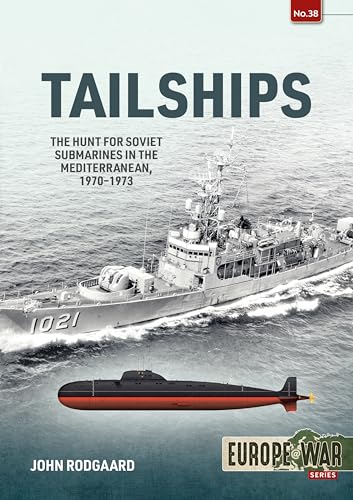
Inhaltsangabe
An illustrated history of America's hunt for Soviet submarines in the early 1970s.Obsolete, except for the experimental anti-submarine warfare sensor they carried, the USS Hammerberg, DE-1015, the USS Courtney, DE-1021 and the USS Lester, DE-1022 went to the Mediterranean to demonstrate the potential of a technology that relied on a passive towed array detection system; what the Navy officially designated as the Interim Towed Array Surveillance System (ITASS).These ‘Tailships’ entered the Med in 1970. It was then that the US and NATO navies operated in a naval environment characterized by the most intense concentration of Soviet submarines and surface ships outside of Soviet home waters. The Mediterranean was the focal point in the great naval rivalry of the United States, with its NATO allies, against the Soviet Union’s Voyenno-morskoi flot (Military Maritime Fleet).When deployed as Tailships, these DEs proved so successful against Soviet submarines that the US Navy committed additional resources to refining the capability of passive towed array sonars. The development of the Towed Array Surveillance System (TASS), the Surveillance Towed Array Sonar System (SURTASS) and the Tactical Towed Array Sonar (TACTASS) deployable systems were direct follow-ons to ITASS.The ships’ deployment occurred during a time when the United States was torn apart by the war in Vietnam. Although far away, the effect of Vietnam on the ships’ crews as well as the Sixth Fleet reflected the greater turmoil within the society they served. The turmoil was evident in the competition for resources to keep the ships steaming and in personnel tensions among the crews.Additionally, the ships and men operated in a sea surrounded by increasing tensions in the Middle East. While stationed in Naples, Italy, the Palestinian Black September Organization created terror across Europe during the summer of 1972, with the massacre of the Israeli Olympic athletes in Munich, West Germany. That summer would see these sailors spending nights in Naples standing anti-terrorist watches with loaded weapons, whilst the pinging of an active sonar system would echo throughout the hulls of the moored ships. It was thought this would discourage swimmers wanting to plant explosive devices on ship hulls.The objective of this book is simply to tell the story of these three ships and their men within the context of the greater events of the Cold War at sea in the Mediterranean; the successes and failures of operating in the Mediterranean, and life for those who called Naples their temporary home.
Die Inhaltsangabe kann sich auf eine andere Ausgabe dieses Titels beziehen.
Über die Autorin bzw. den Autor
Captain John Rodgaard USN (Rtd) has over 41 years with the naval service of the United States, including 12 years as a petty officer and 29 years of commissioned service as a naval intelligence officer. He was the recipient of the Naval Institute's History Author of the Year award in 1999. He is chairman of The 1805 Club.
„Über diesen Titel“ kann sich auf eine andere Ausgabe dieses Titels beziehen.
Suchergebnisse für Tailships: The Hunt for Soviet Submarines in the Mediterrane...

Beispielbild für diese ISBN
Tailships: The Hunt for Soviet Submarines in the Mediterranean, 1970-1973 (Europe@War)
Anbieter: Books From California, Simi Valley, CA, USA
Verkäuferbewertung 4 von 5 Sternen

paperback. Zustand: Very Good. Artikel-Nr. mon0004011503
Gebraucht kaufen
EUR 19,33
EUR 4,47 Versand
Versand innerhalb von USA
Versand innerhalb von USA
Anzahl: 1 verfügbar
Beispielbild für diese ISBN
Tailships: The Hunt for Soviet Submarines in the Mediterranean, 1970-1973 (Europe@War)
Anbieter: Books From California, Simi Valley, CA, USA
Verkäuferbewertung 4 von 5 Sternen
paperback. Zustand: Fine. Artikel-Nr. mon0003963394
Gebraucht kaufen
EUR 20,02
EUR 4,47 Versand
Versand innerhalb von USA
Versand innerhalb von USA
Anzahl: 1 verfügbar
Beispielbild für diese ISBN
Tailships
Anbieter: PBShop.store UK, Fairford, GLOS, Vereinigtes Königreich
Verkäuferbewertung 5 von 5 Sternen

PAP. Zustand: New. New Book. Shipped from UK. Established seller since 2000. Artikel-Nr. GB-9781914377099
Neu kaufen
EUR 21,84
EUR 4,92 Versand
Versand von Vereinigtes Königreich nach USA
Versand von Vereinigtes Königreich nach USA
Anzahl: 2 verfügbar
Beispielbild für diese ISBN
Tailships: The Hunt for Soviet Submarines in the Mediterranean, 1970-1973 (Europe@War)
Anbieter: Ria Christie Collections, Uxbridge, Vereinigtes Königreich
Verkäuferbewertung 5 von 5 Sternen
Zustand: New. In English. Artikel-Nr. ria9781914377099_new
Neu kaufen
EUR 25,20
EUR 11,09 Versand
Versand von Vereinigtes Königreich nach USA
Versand von Vereinigtes Königreich nach USA
Anzahl: 2 verfügbar
Beispielbild für diese ISBN
Tailships: The Hunt for Soviet Submarines in the Mediterranean, 1970-1973
Anbieter: Revaluation Books, Exeter, Vereinigtes Königreich
Verkäuferbewertung 5 von 5 Sternen
Paperback. Zustand: Brand New. 104 pages. 11.75x8.25x0.30 inches. In Stock. Artikel-Nr. __1914377095
Neu kaufen
EUR 23,14
EUR 14,80 Versand
Versand von Vereinigtes Königreich nach USA
Versand von Vereinigtes Königreich nach USA
Anzahl: 2 verfügbar
Beispielbild für diese ISBN
Tailships
Anbieter: Kennys Bookstore, Olney, MD, USA
Verkäuferbewertung 5 von 5 Sternen
Zustand: New. 2023. paperback. . . . . . Books ship from the US and Ireland. Artikel-Nr. V9781914377099
Neu kaufen
EUR 28,94
EUR 9,41 Versand
Versand innerhalb von USA
Versand innerhalb von USA
Anzahl: 2 verfügbar
Beispielbild für diese ISBN
Tailships: The Hunt for Soviet Submarines in the Mediterranean, 1970-1973
Anbieter: Revaluation Books, Exeter, Vereinigtes Königreich
Verkäuferbewertung 5 von 5 Sternen
Paperback. Zustand: Brand New. 104 pages. 11.75x8.25x0.30 inches. In Stock. Artikel-Nr. zk1914377095
Neu kaufen
EUR 29,18
EUR 14,80 Versand
Versand von Vereinigtes Königreich nach USA
Versand von Vereinigtes Königreich nach USA
Anzahl: 1 verfügbar
Foto des Verkäufers
Tailships : The Hunt for Soviet Submarines in the Mediterranean, 1970-1973
Anbieter: AHA-BUCH GmbH, Einbeck, Deutschland
Verkäuferbewertung 5 von 5 Sternen
Taschenbuch. Zustand: Neu. Neuware - 'Both from the analytic description of the scientific background to that of the author's firsthand human experience, to the historical development of the technology, to the political and strategic context of the time, this book contains a LOT - including an extremely important collection of sources referenced in its notes and bibliography.' -- National Maritime Historical SocietyObsolete, except for the experimental anti-submarine warfare sensor they carried, the USS Hammerberg, DE-1015, the USS Courtney, DE-1021 and the USS Lester, DE-1022 went to the Mediterranean to demonstrate the potential of a technology that relied on a passive towed array detection system; what the Navy officially designated as the Interim Towed Array Surveillance System (ITASS).These 'Tailships' entered the Med in 1970. It was then that the US and NATO navies operated in a naval environment characterized by the most intense concentration of Soviet submarines and surface ships outside of Soviet home waters. The Mediterranean was the focal point in the great naval rivalry of the United States, with its NATO allies, against the Soviet Union's Voyenno-morskoi flot (Military Maritime Fleet).When deployed as Tailships, these DEs proved so successful against Soviet submarines that the US Navy committed additional resources to refining the capability of passive towed array sonars. The development of the Towed Array Surveillance System (TASS), the Surveillance Towed Array Sonar System (SURTASS) and the Tactical Towed Array Sonar (TACTASS) deployable systems were direct follow-ons to ITASS.The ships' deployment occurred during a time when the United States was torn apart by the war in Vietnam. Although far away, the effect of Vietnam on the ships' crews as well as the Sixth Fleet reflected the greater turmoil within the society they served. The turmoil was evident in the competition for resources to keep the ships steaming and in personnel tensions among the crews.Additionally, the ships and men operated in a sea surrounded by increasing tensions in the Middle East. While stationed in Naples, Italy, the Palestinian Black September Organization created terror across Europe during the summer of 1972, with the massacre of the Israeli Olympic athletes in Munich, West Germany. That summer would see these sailors spending nights in Naples standing anti-terrorist watches with loaded weapons, whilst the pinging of an active sonar system would echo throughout the hulls of the moored ships. It was thought this would discourage swimmers wanting to plant explosive devices on ship hulls.The objective of this book is simply to tell the story of these three ships and their men within the context of the greater events of the Cold War at sea in the Mediterranean; the successes and failures of operating in the Mediterranean, and life for those who called Naples their temporary home. Artikel-Nr. 9781914377099
Neu kaufen
EUR 27,44
EUR 35,00 Versand
Versand von Deutschland nach USA
Versand von Deutschland nach USA
Anzahl: 2 verfügbar
Beispielbild für diese ISBN
TAILSHIPS
Anbieter: Speedyhen, Hertfordshire, Vereinigtes Königreich
Verkäuferbewertung 5 von 5 Sternen
Zustand: NEW. Artikel-Nr. NW9781914377099
Neu kaufen
EUR 18,88
EUR 48,53 Versand
Versand von Vereinigtes Königreich nach USA
Versand von Vereinigtes Königreich nach USA
Anzahl: 2 verfügbar
Foto des Verkäufers
Tailships: Hunting Soviet Submarines in the Mediteranean 1970-1973
Anbieter: moluna, Greven, Deutschland
Verkäuferbewertung 5 von 5 Sternen
Zustand: New. Über den AutorCaptain John Rodgaard USN (Rtd) has over 41 years with the naval service of the United States, including 12 years as a petty officer and 29 years of commissioned service as a naval intelligence officer. He was the reci. Artikel-Nr. 459831089
Neu kaufen
EUR 25,87
EUR 48,99 Versand
Versand von Deutschland nach USA
Versand von Deutschland nach USA
Anzahl: 2 verfügbar