
Verwandte Artikel zu The Flying Shadow (Handheld World War 2 Classics, 6)
Inhaltsangabe
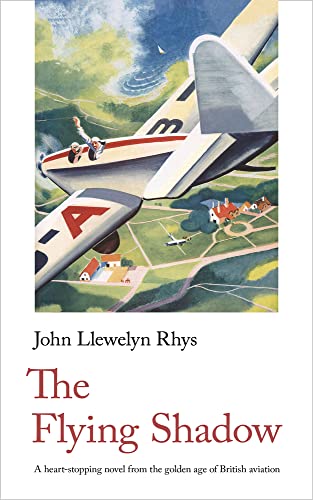
In the 1930s, flying was all the rage. All over Britain women and men had grown up watching wartime flying aces perform aerobatics in the sky. Now they too were learning how to fly.
Robert Owen is the only son from a Welsh vicarage, now a brilliant pilot and flying instructor, recently of the Royal Air Force. He has taken a new job at the flying school at Best, a prosperous cathedral town in England.
Flying has never seemed so alluring and so terrifying. Human frailty is tested in the drilling and repetition of hours in flight, and Robert’s skills as a pilot and in diplomacy with pupils with delusions about their competence are tested to their limits. And then he falls in love, risking his heart as well as his body in the air.
Die Inhaltsangabe kann sich auf eine andere Ausgabe dieses Titels beziehen.
Über die Autorinnen und Autoren
John Llewelyn Rees (1911-1940) was a British author and Royal Air Force pilot who died in August 1940 during a training exercise during the Second World War, north of London. His widow, the novelist Jane Oliver (also published by Handheld) established the John Llewelyn Rhys Prize for young writers in 1942.
Daniel Kilburn is a Lecturer in Geography and the Built Environment at University College London, where his teaching and research spans urbanism, global mobilities and social research methodologies. He is a licensed private pilot with some experience with a range of aircraft types. He lives in Liverpool, UK.
Luke Seaber is a Senior Teaching Fellow in Modern European Culture at University College London. He is the author and editor of various works on British literature in the nineteenth and twentieth centuries, including (with Michael McCluskey) Aviation in the Literature and Culture of Interwar Britain (2020). He lives in London.
Auszug. © Genehmigter Nachdruck. Alle Rechte vorbehalten.
For scores of miles there was no movement, nothing but the sunny emptiness of the sky and the hard, white floor of the clouds, the enormous silence pricked by the stutter of the engine. For the hundredth time the beauty of such a scene hooded his mind, the sense of overwhelming desolation intensifying his realization of individuality. Nothing in the world, he thought, was as lonely as this, no scene so static in beauty, so expansive in monotony.
‘Now the aircraft is completely stalled. When I move the stick about the cockpit, it has no effect upon ailerons and elevators, the sound of the wind in the wires has died away. To spin I pull the stick right back and apply full right rudder.’
As the nose of the aircraft swung sharply downwards the horizon heeled till it disappeared overhead, the whiteness of the clouds whirling up to meet them.
***
‘You look horribly worried, Robert,’ said Janet when the game was over.
‘Doesn’t he?’ murmured Mrs Hateling.
‘It’s probably about your landings,’ Janet went on.
‘She lands very nicely,’ Robert said.
‘M’m. I got them all this morning –’
‘Though some of them were wheel landings.’
‘Do they count as bad ones?’
‘They’re quite safe, but you have to do consistent tail-down landings for your ‘A’ licence.’
‘Well, all I’m worried about now is going solo.’
‘I wouldn’t worry about that if I were you,’ said Janet. ‘Going solo is like sex, there’s not so much in it as people would have one believe.’
‘There’s a dreadful smartness about you, Janet,’ said Robert, ‘that makes me thankful I belong to the last generation.’
‘But you don’t. You were a small boy when the War was on, weren’t you?’ He nodded, and the girl went on, ‘Then you belong to us!’
***
He was horribly frightened, very cool, very certain of himself. There was a causeway of railway sleepers running between two rows of half-built houses upon which a Gipsy Moth might conceivably be landed.
Without hesitation he slammed the Moth into a steep turn, pulling out as she stalled. Down went the nose again till the wires sang. He became aware of his pupil, who was screaming something about a crash and clutching the stick so that he had to use both hands to keep it forward.
He skid-slipped a few feet off and, ten seconds later he dropped the ’plane for a perfect landing, the tail-skid rattling on the uneven sleepers. The Moth bumped to rest, the airscrew within ten yards of a slovenly fence. As he swung himself to the ground he took a deep breath and let it out very slowly. The Moth was undamaged and his pupil had fainted.
-- John Llewelyn Rhys ― The Flying Shadow„Über diesen Titel“ kann sich auf eine andere Ausgabe dieses Titels beziehen.
Suchergebnisse für The Flying Shadow (Handheld World War 2 Classics, 6)

Beispielbild für diese ISBN
The Flying Shadow (Handheld Classics, 29)
Anbieter: WorldofBooks, Goring-By-Sea, WS, Vereinigtes Königreich
Verkäuferbewertung 5 von 5 Sternen

Paperback. Zustand: Fine. Artikel-Nr. GOR013273931
Gebraucht kaufen
EUR 3,41
EUR 6,63 Versand
Versand von Vereinigtes Königreich nach USA
Versand von Vereinigtes Königreich nach USA
Anzahl: 1 verfügbar
Beispielbild für diese ISBN
The Flying Shadow
Anbieter: Better World Books Ltd, Dunfermline, Vereinigtes Königreich
Verkäuferbewertung 5 von 5 Sternen
Zustand: Very Good. Former library copy. Pages intact with possible writing/highlighting. Binding strong with minor wear. Dust jackets/supplements may not be included. Includes library markings. Stock photo provided. Product includes identifying sticker. Better World Books: Buy Books. Do Good. Artikel-Nr. 55257120-20
Gebraucht kaufen
EUR 6,13
EUR 5,92 Versand
Versand von Vereinigtes Königreich nach USA
Versand von Vereinigtes Königreich nach USA
Anzahl: 1 verfügbar
Beispielbild für diese ISBN
The Flying Shadow: 6 (Handheld World War 2 Classics, 6)
Anbieter: AwesomeBooks, Wallingford, Vereinigtes Königreich
Verkäuferbewertung 5 von 5 Sternen
Paperback. Zustand: Very Good. The Flying Shadow: 6 (Handheld World War 2 Classics, 6) This book is in very good condition and will be shipped within 24 hours of ordering. The cover may have some limited signs of wear but the pages are clean, intact and the spine remains undamaged. This book has clearly been well maintained and looked after thus far. Money back guarantee if you are not satisfied. See all our books here, order more than 1 book and get discounted shipping. . Artikel-Nr. 7719-9781912766642
Gebraucht kaufen
EUR 10,51
EUR 4,88 Versand
Versand von Vereinigtes Königreich nach USA
Versand von Vereinigtes Königreich nach USA
Anzahl: 1 verfügbar
Beispielbild für diese ISBN
The Flying Shadow: 6 (Handheld World War 2 Classics, 6)
Verlag:
Handheld Classics 02/v /15 N, 2022
ISBN 10: 1912766647
ISBN 13: 9781912766642
Gebraucht
Paperback
Anbieter: Bahamut Media, Reading, Vereinigtes Königreich
Verkäuferbewertung 4 von 5 Sternen

Paperback. Zustand: Very Good. Shipped within 24 hours from our UK warehouse. Clean, undamaged book with no damage to pages and minimal wear to the cover. Spine still tight, in very good condition. Remember if you are not happy, you are covered by our 100% money back guarantee. Artikel-Nr. 6545-9781912766642
Gebraucht kaufen
EUR 10,51
EUR 8,26 Versand
Versand von Vereinigtes Königreich nach USA
Versand von Vereinigtes Königreich nach USA
Anzahl: 1 verfügbar
Beispielbild für diese ISBN
The Flying Shadow
Anbieter: Revaluation Books, Exeter, Vereinigtes Königreich
Verkäuferbewertung 5 von 5 Sternen
Paperback. Zustand: Brand New. reprint edition. 201 pages. 8.25x5.00x0.50 inches. In Stock. Artikel-Nr. __1912766647
Neu kaufen
EUR 15,84
EUR 11,84 Versand
Versand von Vereinigtes Königreich nach USA
Versand von Vereinigtes Königreich nach USA
Anzahl: 1 verfügbar
Beispielbild für diese ISBN
The Flying Shadow (Handheld World War 2 Classics, 6)
Anbieter: Roundabout Books, Greenfield, MA, USA
Verkäuferbewertung 4 von 5 Sternen
paperback. Zustand: New. Condition Notes: New from the publisher. Artikel-Nr. 1658437