
Verwandte Artikel zu Emily Brontë Reappraised: A View From The Twenty-First...
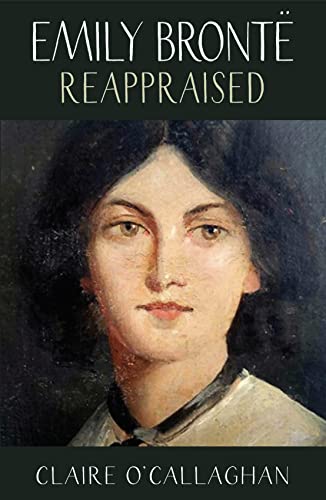
Emily Brontë Reappraised: A View From The Twenty-First Century (Women Writers Rediscovered) - Softcover
Inhaltsangabe
“Thoughtful…an informally written, no-nonsense reappraisal” – Jacqueline Banerjee, Times Literary Supplement.
Emily Brontë occupies a special place in the English literary canon. And rightly so: the incomparable Wuthering Heights is a novel that has bewitched us for almost 200 years, and the character of Heathcliff is, perhaps, the ultimate romantic hero – and villain. But Emily herself remains an enigmatic figure, often portrayed as awkward, as a misanthrope, as “no normal being”. That’s the conventional wisdom on Emily as a person, but is it accurate, is it fair?
In this biography with a twist, Claire O’Callaghan conjures a new image of Emily and rehabilitates her reputation by exploring the themes of her life and work – her feminism, her passion for the natural world – as well as the art she has inspired, and even the ‘fake news’ stories about her. What we discover is that she was, in fact, a thoroughly modern woman. And now, in the 21st century, it’s time for the real Emily Brontë to please stand up.
Die Inhaltsangabe kann sich auf eine andere Ausgabe dieses Titels beziehen.
Über die Autorin bzw. den Autor
<p>Dr Claire O'Callaghan is a Lecturer in English in the School of Arts, English and Drama at Loughborough University, where her research focuses on Victorian and neo-Victorian literature and culture, with an emphasis on gender, sexuality and queerness. She has published widely on these topics.
Auszug. © Genehmigter Nachdruck. Alle Rechte vorbehalten.
Why all the fuss? She wanted liberty. Well, didn’t she have it? A reasonably satisfactory home life, a most satisfactory dream-life―why then all this beating of wings? What was this cage, invisible to us, which she felt herself to be confined in?’ So said Cecil Day Lewis in 1957. The horror he expresses in this article (published in Brontë Society Transactions, now Brontë Studies) towards the idea that women might dream of something more than domesticity seems rather humorous today. But, sadly, it’s also indicative of the way in which, historically, especially in the mid-19th century, a woman’s place was considered to be in the home. The Brontës wrote at a time during which the ideology of separate spheres was dominant in middle-class households. While women were said to govern the domestic sphere, men had far more freedom, enjoying life in the public world. Theirs was a world of education, medicine, science, travel, employment, business, the military and government. Women had no such power nor were their attempts to leave their ‘proper’ place welcomed, as Cecil Day Lewis’ comment indicates.
Within the history of feminism, then, the Brontës have an important place. Their works come after the ‘birth’ of feminism, which is nominally marked as the publication of Mary Wollstonecraft’s A Vindication of the Rights of Woman in 1792, but before the advent of the first wave of feminism in the late 19th century, which focused on women’s legal emancipation. Charlotte’s Jane Eyre is considered by many to be an early feminist novel, and readings of the text have been enriched since the rise of literary feminisms led by critics such as Sandra Gilbert and Susan Gubar in the late 1970s.
Anne’s work too, especially The Tenant of Wildfell Hall, has long been recognised (probably much to Charlotte’s horror) as a feminist manifesto of sorts. Yet, for some reason, despite the work of feminist critics, such as Lynn Pykett and Stevie Davies, both of whom have provided rich insights into Emily’s gender agenda, she’s not so readily recognised as a feminist in the same manner as her sisters. One reason for this is that, as Davies notes, Emily was ‘publicly silent’ about ‘feminist social issues on which her sisters took up outspoken positions’. What Davies indicates here is that neither Emily’s poetry nor Wuthering Heights include such an impassioned speech as that spoken by Jane to Mr Rochester in Charlotte’s novel: ‘Do you think, because I am poor, obscure, plain, and little, I am soulless and heartless? You think wrong!―I have as much soul as you,―and full as much heart! And if God had gifted me with some beauty and much wealth, I should have made it as hard for you to leave me, as it is now for me to leave you. I am not talking to you now through the medium of custom, conventionalities, nor even of mortal flesh;―it is my spirit that addresses your spirit; just as if both had passed through the grave, and we stood at God’s feet, equal,―as we are!’
Neither does Emily’s writing reveal any feminist declaration as offered by Anne in her preface to the second edition of The Tenant of Wildfell Hall: ‘if I have warned one rash youth from following in their steps, or prevented one thoughtless girl from falling into the very natural error of my heroine, the book has not been written in vain.’ But I disagree with Davies and think that Emily was a feminist (or more properly, protofeminist) and her work is, despite views to the contrary, readily accessible as such. It is just presented differently to her sisters.
„Über diesen Titel“ kann sich auf eine andere Ausgabe dieses Titels beziehen.
Suchergebnisse für Emily Brontë Reappraised: A View From The Twenty-First...

Beispielbild für diese ISBN
Emily Bronte Reappraised: A View From The Twenty-First Century (Women Writers Rediscovered)
Verlag:
Saraband, United Kingdom, Glasgow, 2018
ISBN 10: 1912235056
ISBN 13: 9781912235056
Gebraucht
Paperback
Anbieter: WorldofBooks, Goring-By-Sea, WS, Vereinigtes Königreich
Verkäuferbewertung 5 von 5 Sternen

Paperback. Zustand: Very Good. Revised edition of this biography with a twist about Emily Bronte, the subject of major 2022 filmEmilystarring Emma Mackey. Bronte scholarClaire O'Callaghan conjures a new image of EmilyBronte and rehabilitates her reputation by exploring the themes of her life and work. We discover that Emily was a thoroughly modern woman. EmilyBronte occupies a special place in the English literary canon. And rightly so: the incomparableWuthering Heightsis a novel that has bewitched us for almost 200 years, and the character of Heathcliff is, perhaps, the ultimate romantic heroand villain. But Emily herself remains an enigmatic figure, often portrayed as awkward, as a misanthrope, as no normal being. That's the conventional wisdom on Emily as a person, but is it accurate? Is it fair? It's time for the real Emily Bronteto please stand up. The book has been read, but is in excellent condition. Pages are intact and not marred by notes or highlighting. The spine remains undamaged. Artikel-Nr. GOR009213019
Gebraucht kaufen
EUR 10,22
EUR 6,53 Versand
Versand von Vereinigtes Königreich nach USA
Versand von Vereinigtes Königreich nach USA
Anzahl: 4 verfügbar
Beispielbild für diese ISBN
Emily Brontë Reappraised: A View From The Twenty-First Century
Anbieter: Revaluation Books, Exeter, Vereinigtes Königreich
Verkäuferbewertung 5 von 5 Sternen
Paperback. Zustand: Brand New. 192 pages. 7.50x5.00x0.75 inches. In Stock. Artikel-Nr. 1912235056
Neu kaufen
EUR 32,02
EUR 11,66 Versand
Versand von Vereinigtes Königreich nach USA
Versand von Vereinigtes Königreich nach USA
Anzahl: 1 verfügbar