
Verwandte Artikel zu Developing As a Reflective Early Years Professional:...
Inhaltsangabe
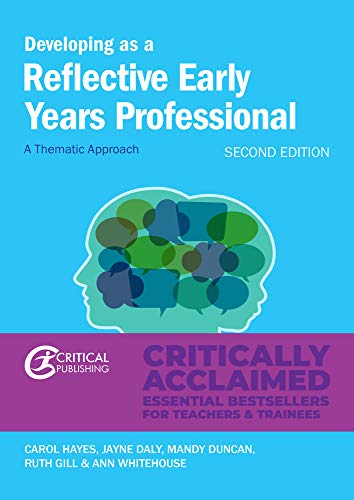
Provides an accessible yet critical approach to key themes within the early years, with a focus throughout on reflective practice.
It starts by examining theories and research into the nature of reflection, how it can be used and how it can improve practice and produce a more responsive and thoughtful, research-based workforce for young children and their families. A range of themes, including global childhood poverty, observation and assessment, leadership, and multi-professional working, are then explored, highlighting the importance and application of reflection throughout these areas of research and practice.
This new edition includes two completely new chapters on reflecting on work-based learning and reflecting on children’s play and creativity. Information on mentoring and on the position of men in early years higher education has also been added. Greater depth and challenge is provided through extended thinking questions and extended reflections at the end of each chapter.
Die Inhaltsangabe kann sich auf eine andere Ausgabe dieses Titels beziehen.
Über die Autorin bzw. den Autor
Carol Hayes worked in early years for over 40 years as a teacher and tutor. She most recently worked at Staffordshire University as a principal lecturer and academic group leader where she helped to develop a thriving early childhood studies department with programmes from Foundation Degrees to Masters. Her specialist area is cognitive development, language, literacy and communication. Her main research interests are dyslexia and communication difficulties and graduate teaching assistants in the workforce.
Jayne Daly has worked in early years for the past 25 years as a nursery officer (NNEB), an early years manager and tutor. Throughout her professional practice she has worked within the public care, health and education sectors. Her desire to ‘give something back’ to those new to providing positive outcomes for young children and their families pushed her forward into teaching within the higher education sector at Staffordshire University. She now teaches within the early childhood studies department at the University of Wolverhampton.
Mandy Duncan began her career as a nursery nurse 15 years ago, before training as a teacher. She worked initially with young children in primary schools in both inner city and rural areas and later with young people aged 14-19 in a further education college. She has been a lecturer in higher education for the last four years teaching on BA (Hons) and MA Early Childhood Studies and BA (Hons) Childhood & Youth Studies. She is currently engaged in doctoral research with young people undergoing child protection proceedings.
Ruth Gill's experience with children started as a children’s nanny to bereaved families and progressed to working in a Further Education based nursery as an assistant. She quickly progressed to management but continued to study at HE level. Teaching in HE allows her to share her passion for quality interactions between staff and children with a wide audience of new and experienced practitioners.
Ann Whitehouse started her career as an NNEB and worked for a number of years in nursery education. More recently, she has worked as an Early Years lecturer in FE and played an integral role in developing a Foundation Degree in Early Years for experienced practitioners. Most recently she was a Senior Lecturer at Staffordshire University, working with full-time and part-time students on Early Childhood Studies programmes and Award Leader for the Foundation Degree. Her specific interests are related to the development of early years' pedagogy.
Auszug. © Genehmigter Nachdruck. Alle Rechte vorbehalten.
Developing as a Reflective Early Years Professional
A Thematic Approach
By Carol Hayes, Jayne Daly, Mandy Duncan, Ruth Gill, Ann WhitehouseCritical Publishing Ltd
Copyright © 2017 Carol Hayes, Jayne Daly, Mandy Duncan, Ruth Gill and Ann Whitehouse
All rights reserved.
ISBN: 978-1-911106-22-7All rights reserved.
Contents
Praise for the first edition,
Meet the authors,
Foreword by Kathy Brodie,
1 The nature of reflective practice Carol Hayes,
2 Writing for reflection Ruth Gill,
3 Critical friends: the reflective facilitators Ann Whitehouse,
4 Reflecting on work-based learning Ruth Gill and Ann Whitehouse,
5 Reflecting on the transition from vocational practice to university study Jayne Daly,
6 Reflection informed by observation and assessment Carol Hayes,
7 Reflecting on emotionally enabled practice Ruth Gill,
8 Reflecting on racism in predominantly white settings Mandy Duncan,
9 Reflecting on global childhood poverty Mandy Duncan,
10 Reflecting upon childhood, creativity and play Jayne Daly,
11 The reflective leader Jayne Daly,
12 Reflecting on the multi-professional team Carol Hayes, Mandy Duncan and Ann Whitehouse,
13 Reflection and change Carol Hayes,
Index,
CHAPTER 1
The nature of reflective practice
CAROL HAYES
Harry stared at the stone basin. The contents had returned to their original, silvery-white state swirling and rippling beneath his gaze.
'What is it?' Harry asked shakily.
'This? It is called a Pensieve,' said Dumbledore. 'I sometimes find, and I am sure that you know the feeling, that I simply have too many thoughts and memories crammed into my mind.'
'Err,' said Harry who couldn't truthfully say that he had ever felt anything of the sort.
'At these times,' said Dumbledore, indicating the stone basin, 'I use the Pensieve. One simply siphons the excess thoughts from one's mind, pours them into the basin, and examines them at one's leisure. It becomes easier to spot patterns and links, you understand, when they are in this form.'
(J K Rowling, 2000)
What is reflection?
Can you swim? When you go to the swimming pool do you dive in with a flourish or do you lower yourself into the water carefully and with trepidation? Are you comfortable at the deep end where you cannot put your feet down or do you wade in slowly ensuring that you know how to get back?
Reflection is a little like this. You can lean over the pool looking at the blue water glistening in the sunlight and see your reflection looking back at you and while the pool is not disturbed your image is clear and easy to see. Once other people enter the pool the water starts to move and ripple and your reflection gets more difficult to assess. When children enter the water, the splashing and energy with which they engage makes it even harder to see your reflection clearly.
When you see your reflection in the water do you say
• Oh look there's me, or
• Is this what I want to be like?
When you look into the water do you see who you expect to see or can you see someone else at your shoulder? Those of you who are confident swimmers, like confident practitioners, are happy to take the plunge and accept the challenges of the deep water with no armbands or life jacket. As you dive in, the water opens up for you to see as you explore the depths of the pool, touching the bottom, perhaps gathering new things from the floor of the pool. These practitioners perfect their style and levels of confidence by listening to friends and instructors, talking to others who have observed them and perhaps reading about how water is displaced, aerodynamic shapes, speed and velocity.
However, most of us slip gingerly into the cold pool, putting a toe into the water of reflective practice; needing instructors to keep us afloat and to help us to take our feet off the bottom, change our style and review our practices.
It is common to hear early years practitioners say:
• We can do the job so why do we need to do more?
• I have been in the job for the last 30 years and have vast experience; I do not need to do more.
• Forget about what you were taught in college. This is the real world!
Sylva et al (2004) documented, in The Effective Provision of Pre-school Education (EPPE) Project, that early years settings run by critically reflective, well-qualified staff were more effectively run, more reflective and more open to change and challenge. The evidence for the importance of reflective practice is so compelling that it cannot be ignored any more.
Like the experienced swimmer and diver, the reflective practitioner is the one with vision, the ability to judge the depth of the water, the temperature of the water and the content of the water and has creative flair as they dive. With this ability they are able to be responsive and creative in their practice. The experienced swimming instructor is there to take you by the hand and guide you through further training, which will give you better understanding, develop your confidence and resilience and encourage your reflection upon events, critical incidents and experiences past, present and future. So too is a book like this designed to take you through the processes and hold your hand when the reflection appears scary, to raise your levels of confidence and your image as an advanced practitioner.
Reflection could be considered a synonym for 'thought process' which involves looking back at events and asking questions, looking forward and crystal ball gazing. Reflection involves a self-assessment or self-appraisal of practice and competence at a given time and in a given situation. It is about looking for learning points within the reflection, about striving for better understanding and eventually identifying future developmental needs.
Is there really a definition?
The original definition of reflection in education probably came from Dewey (1933), who discusses reflection in the light of professionalism, and this was developed further by Schön (1983), into a process he called 'reflective practice'. How often have you heard the phrase That's all very well in theory but what about here in the nursery, what use is that here in the real world? from practitioners looking for real solutions to real problems? However, Schön (1983) saw this as a serious misunderstanding of the relationship of theory to practice. He thought that attributing to professionals' knowledge and autonomy in their work granted them extraordinary rights and privileges in return for their very special contribution to society. His concern about this led to his idea that there are two types of reflection: reflection on action and reflection in action.
Reflection on action
Reflection on action is looking back, so it can only be done retrospectively, once the situation has happened and a possible solution has been found. This then involves asking questions such as:
• Are these the right solutions?
• Are there other solutions?
• What would be the consequences if different solutions had been found?
If you are a driver you could liken this to replaying a 'near miss' in your mind; as a practitioner this is perhaps an incident with a parent that was not resolved satisfactorily – the scenario of If only I had....
Reflection in...
„Über diesen Titel“ kann sich auf eine andere Ausgabe dieses Titels beziehen.
Suchergebnisse für Developing As a Reflective Early Years Professional:...

Beispielbild für diese ISBN
Developing As a Reflective Early Years P: A Thematic Approach
Verlag:
Critical Publishing Ltd 01/04/2017, 2017
ISBN 10: 1911106228
ISBN 13: 9781911106227
Gebraucht
Softcover
Anbieter: AwesomeBooks, Wallingford, Vereinigtes Königreich
Verkäuferbewertung 5 von 5 Sternen

Zustand: Very Good. This book is in very good condition and will be shipped within 24 hours of ordering. The cover may have some limited signs of wear but the pages are clean, intact and the spine remains undamaged. This book has clearly been well maintained and looked after thus far. Money back guarantee if you are not satisfied. See all our books here, order more than 1 book and get discounted shipping. . Artikel-Nr. 7719-9781911106227
Gebraucht kaufen
EUR 3,33
EUR 4,91 Versand
Versand von Vereinigtes Königreich nach USA
Versand von Vereinigtes Königreich nach USA
Anzahl: 1 verfügbar
Beispielbild für diese ISBN
Developing as a Reflective Early Years Professional: A Thematic Approach
Anbieter: WorldofBooks, Goring-By-Sea, WS, Vereinigtes Königreich
Verkäuferbewertung 5 von 5 Sternen
Paperback. Zustand: Very Good. The book has been read, but is in excellent condition. Pages are intact and not marred by notes or highlighting. The spine remains undamaged. Artikel-Nr. GOR010975856
Gebraucht kaufen
EUR 2,71
EUR 6,68 Versand
Versand von Vereinigtes Königreich nach USA
Versand von Vereinigtes Königreich nach USA
Anzahl: 1 verfügbar
Foto des Verkäufers
Developing as a Reflective Early Years Professional: A Thematic Approach
Anbieter: WeBuyBooks, Rossendale, LANCS, Vereinigtes Königreich
Verkäuferbewertung 5 von 5 Sternen
paperback. Zustand: Very Good. Most items will be dispatched the same or the next working day. A copy that has been read, but is in excellent condition. Pages are intact and not marred by notes or highlighting. The spine remains undamaged. Artikel-Nr. rev3122406144
Gebraucht kaufen
EUR 1,92
EUR 8,12 Versand
Versand von Vereinigtes Königreich nach USA
Versand von Vereinigtes Königreich nach USA
Anzahl: 1 verfügbar
Beispielbild für diese ISBN
Developing as a Reflective Early Years Professional : A Thematic Approach
Anbieter: Better World Books Ltd, Dunfermline, Vereinigtes Königreich
Verkäuferbewertung 5 von 5 Sternen
Zustand: Good. Former library copy. Pages intact with minimal writing/highlighting. The binding may be loose and creased. Dust jackets/supplements are not included. Includes library markings. Stock photo provided. Product includes identifying sticker. Better World Books: Buy Books. Do Good. Artikel-Nr. 42646283-20
Gebraucht kaufen
EUR 5,75
EUR 5,96 Versand
Versand von Vereinigtes Königreich nach USA
Versand von Vereinigtes Königreich nach USA
Anzahl: 1 verfügbar
Beispielbild für diese ISBN
Developing as a Reflective Early Years Professional : A Thematic Approach
Anbieter: Better World Books Ltd, Dunfermline, Vereinigtes Königreich
Verkäuferbewertung 5 von 5 Sternen
Zustand: Very Good. Former library copy. Pages intact with possible writing/highlighting. Binding strong with minor wear. Dust jackets/supplements may not be included. Includes library markings. Stock photo provided. Product includes identifying sticker. Better World Books: Buy Books. Do Good. Artikel-Nr. 42644935-20
Gebraucht kaufen
EUR 5,75
EUR 5,96 Versand
Versand von Vereinigtes Königreich nach USA
Versand von Vereinigtes Königreich nach USA
Anzahl: 1 verfügbar
Beispielbild für diese ISBN
Developing as a Reflective Early Years Professional: A Thematic Approach
Anbieter: Phatpocket Limited, Waltham Abbey, HERTS, Vereinigtes Königreich
Verkäuferbewertung 5 von 5 Sternen
Zustand: Good. Your purchase helps support Sri Lankan Children's Charity 'The Rainbow Centre'. Ex-library, so some stamps and wear, but in good overall condition. Our donations to The Rainbow Centre have helped provide an education and a safe haven to hundreds of children who live in appalling conditions. Artikel-Nr. Z1-L-030-02577
Gebraucht kaufen
EUR 1,23
EUR 12,69 Versand
Versand von Vereinigtes Königreich nach USA
Versand von Vereinigtes Königreich nach USA
Anzahl: 4 verfügbar
Beispielbild für diese ISBN
Developing As a Reflective Early Years P: A Thematic Approach
Verlag:
Critical Publishing Ltd 01/04/2017, 2017
ISBN 10: 1911106228
ISBN 13: 9781911106227
Gebraucht
Softcover
Anbieter: Bahamut Media, Reading, Vereinigtes Königreich
Verkäuferbewertung 4 von 5 Sternen

Zustand: Very Good. Shipped within 24 hours from our UK warehouse. Clean, undamaged book with no damage to pages and minimal wear to the cover. Spine still tight, in very good condition. Remember if you are not happy, you are covered by our 100% money back guarantee. Artikel-Nr. 6545-9781911106227
Gebraucht kaufen
EUR 10,78
EUR 8,32 Versand
Versand von Vereinigtes Königreich nach USA
Versand von Vereinigtes Königreich nach USA
Anzahl: 1 verfügbar