
Verwandte Artikel zu Beginning Teachers' Learning: Making experience...
Beginning Teachers' Learning: Making experience count (Critical Guides for Teacher Educators) - Softcover
Buch 5 von 18: Critical Guides for Teacher Educators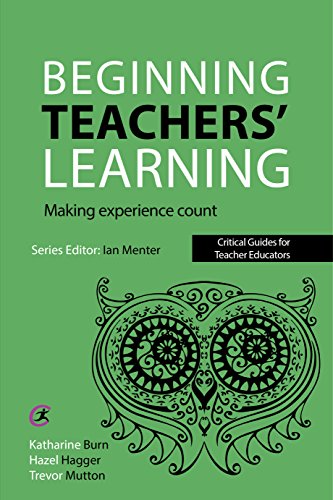
Inhaltsangabe
Draws on individual case studies and up to date research to explains how teacher educators can equip beginning teachers to learn much more effectively in school.
Die Inhaltsangabe kann sich auf eine andere Ausgabe dieses Titels beziehen.
Über die Autorin bzw. den Autor
Ian Menter (AcSS) is Professor of Teacher Education and Director of Professional Programmes in the Department of Education at the University of Oxford. He previously worked at the Universities of Glasgow, the West of Scotland, London Metropolitan, the West of England and Gloucestershire. Before that he was a primary school teacher in Bristol, England. His most recent publications include A Literature Review on Teacher Education for the 21st Century (Scottish Government) and A Guide to Practitioner Research in Education(Sage). His work has also been published in many academic journals.
Katharine Burnis a university lecturer in education at the University of Oxford where she leads the PGCE history programme. She taught history for 10 years in school and became fascinated by the process of professional learning, first as a mentor of beginning teachers and then as a head of department desperately trying to keep more senior colleagues focused on developing their classroom practice. After completing a doctorate studying history teachers' learning in school and university, she became research officer for the Developing Expertise of Beginning Teachers (DEBT) project, a longitudinal study of 24 beginning teachers that traced their development over the course of their initial training and through the first two years of their career.
Hazel Haggerwas co-director of the Developing Expertise of Beginning Teachers (DEBT) project. She taught English for many years before joining the University of Oxford in order to contribute to the development of one of the earliest ITE partnerships, and went on to become PGCE course director. Her doctoral research focused on ways of making practising teachers' expertise accessible to beginners and she has written extensively on teachers' learning and development.
Trevor Mutton is the current PGCE course director at the University of Oxford, where he also contributes to the Master's programme in Learning and Teaching. He taught Modern Foreign Languages before joining the university and has since been involved in a range of research into language teaching and into the nature of beginning teachers' learning (including the Developing Expertise of Beginning Teachers (DEBT) project).
Auszug. © Genehmigter Nachdruck. Alle Rechte vorbehalten.
Beginning Teachers' Learning
Making Experience Count
By Katharine Burn, Hazel Hagger, Trevor MuttonCritical Publishing Ltd
Copyright © 2015 Katharine Burn, Hazel Hagger and Trevor Mutton
All rights reserved.
ISBN: 978-1-910391-17-4All rights reserved.
Contents
About the series editor,
About the authors,
Foreword by Ian Menter,
Chapter 1 Introduction: learning from experience,
Chapter 2 What are the challenges of learning to teach?,
Chapter 3 What do we know about beginning teachers as learners?,
Chapter 4 How can we help beginning teachers to become more effective learners?,
References,
Index,
CHAPTER 1
INTRODUCTION: LEARNING FROM EXPERIENCE
The ideal beginner
It is easy to paint a portrait of the ideal beginning teacher, to conjure up the mix of enthusiasm, thoughtfulness and commitment that characterises an effective learner and nascent colleague – someone with whom you would be happy to share your classes, to observe and advise as they get to grips with the demands of the role.
Such a trainee would arrive not only full of high aspirations for their pupils but also fully aware of how much they, too, had to learn. They would recognise the importance of thorough planning before any lesson and the value of finding out about their pupils' current levels of knowledge and common misconceptions before determining what their objectives should be. While they would seek advice at the planning stage and feedback on their early teaching endeavours, they would also take responsibility for self -evaluation and approach any debriefing with a list of aspects that they had already identified as requiring improvement and even some suggestions about how to make those changes.
While aware of their weaknesses, they would take a realistic view of their own development, recognising where things had genuinely worked well and seeking to build on them. They would welcome constructive criticism, accepting it in the positive spirit in which it was intended, and look for opportunities to take it on board. They would also be alert to the opportunities available to them to learn from their pupils: identifying from the pupils' difficulties where a fuller explanation was needed; paying attention to the pupils' questions and the strategies on which they tended to rely, in order to rethink their own instruction and consider alternative methods.
This may all sound too good to be true, but this particular portrait is not an imaginary one. Although we have given him a pseudonym, Hanif, whom we tracked within a research project through his training year and on into his first two years as a qualified mathematics teacher, displayed all these qualities. He was indeed an outstanding trainee who made tremendous progress. His mentor and other colleagues within the mathematics department thoroughly enjoyed working with him and were always happy to share their ideas, advice and resources with him (as they did with each other). Moreover, the approaches that he had adopted as a trainee continued to inspire his professional learning over the next two years. He always recognised that there was more to learn, insisting that every lesson brought something new. When invited to predict how his first year as a newly qualified teacher (NQT) might compare with his training year, he immediately emphasised his need to go on learning:
Well, for a start the big similarity is that I'll always be learning. Even going beyond an NQT, there is always going to be something else that I can learn. So many million more things that I can learn, in fact.
He was
„Über diesen Titel“ kann sich auf eine andere Ausgabe dieses Titels beziehen.
Suchergebnisse für Beginning Teachers' Learning: Making experience...

Beispielbild für diese ISBN
Beginning Teachers' Learning : Making Experience Count
Anbieter: Better World Books Ltd, Dunfermline, Vereinigtes Königreich
Verkäuferbewertung 5 von 5 Sternen

Zustand: Good. Pages intact with minimal writing/highlighting. The binding may be loose and creased. Dust jackets/supplements are not included. Stock photo provided. Product includes identifying sticker. Better World Books: Buy Books. Do Good. Artikel-Nr. 52696865-20
Gebraucht kaufen
EUR 19,26
EUR 5,97 Versand
Versand von Vereinigtes Königreich nach USA
Versand von Vereinigtes Königreich nach USA
Anzahl: 2 verfügbar
Foto des Verkäufers
Theories of Professional Learning
Verlag:
Critical Publishing, UK, 2015
ISBN 10: 1910391174
ISBN 13: 9781910391174
Gebraucht
paperback
Anbieter: PsychoBabel & Skoob Books, Didcot, Vereinigtes Königreich
Verkäuferbewertung 5 von 5 Sternen
paperback. Zustand: Very Good. Paperback. (2015 reprint of 2014) Very good condition. Unread display stock. Pages and text fine. RB. Used. Artikel-Nr. 506982
Gebraucht kaufen
EUR 14,76
EUR 14,93 Versand
Versand von Vereinigtes Königreich nach USA
Versand von Vereinigtes Königreich nach USA
Anzahl: 1 verfügbar
Beispielbild für diese ISBN
Beginning Teachers' Learning: Making Experience Count (Critical Guides for Teacher Educators)
Anbieter: Majestic Books, Hounslow, Vereinigtes Königreich
Verkäuferbewertung 4 von 5 Sternen

Zustand: New. pp. 72. Artikel-Nr. 373683925
Neu kaufen
EUR 39,16
EUR 7,76 Versand
Versand von Vereinigtes Königreich nach USA
Versand von Vereinigtes Königreich nach USA
Anzahl: 3 verfügbar
Beispielbild für diese ISBN
Beginning Teachers' Learning: Making experience count (Critical Guides for Teacher Educators)
Anbieter: Ria Christie Collections, Uxbridge, Vereinigtes Königreich
Verkäuferbewertung 5 von 5 Sternen
Zustand: New. In English. Artikel-Nr. ria9781910391174_new
Neu kaufen
EUR 48,12
EUR 11,19 Versand
Versand von Vereinigtes Königreich nach USA
Versand von Vereinigtes Königreich nach USA
Anzahl: Mehr als 20 verfügbar
Beispielbild für diese ISBN
Beginning Teachers' Learning: Making Experience Count
Verlag:
Intl Specialized Book Services, 2015
ISBN 10: 1910391174
ISBN 13: 9781910391174
Neu
Paperback
Anbieter: Revaluation Books, Exeter, Vereinigtes Königreich
Verkäuferbewertung 5 von 5 Sternen
Paperback. Zustand: Brand New. 64 pages. 9.00x6.00x0.25 inches. In Stock. Artikel-Nr. x-1910391174
Neu kaufen
EUR 57,31
EUR 11,94 Versand
Versand von Vereinigtes Königreich nach USA
Versand von Vereinigtes Königreich nach USA
Anzahl: 2 verfügbar
Beispielbild für diese ISBN
Beginning Teachers' Learning: Making experience count (Critical Guides for Teacher Educators)
Anbieter: Kennys Bookstore, Olney, MD, USA
Verkäuferbewertung 5 von 5 Sternen
Zustand: New. Draws on individual case studies and up to date research to explains how teacher educators can equip beginning teachers to learn much more effectively in school. Editor(s): Menter, Ian. Series: Critical Guides for Teacher Educators. Num Pages: 72 pages. BIC Classification: JNMT; JNT. Category: (P) Professional & Vocational. Dimension: 236 x 157 x 12. Weight in Grams: 134. . 2015. Paperback. . . . . Books ship from the US and Ireland. Artikel-Nr. V9781910391174
Neu kaufen
EUR 76,13
EUR 9,40 Versand
Versand innerhalb von USA
Versand innerhalb von USA
Anzahl: Mehr als 20 verfügbar