
Verwandte Artikel zu Clinical Evidence Made Easy: The Basics of Evidence-Based...
Inhaltsangabe
Clinical Evidence Made Easy scores maximum 100 and 5 stars on Doody's (Sept 2014)!
Here's what the reviewer said: "This is one of a number of basic science books on evidence-based medicine and a very good addition to the library. The authors present the concepts in a unique and simple way that is easy to read and understand."
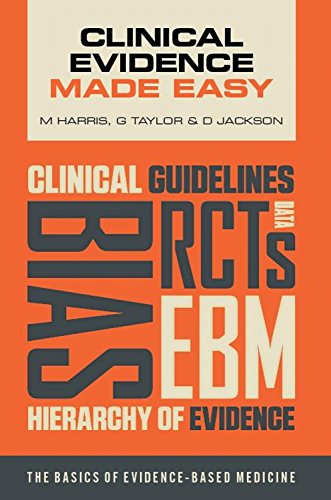
Clinical Evidence Made Easy is a concise and accessible introduction for any healthcare professional looking to understand clinical data sources. As clinical evidence becomes increasingly important in healthcare it is vital that healthcare professionals can read, analyze and understand the clinical data being presented. This book will equip the reader with the core skills and knowledge to make sense of the clinical evidence, without over-burdening them with information and jargon. Building on the success of the other ‘Made Easy’ books (Medical StatisticsMade Easy, Healthcare Economics Made Easy, PracticeAccounts Made Easy), this is a book for non-specialists who need knowledge of the key tools and techniques so they can understand the clinical data, but who have no need to become experts in the subject.
Clinical Evidence Made Easy will enable healthcare workers in all fields to understand and implement the results from clinical trials, clinical journals and other data sources with confidence.
Here's what the reviewer said: "This is one of a number of basic science books on evidence-based medicine and a very good addition to the library. The authors present the concepts in a unique and simple way that is easy to read and understand."
Clinical Evidence Made Easy is a concise and accessible introduction for any healthcare professional looking to understand clinical data sources. As clinical evidence becomes increasingly important in healthcare it is vital that healthcare professionals can read, analyze and understand the clinical data being presented. This book will equip the reader with the core skills and knowledge to make sense of the clinical evidence, without over-burdening them with information and jargon. Building on the success of the other ‘Made Easy’ books (Medical StatisticsMade Easy, Healthcare Economics Made Easy, PracticeAccounts Made Easy), this is a book for non-specialists who need knowledge of the key tools and techniques so they can understand the clinical data, but who have no need to become experts in the subject.
Clinical Evidence Made Easy will enable healthcare workers in all fields to understand and implement the results from clinical trials, clinical journals and other data sources with confidence.
Die Inhaltsangabe kann sich auf eine andere Ausgabe dieses Titels beziehen.
Auszug. © Genehmigter Nachdruck. Alle Rechte vorbehalten.
Clinical Evidence Made Easy
By M. Harris, G. Taylor, D. JacksonScion Publishing Limited
Copyright © 2014 Scion Publishing Limited
All rights reserved.
ISBN: 978-1-907904-20-2All rights reserved.
Contents
Foreword, vii,
Preface, viii,
About the authors, ix,
Acknowledgements, ix,
How to use this book, x,
Abbreviations, xii,
Understanding clinical evidence,
1 The importance of clinical evidence, 2,
2 Asking the right questions, 6,
3 Looking for evidence, 11,
4 Choosing and reading a paper, 17,
5 Recognizing bias, 22,
6 Statistics that describe, 28,
7 Statistics that predict, 36,
8 Randomized controlled trials, 45,
9 Cohort studies, 53,
10 Case–control studies, 58,
11 Research on diagnostic tests, 64,
12 Qualitative research, 72,
13 Research that summarizes other research, 80,
14 Clinical guidelines, 91,
15 Health economic evidence, 98,
16 Evidence from pharmaceutical companies, 111,
17 Applying the evidence in real life, 115,
Clinical evidence at work,
18 Asking the right questions, 122,
19 Choosing the right statistical test, 127,
20 Randomized controlled trials, 133,
21 Cohort studies, 141,
22 Case–control studies, 150,
23 Research on diagnostic tests, 157,
24 Qualitative research, 164,
25 Research that summarizes other research, 173,
26 Clinical guidelines, 183,
27 Health economic evidence, 192,
28 Evidence from pharmaceutical companies, 200,
29 Putting it all together ..., 206,
Index, 208,
CHAPTER 1
The importance of clinical evidence
Combining the skill that an individual clinician has gained through experience and practice with the best available external clinical evidence is called evidence-based practice (EBP). It is also known as evidence-based medicine (EBM) and evidence-based healthcare (EBHC).
Definition
Clinical evidence is the information from research studies that helps decide the value of screening programmes, diagnostic tests, management plans and treatments.
Evidence-based practice
Integrating evidence-based medicine with patients' own values and preferences is the basis of good clinical decision-making.
Expert opinion or evidence-based practice?
In the past, clinicians relied on their own experience and the opinions of experts to make clinical management decisions. While these judgements were often correct, the careful application of research evidence has been found to improve patient care, making it safer and more effective.
Grounding care in clinical evidence has now become routine. Concepts like P values, meta-analysis and randomized controlled trials (RCTs) are such an important part of decision-making that clinicians need to understand them.
The types of clinical evidence
Researchers design a study to answer a specific clinical question, for instance "Is a steroid injection likely to be more effective than physiotherapy for tennis elbow?".
Early in their planning, researchers need to check whether their question has been answered already. If it has, there is no point in wasting resources on replicating the work of previous researchers.
A study is therefore designed to answer either a new question, one that hasn't been adequately answered before, or to confirm an answer that is unexpected or is particularly important.
The research method used depends on the question. The different methods are described in more detail in the following chapters, but here is a summary list of common ones.
Randomized controlled trials(Chapter 8) are a type of prospective study, i.e. one whose patients are identified and then followed up into the future. In these studies the risk of bias (see Chapter 5) is minimized by randomly allocating the subjects to one of two or more treatments; it could be used to compare the effectiveness of a new treatment for temporal lobe epilepsy with the existing best treatment, for example. The P value (Chapter 7) gives information on how likely it is that any difference in outcome was due to chance.
Cohort studies(Chapter 9) are another type of prospective research. Here, researchers follow groups of patients who are alike in many ways but differ in one or more particular characteristics. They may follow them for some years to look at outcomes, i.e. what happens to them. For example, researchers may study a group of patients to compare the effect of high and low levels of computer use on long-term visual acuity. A statistic called a risk ratio is used to compare the outcomes of these two 'cohorts' of patients.
A case–control study(Chapter 10) is an example of a retrospective design, i.e. one that looks back over time: the outcome of interest has already happened and the researchers want to know what factors may have influenced it. These studies compare a group of patients having a condition, the 'cases', with a group without it, known as the 'controls'. This method could be used to assess whether hospital patients who have developed a deep vein thrombosis (DVT) during their stay are more (or less) likely to have taken aspirin in the last month than similar, 'matched' patients without a DVT. The odds ratio is a statistic that compares these groups.
Research on diagnostic tests(Chapter 11) typically compares a test with a 'gold standard' test, for example how a new blood test for coeliac disease performs compared with the results of small bowel biopsies in the same patients. The resulting specificity and sensitivity values show how often the test is negative in patients without the condition, and positive in those with the condition, respectively.
Qualitative research(Chapter 12) finds out about what people are thinking and why. It could be used to find out why patients do (or don't) see their GPs if they have a productive cough. Researchers find the key themes and can develop a hypothesis that fits them together.
Health economic evidence(Chapter 15) typically examines the costs and benefits of different healthcare interventions, treatments or policies. When applying economic tools to the world of healthcare, researchers may try to answer broad questions on health policy. They may also look at a more specific question; for instance, one that asks which treatment is most cost-effective for control of hypertension, when compared to an alternative. Our financial resources are limited, so health economists work out how to optimize the provision of healthcare.
Can one paper do it all?
Very occasionally a single research paper causes a big change in practice. However, more often individual pieces of research don't give the whole answer, but are small building blocks to it.
One way for a clinician to plan an evidence-based approach to a clinical problem is to appraise and synthesize all the relevant papers. This is very time-consuming, so many rely on the work of others that have done that for them.
A systematic review(Chapter 13) is a literature review that identifies, assesses and synthesizes all the relevant research evidence. An author might review all the papers on the non-surgical management of appendicitis, for instance.
A meta-analysis(Chapter 13) combines the numerical data from different...
„Über diesen Titel“ kann sich auf eine andere Ausgabe dieses Titels beziehen.
Suchergebnisse für Clinical Evidence Made Easy: The Basics of Evidence-Based...

Foto des Verkäufers
Clinical Evidence Made Easy: The basics of evidence-based medicine
Anbieter: WeBuyBooks, Rossendale, LANCS, Vereinigtes Königreich
Verkäuferbewertung 5 von 5 Sternen

paperback. Zustand: Like New. Most items will be dispatched the same or the next working day. An apparently unread copy in perfect condition. Dust cover is intact with no nicks or tears. Spine has no signs of creasing. Pages are clean and not marred by notes or folds of any kind. Artikel-Nr. rev6234850123
Gebraucht kaufen
EUR 3,40
EUR 7,26 Versand
Versand von Vereinigtes Königreich nach USA
Versand von Vereinigtes Königreich nach USA
Anzahl: 1 verfügbar
Beispielbild für diese ISBN
Clinical Evidence Made Easy: The basics of evidence-based medicine
Anbieter: WorldofBooks, Goring-By-Sea, WS, Vereinigtes Königreich
Verkäuferbewertung 5 von 5 Sternen
Paperback. Zustand: Very Good. The book has been read, but is in excellent condition. Pages are intact and not marred by notes or highlighting. The spine remains undamaged. Artikel-Nr. GOR009548675
Gebraucht kaufen
EUR 4,47
EUR 6,68 Versand
Versand von Vereinigtes Königreich nach USA
Versand von Vereinigtes Königreich nach USA
Anzahl: 2 verfügbar
Beispielbild für diese ISBN
Clinical Evidence Made Easy : The Basics of Evidence-Based Medicine
Verlag:
Scion Publishing Limited, 2014
ISBN 10: 1907904204
ISBN 13: 9781907904202
Gebraucht
Softcover
Anbieter: Better World Books Ltd, Dunfermline, Vereinigtes Königreich
Verkäuferbewertung 5 von 5 Sternen
Zustand: Good. Former library copy. Pages intact with minimal writing/highlighting. The binding may be loose and creased. Dust jackets/supplements are not included. Includes library markings. Stock photo provided. Product includes identifying sticker. Better World Books: Buy Books. Do Good. Artikel-Nr. 42736899-20
Gebraucht kaufen
EUR 5,75
EUR 5,96 Versand
Versand von Vereinigtes Königreich nach USA
Versand von Vereinigtes Königreich nach USA
Anzahl: 2 verfügbar
Beispielbild für diese ISBN
Clinical Evidence Made Easy : The Basics of Evidence-Based Medicine
Verlag:
Scion Publishing Limited, 2014
ISBN 10: 1907904204
ISBN 13: 9781907904202
Gebraucht
Softcover
Anbieter: Better World Books Ltd, Dunfermline, Vereinigtes Königreich
Verkäuferbewertung 5 von 5 Sternen
Zustand: Very Good. Former library copy. Pages intact with possible writing/highlighting. Binding strong with minor wear. Dust jackets/supplements may not be included. Includes library markings. Stock photo provided. Product includes identifying sticker. Better World Books: Buy Books. Do Good. Artikel-Nr. GRP101811444
Gebraucht kaufen
EUR 5,75
EUR 5,96 Versand
Versand von Vereinigtes Königreich nach USA
Versand von Vereinigtes Königreich nach USA
Anzahl: 2 verfügbar
Beispielbild für diese ISBN
Clinical Evidence Made Easy: The Basics of Evidence-Based Medicine
Anbieter: Phatpocket Limited, Waltham Abbey, HERTS, Vereinigtes Königreich
Verkäuferbewertung 5 von 5 Sternen
Zustand: Good. Your purchase helps support Sri Lankan Children's Charity 'The Rainbow Centre'. Ex-library, so some stamps and wear, but in good overall condition. Our donations to The Rainbow Centre have helped provide an education and a safe haven to hundreds of children who live in appalling conditions. Artikel-Nr. Z1-F-052-01426
Gebraucht kaufen
EUR 1,23
EUR 12,69 Versand
Versand von Vereinigtes Königreich nach USA
Versand von Vereinigtes Königreich nach USA
Anzahl: 7 verfügbar
Beispielbild für diese ISBN
Clinical Evidence Made Easy: The Basics of Evidence-based Medicine
Anbieter: Revaluation Books, Exeter, Vereinigtes Königreich
Verkäuferbewertung 5 von 5 Sternen
Paperback. Zustand: Brand New. 1st edition. 212 pages. 9.25x6.25x0.50 inches. In Stock. Artikel-Nr. zk1907904204
Neu kaufen
EUR 38,74
EUR 11,93 Versand
Versand von Vereinigtes Königreich nach USA
Versand von Vereinigtes Königreich nach USA
Anzahl: 1 verfügbar