
Verwandte Artikel zu Barn Owl Conservation Handbook: A comprehensive guide...
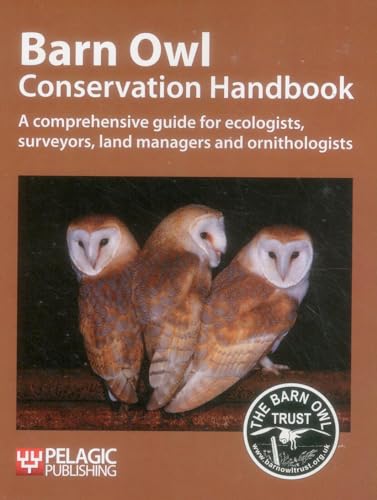
Barn Owl Conservation Handbook: A comprehensive guide for ecologists, surveyors, land managers and ornithologists (Conservation Handbooks) - Softcover
Inhaltsangabe
A comprehensive handbook covering all aspects of the conservation of Barn Owls. Written by the Barn Owl Trust, this book includes in-depth information on Barn Owl survey techniques, relevant ecology, Barn Owls and the law, mortality, habitat management, use of nest boxes and barn Owl rehabilitation. Essential reading for ecologists, planners, land managers and ornithologists.
Die Inhaltsangabe kann sich auf eine andere Ausgabe dieses Titels beziehen.
Über die Autorin bzw. den Autor
By Barn Owl Trust
Auszug. © Genehmigter Nachdruck. Alle Rechte vorbehalten.
Barn Owl Conservation Handbook
A comprehensive guide for ecologists, surveyors, land managers and ornithologists
By Barn Owl TrustPelagic Publishing
Copyright © 2012 Barn Owl Trust
All rights reserved.
ISBN: 978-1-907807-14-5All rights reserved.
Contents
Foreword,
Preface,
Acknowledgements,
List of abbreviations,
1 Introduction,
2 Ecological issues,
3 Legal considerations,
4 Barn Owl surveys,
5 Foraging habitat – creation and management,
6 Nestboxes and other Barn Owl accommodation,
7 Mortality and the scope for reducing it,
8 Planning issues, mitigation and enhancement,
9 Casualty assessment, short-term care and the principles of rehabilitation,
Appendix 1,
Appendix 2,
References,
Index,
CHAPTER 1
Introduction
1.1 Part One – The owls
1.1.1 Western Barn Owls Tyto alba alba
See Plate 1 Barn Owl portrait Plate 2 Barn Owl foraging in flight by day Plate 3 Barn Owl in flight at dusk silhouetted
With their characteristic heart-shaped face, Barn Owls Tyto alba are one of the most studied and best-known owl species in the world. Once considered the most common owls in Britain, they have suffered such a drastic decline in numbers that there were probably no more than 4,000 pairs left by the turn of the millennium (Toms, Crick & Shawyer 2000). Nevertheless, Barn Owls are still widely but thinly distributed across much of lowland Britain and, with the exception of urban areas and dense woodland, may forage over any habitat that supports small mammal populations.
Although not territorial, Barn Owls are highly faithful to their home range and to the roost and nest sites they use within it. This would typically be a vast area extending up to 5,000 hectares (ha), although during the nesting period only a small portion of this is used – perhaps about 350 ha. Within their range most Barn Owls use one nest site, several main roost sites and other occasional roost sites. Whilst some pairs roost together all year round, others seem to live quite separate lives and only come together to breed (see 2.4). They generally roost and breed in dry elevated spaces in buildings or tree cavities, but will make use of almost any structure or hole that meets their needs. Because of the loss of so many old farm buildings and hollow trees they are increasingly dependent on the availability of nestboxes (see Chapter 6).
Barn Owls usually breed once a year; most eggs are laid in April or May and the young fledge in July or August. However, there is a great deal of variation. In a good year, some pairs will breed twice or even three times and nesting has been recorded in every month of the year. The presence of a nest is often given away by the sound of the young calling for food; sometimes likened to 'snoring' it is a repeated 'shshsh shshsh shshsh', which may continue for many hours. The most noticeable call of the adult is a long drawn out shriek or screech that can sound either hoarse or tremulous. However, some individuals hardly ever screech, whilst others screech quite frequently, particularly in the spring. In spring or summer unpaired birds sometimes fly far and wide while screeching continuously (see 2.4).
Barn Owls have buff-coloured upper surfaces delicately marked with white and shades of grey. In most birds their distinctive heart-shaped face and under-parts are predominantly white. When seen in flight the overall impression is usually of a large pure-white bird. Foraging Barn Owls generally fly buoyantly back and forth, 'quartering' areas of rough grassland and other open prey-rich patches or strips. They may also hunt from fence posts or other fairly low perching places, usually less than 3 m above the ground. Although daylight hunting does occur, Barn Owls are mainly nocturnal and crepuscular, with peaks of activity around dusk and dawn. Their diet consists mainly of small mammals, particularly voles, mice and shrews, together with rats and the occasional bird or frog (Love 2009). Unlike Little Owls Athene noctua and Tawny Owls Strix aluco, Barn Owls do not eat worms and hardly ever eat insects. Their diet can vary considerably between sites and from year to year, depending on prey availability, but they are definitely specialist rather than generalist feeders and depend almost entirely on the availability of small mammals (see 2.1.4.2).
In a landscape with many isolated trees and copses, Barn Owl home ranges will contain numerous Tawny Owl territories; in mixed farming areas they are also likely to contain one or more pairs of Little Owls. In general, these species ignore each other. Direct competition for nest cavities is only likely to occur where there is a severe shortage of sites, as each species has a different cavity size preference. Although there is considerable overlap in their diet, direct competition over food resources is not a major problem, partly because Little Owls and Tawny Owls have a much more varied diet than Barn Owls, and partly because they are restricted to hunting from a perch. By hunting from the air Barn Owls are able to utilise parts of the landscape that perch-hunting owls cannot normally reach (see 2.1.3.1).
Most reports of Barn Owls received from the general public are of birds seen while driving at night. They are almost always described as 'white' because of the headlights and because the birds are usually in flight. Indeed, the front or underside of a Barn Owl sighted in any circumstances will almost always be described as 'white', though this is less likely to be the case if the bird is viewed from above, behind, or as a silhouette (see Plate 3).
1.1.2 Identifying owls and interpreting reports from the public
In order to identify Barn Owls correctly it is important to be able to recognise the other owls that may also be encountered. In addition, a good survey of any potential Barn Owl site or area will always include interviews with the people who live or work there in order to collect reports of owls they may have seen or heard (see 4.2.2). The ability to interpret the way people describe owl sounds and sightings is thus a very useful skill. Care will always be needed because words such as 'big' and 'screech' mean different things to different people and 'white owls' (Barn Owls) do not always look white. Furthermore, an owl sound reported as a 'screech' or 'shriek' may not always come from a Barn Owl (see 4.2.2).
The following species accounts provide an introduction to the four other owl species that are resident in Britain in order to:
• enable the reader to differentiate between Barn Owls and other owls
• summarise the extent to which other owl species may affect Barn Owls
• explain the relevance of each owl species to Barn Owl surveys and conservation work
1.1.2.1 Little Owls Athene noctua
See Plate 4 Little Owl portrait
Little Owls are the only other owl species in Britain commonly referred to as 'farmland birds' and, like Barn Owls, they mainly roost and nest in tree hollows and farm buildings. It is therefore highly likely that anyone surveying for Barn Owls will come across Little Owls at some point. The sound of a Little Owl calling may also be reported as a 'screech' and so there is considerable potential for confusion with Barn Owls.
With an estimated c. 5,800–12,000 pairs (Toms, Crick & Shawyer 2000), there are more Little Owls than Barn Owls in Britain. However,...
„Über diesen Titel“ kann sich auf eine andere Ausgabe dieses Titels beziehen.
Suchergebnisse für Barn Owl Conservation Handbook: A comprehensive guide...

Beispielbild für diese ISBN
Barn Owl Conservation Handbook: A Comprehensive Guide for Ecologists, Surveyors, Land Managers and Ornithologists (Conservation Handbooks)
Verlag:
Pelagic Publishing, United Kingdom, Exeter, 2012
ISBN 10: 1907807144
ISBN 13: 9781907807145
Gebraucht
Paperback
Anbieter: WorldofBooks, Goring-By-Sea, WS, Vereinigtes Königreich
Verkäuferbewertung 5 von 5 Sternen

Paperback. Zustand: Very Good. A comprehensive handbook covering all aspects of the conservation of Barn Owls. Written by the Barn Owl Trust, this book includes in-depth information on Barn Owl survey techniques, relevant ecology, Barn Owls and the law, mortality, habitat management, use of nest boxes and barn Owl rehabilitation. Essential reading for ecologists, planners, land managers and ornithologists. The book has been read, but is in excellent condition. Pages are intact and not marred by notes or highlighting. The spine remains undamaged. Artikel-Nr. GOR012653845
Gebraucht kaufen
EUR 42,93
EUR 6,53 Versand
Versand von Vereinigtes Königreich nach USA
Versand von Vereinigtes Königreich nach USA
Anzahl: 2 verfügbar
Beispielbild für diese ISBN
Barn Owl Conservation Handbook
Anbieter: PBShop.store UK, Fairford, GLOS, Vereinigtes Königreich
Verkäuferbewertung 5 von 5 Sternen
PAP. Zustand: New. New Book. Shipped from UK. Established seller since 2000. Artikel-Nr. CX-9781907807145
Neu kaufen
EUR 51,63
EUR 7,88 Versand
Versand von Vereinigtes Königreich nach USA
Versand von Vereinigtes Königreich nach USA
Anzahl: 15 verfügbar
Beispielbild für diese ISBN
Barn Owl Conservation Handbook
Anbieter: PBShop.store US, Wood Dale, IL, USA
Verkäuferbewertung 5 von 5 Sternen
PAP. Zustand: New. New Book. Shipped from UK. Established seller since 2000. Artikel-Nr. CX-9781907807145
Beispielbild für diese ISBN
Barn Owl Conservation Handbook: A comprehensive guide for ecologists, surveyors, land managers and ornithologists
Anbieter: Ria Christie Collections, Uxbridge, Vereinigtes Königreich
Verkäuferbewertung 5 von 5 Sternen
Zustand: New. In English. Artikel-Nr. ria9781907807145_new
Neu kaufen
EUR 61,01
EUR 17,42 Versand
Versand von Vereinigtes Königreich nach USA
Versand von Vereinigtes Königreich nach USA
Anzahl: Mehr als 20 verfügbar
Beispielbild für diese ISBN
Barn Owl Conservation Handbook: A Comprehensive Guide for Ecologists, Surveyors, Land Managers and Ornithologists
Anbieter: Revaluation Books, Exeter, Vereinigtes Königreich
Verkäuferbewertung 5 von 5 Sternen
Paperback. Zustand: Brand New. 395 pages. 9.75x7.25x1.25 inches. In Stock. Artikel-Nr. x-1907807144
Neu kaufen
EUR 98,55
EUR 17,49 Versand
Versand von Vereinigtes Königreich nach USA
Versand von Vereinigtes Königreich nach USA
Anzahl: 2 verfügbar