
Verwandte Artikel zu Bee Conservation: Evidence for the effects of interventions...
Bee Conservation: Evidence for the effects of interventions (Synopses of Conservation Evidence, 1, Band 1) - Softcover
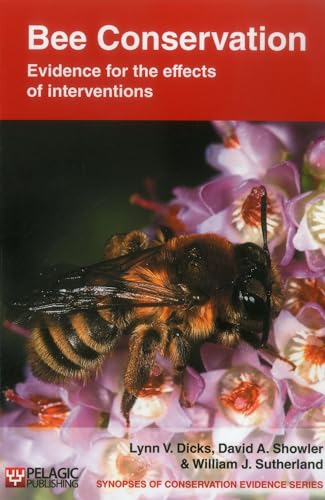
Inhaltsangabe
This book brings together scientific evidence and experience relevant to the practical conservation of wild bees. The authors worked with an international group of bee experts and conservationists to develop a global list of interventions that could benefit wild bees. They range from protecting natural habitat to controlling disease in commercial bumblebee colonies.
For each intervention, the book summarises studies captured by the Conservation Evidence project, where that intervention has been tested and its effects on bees quantified. The result is a thorough guide to what is known, or not known, about the effectiveness of bee conservation actions throughout the world. Bee Conservation is the first in a series of synopses that will cover different species groups and habitats, gradually building into a comprehensive summary of evidence on the effects of conservation interventions for all biodiversity throughout the world.
By making evidence accessible in this way, we hope to enable a change in the practice of conservation, so it can become more evidence-based. We also aim to highlight where there are gaps in knowledge.
Evidence from all around the world is included. If there appears to be a bias towards evidence from northern European or North American temperate environments, this reflects a current bias in the published research that is available to us. Conservation interventions are grouped primarily according to the relevant direct threats, as defined in the International Union for the Conservation of Nature (IUCN)’s Unified Classification of Direct Threats.
Die Inhaltsangabe kann sich auf eine andere Ausgabe dieses Titels beziehen.
Über die Autorin bzw. den Autor
Lynn Dicks is a Research Fellow at the Department of Zoology, University of Cambridge. She has been a NERC Knowledge Exchange Fellow, linked to the Insect Pollinators Initiative(2011-2014) and a Co-ordinating Lead Author of the IPBES Thematic assessment of pollinators, pollination and food production. She has a degree from Oxford University in Biological Sciences (1995) and a PhD from Cambridge University (2002) on the ecology of flower-visiting insects.
Bill Sutherland is Miriam Rothschild Professor of Conservation Biology at the University of Cambridge and President of the British Ecological Society. He is known for his research on integrating science and policy particularly in the field of evidence-based conservation. Two of his key contributions have been the horizon-scanning exercises to identify future priority issues and the 100 important questions in various disciplines (ecology, poverty prevention, global agriculture and food amongst others). He has also worked extensively on bird population ecology and the biodiversity impacts of agriculture.
Auszug. © Genehmigter Nachdruck. Alle Rechte vorbehalten.
Bee Conservation
Evidence for the effects of interventions
By Lynn V. Dicks, David A. Showler, William J. SutherlandPelagic Publishing
Copyright © 2010 Lynn V. Dicks, David A. Showler & William J. Sutherland
All rights reserved.
ISBN: 978-1-907807-00-8All rights reserved.
Contents
Advisory board,
About the authors,
Acknowledgements,
1. Introduction,
2. Threat: residential and commercial development,
3. Threat: land use change due to agriculture,
4. Threat: pollution - agricultural and forestry effluents,
5. Threat: transportation and service corridors,
6. Threat: biological resource use,
7. Threat: natural system modification - natural fire and fire suppression,
8. Threat: invasive non-native species,
9. Threat: problematic native species,
10. Providing artificial nest sites for bees,
11. Captive breeding and rearing of wild bees (ex-situconservation),
12. Education and awareness-raising,
Index,
CHAPTER 1
Introduction
1.1 The purpose of Conservation Evidence synopses
This book, Bee Conservation, is the first in a series of synopses that will cover different species groups and habitats, gradually building into a comprehensive summary of evidence on the effects of conservation interventions for all biodiversity throughout the world.
By making evidence accessible in this way, we hope to enable a change in the practice of conservation, so it can become more evidence-based. We also aim to highlight where there are gaps in knowledge.
1.2 Who this synopsis is for
If you are reading this, we hope you are someone who has to make decisions about how best to support or conserve biodiversity. You might be a land manager, a conservationist in the public or private sector, a farmer, a campaigner, an advisor or consultant, a policymaker, a researcher or someone taking action to protect your own local wildlife. Our synopses summarise scientific evidence relevant to your conservation objectives and the actions you could take to achieve them.
We do not aim to make your decisions for you, but to support your decision-making by telling you what evidence there is (or isn't) about the effects that your planned actions could have.
When decisions have to be made with particularly important consequences, we recommend carrying out a systematic review, as the latter is likely to be more comprehensive than the summary of evidence presented here. Guidance on how to carry out systematic reviews can be found from the Centre for Evidence-Based Conservation at the University of Wales, Bangor (www.cebc.bangor.ac.uk).
1.3 The Conservation Evidence project
The Conservation Evidence project has three parts:
1. An online, open access journalConservation Evidence publishes new pieces of research on the effects of conservation management interventions. All our papers are written by, or in conjunction with, those who carried out the conservation work and include some monitoring of its effects.
2. An ever-expanding database of summaries of previously published scientific papers, reports, reviews or systematic reviews that document the effects of interventions.
3. Synopses of the evidence captured in parts one and two on particular species groups or habitats. Synopses bring together the evidence for each possible intervention. They are freely available online and available to purchase in printed book form.
These resources currently comprise over 2,000 pieces of evidence, all available in a searchable database on the websitewww.conservationevidence.com.
Alongside this project, the Centre for Evidence-Based Conservation (www.cebc.bangor.ac.uk) and the Collaboration for Environmental Evidence (www.environmentalevidence.org) carry out and compile systematic reviews of evidence on the effectiveness of particular conservation interventions. These systematic reviews are included on the Conservation Evidence database.
Of the 59 bee conservation interventions identified in this synopsis, one is the subject of a current systematic review (Systematic Review number 72: Does delaying the first mowing date increase biodiversity in European farmland meadows? www.environmentalevidence.org/SR72.html). We identify an immediate need for a systematic review in relation to one other set of interventions (agri-environment schemes), and a potential need for systematic reviews for three further interventions, should they become more widely practised (nest boxes for solitary bees and captive rearing of bumblebees or solitary bees).
1.4 Scope of the Bee Conservation synopsis
This synopsis covers evidence for the effects of conservation interventions for native, wild bees.
It is restricted to evidence captured on the websitewww.conservationevidence.com. It includes papers published in the journal Conservation Evidence, evidence summarised on our database and systematic reviews collated by the Collaboration for Environmental Evidence.
It does not include evidence from the substantial literature on husbandry methods for the largely domesticated honey bee Apis mellifera. It does include husbandry methods where they are relevant to native, wild bee species that are declining or threatened, such as bumblebees (Bombus spp.) and stingless bees (Meliponinae). Although the number of managed honey bee colonies is known to have declined in Europe and America, it is seldom the native subspecies that is kept and so we consider this to be outside the remit of Conservation Evidence. We do include some interventions and evidence relating to the conservation of subspecies of Apis mellifera in areas where they are native.
Evidence from all around the world is included. If there appears to be a bias towards evidence from northern European or North American temperate environments, this reflects a current bias in the published research that is available to us.
1.5 How we decided which bee conservation interventions to include
Our list of interventions has been agreed in partnership with an Advisory Board made up of international conservationists and academics with expertise in bee conservation. Although the list of interventions may not be exhaustive, we have tried to include all actions that have been carried out or advised to support populations or communities of wild bees.
1.6 How we reviewed the literature
In addition to evidence already captured by the Conservation Evidence project, we have searched the following sources for evidence relating to bee conservation: four specialist bee or insect conservation journals, from their first publication date to the end of 2009 (Apidologie, Journal of Apicultural Research, Insect Conservation and Diversity, Journal of Insect Conservation); ISI Web of Knowledge searched for papers with 'bee' as a search term, from 1997 to 2009 inclusive; all reports concerning bees published by Natural England or the UK Bumblebee Working Group up to 2009; other relevant papers or books frequently cited within the bee conservation literature, going back to 1912.
In total, 168 individual studies are covered in this synopsis, all included in full or in summary on the Conservation Evidence website.
The criteria for inclusion of studies in the Conservation Evidence database are as follows:
• There must have been an intervention that conservationists would do
• Its effects must have been monitored...
„Über diesen Titel“ kann sich auf eine andere Ausgabe dieses Titels beziehen.
Suchergebnisse für Bee Conservation: Evidence for the effects of interventions...

Beispielbild für diese ISBN
Bee Conservation: Evidence for the effects of interventions (Synopses of Conservation Evidence) (Vol)
Anbieter: Phatpocket Limited, Waltham Abbey, HERTS, Vereinigtes Königreich
Verkäuferbewertung 5 von 5 Sternen

Zustand: Good. Your purchase helps support Sri Lankan Children's Charity 'The Rainbow Centre'. Ex-library, so some stamps and wear, but in good overall condition. Our donations to The Rainbow Centre have helped provide an education and a safe haven to hundreds of children who live in appalling conditions. Artikel-Nr. Z1-W-010-01466
Gebraucht kaufen
EUR 5,27
EUR 12,54 Versand
Versand von Vereinigtes Königreich nach USA
Versand von Vereinigtes Königreich nach USA
Anzahl: 3 verfügbar
Beispielbild für diese ISBN
Bee Conservation: Evidence for the Effects of Interventions: 1 (Synopses of Conservation Evidence)
Anbieter: Anybook.com, Lincoln, Vereinigtes Königreich
Verkäuferbewertung 5 von 5 Sternen
Zustand: Good. This is an ex-library book and may have the usual library/used-book markings inside.This book has soft covers. In good all round condition. Please note the Image in this listing is a stock photo and may not match the covers of the actual item,300grams, ISBN:9781907807008. Artikel-Nr. 9186489
Gebraucht kaufen
EUR 14,25
EUR 15,37 Versand
Versand von Vereinigtes Königreich nach USA
Versand von Vereinigtes Königreich nach USA
Anzahl: 1 verfügbar
Beispielbild für diese ISBN
Bee Conservation: Evidence for the Effects of Interventions: 1 (Synopses of Conservation Evidence)
Verlag:
Pelagic Publishing Ltd, 2010
ISBN 10: 1907807004
ISBN 13: 9781907807008
Gebraucht
Soft cover
Anbieter: Herons' Nest Books, Kings Langley, Vereinigtes Königreich
Verkäuferbewertung 5 von 5 Sternen
Soft cover. Zustand: Very Good. Artikel-Nr. ABE-1703858658408
Gebraucht kaufen
EUR 6,68
EUR 23,58 Versand
Versand von Vereinigtes Königreich nach USA
Versand von Vereinigtes Königreich nach USA
Anzahl: 1 verfügbar
Beispielbild für diese ISBN
Bee Conservation
Anbieter: PBShop.store UK, Fairford, GLOS, Vereinigtes Königreich
Verkäuferbewertung 5 von 5 Sternen
PAP. Zustand: New. New Book. Shipped from UK. Established seller since 2000. Artikel-Nr. CX-9781907807008
Neu kaufen
EUR 30,53
EUR 4,90 Versand
Versand von Vereinigtes Königreich nach USA
Versand von Vereinigtes Königreich nach USA
Anzahl: 15 verfügbar
Foto des Verkäufers
Bee Conservation: Evidence for the effects of interventions
Verlag:
Pelagic Publishing, Exeter, 2010
ISBN 10: 1907807004
ISBN 13: 9781907807008
Gebraucht
Softcover
Anbieter: PEMBERLEY NATURAL HISTORY BOOKS BA, ABA, Iver, Vereinigtes Königreich
Verkäuferbewertung 5 von 5 Sternen
Zustand: Fine. 139, . . PB. Fine, as new. Bee Conservation is the first in a series of synopses that will cover different species groups and habitats, gradually building into a comprehensive summary of evidence on the effects of conservation interventions for all biodiversity throughout the world. This synopsis covers evidence on the effects of conservation interventions for native, wild bees. [9781907807008]. Artikel-Nr. S53279
Gebraucht kaufen
EUR 18,21
EUR 25,94 Versand
Versand von Vereinigtes Königreich nach USA
Versand von Vereinigtes Königreich nach USA
Anzahl: 1 verfügbar
Foto des Verkäufers
Bee Conservation: Evidence for the effects of interventions
Verlag:
Pelagic Publishing, Exeter, 2010
ISBN 10: 1907807004
ISBN 13: 9781907807008
Gebraucht
Softcover
Anbieter: PEMBERLEY NATURAL HISTORY BOOKS BA, ABA, Iver, Vereinigtes Königreich
Verkäuferbewertung 5 von 5 Sternen
Zustand: As New. 139, . . PB. As new. Bee Conservation is the first in a series of synopses that will cover different species groups and habitats, gradually building into a comprehensive summary of evidence on the effects of conservation interventions for all biodiversity throughout the world. This synopsis covers evidence on the effects of conservation interventions for native, wild bees. [9781907807008]. Artikel-Nr. S52172
Gebraucht kaufen
EUR 18,21
EUR 25,94 Versand
Versand von Vereinigtes Königreich nach USA
Versand von Vereinigtes Königreich nach USA
Anzahl: 1 verfügbar
Beispielbild für diese ISBN
Bee Conservation: Evidence for the effects of interventions: 1 (Synopses of Conservation Evidence) [Paperback] Dicks, Lynn V.; Showler, David A. and Sutherland, William J.
Anbieter: Hay-on-Wye Booksellers, Hay-on-Wye, HEREF, Vereinigtes Königreich
Verkäuferbewertung 4 von 5 Sternen

Zustand: Very Good. Light scratches to cover & minor wear at edges. Content excellent, possibly unread. Artikel-Nr. 137169-5
Gebraucht kaufen
EUR 16,03
EUR 29,47 Versand
Versand von Vereinigtes Königreich nach USA
Versand von Vereinigtes Königreich nach USA
Anzahl: 1 verfügbar
Foto des Verkäufers
Bee Conservation: Evidence for the Effects of Interventions: 1 (Synopses of Conservation Evidence)
Verlag:
Pelagic Publishing Ltd, 2010
ISBN 10: 1907807004
ISBN 13: 9781907807008
Gebraucht
Soft cover
Anbieter: PKRD, Cardiff, Vereinigtes Königreich
Verkäuferbewertung 5 von 5 Sternen
Soft cover. Zustand: As New. No damage, markings or signs of use. 2010 paperback. The photo is of the actual book you will receive. Fast dispatch, normally within 24 hours, by UK seller. Artikel-Nr. 12180
Gebraucht kaufen
EUR 18,20
EUR 29,47 Versand
Versand von Vereinigtes Königreich nach USA
Versand von Vereinigtes Königreich nach USA
Anzahl: 1 verfügbar
Beispielbild für diese ISBN
Bee Conservation - Evidence for the effects of interventions (Synopses of Conservation Evidence)
Anbieter: Revaluation Books, Exeter, Vereinigtes Königreich
Verkäuferbewertung 5 von 5 Sternen
Paperback. Zustand: Brand New. 139 pages. 8.75x6.00x0.25 inches. In Stock. Artikel-Nr. x-1907807004
Neu kaufen
EUR 43,66
EUR 11,79 Versand
Versand von Vereinigtes Königreich nach USA
Versand von Vereinigtes Königreich nach USA
Anzahl: 2 verfügbar
Beispielbild für diese ISBN
Bee Conservation: Evidence for the effects of interventions (Synopses of Conservation Evidence) (Vol)
Anbieter: Ria Christie Collections, Uxbridge, Vereinigtes Königreich
Verkäuferbewertung 5 von 5 Sternen
Zustand: New. In English. Artikel-Nr. ria9781907807008_new
Neu kaufen
EUR 44,76
EUR 11,05 Versand
Versand von Vereinigtes Königreich nach USA
Versand von Vereinigtes Königreich nach USA
Anzahl: 1 verfügbar