
Verwandte Artikel zu CANON POWERSHOT G1 X (Expanded Guides)
Inhaltsangabe
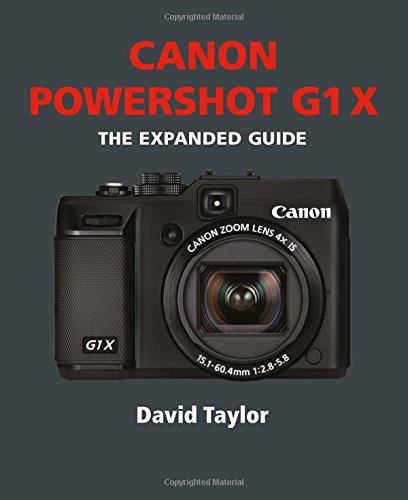
A comprehensive step-by-step guide that includes practical tips on how to get the best from this versatile camera
The PowerShot G1 X is the latest and, arguably, the greatest of the G series of compact cameras produced by Canon, aimed at advanced amateur and professional photographers, and achieved through tactile controls, a wide range of creative functions and a more functional design aesthetic. The G1 X is well specified, with logical, easy-to-use controls.
Die Inhaltsangabe kann sich auf eine andere Ausgabe dieses Titels beziehen.
Über die Autorin bzw. den Autor
David Taylor is an award-winning landscape and travel photographer.
Auszug. © Genehmigter Nachdruck. Alle Rechte vorbehalten.
Canon Powershot G1 X
The Expanded Guide
By David TaylorAE Publications Ltd
Copyright © 2012 AE Publications Ltd
All rights reserved.
ISBN: 978-1-907708-87-9All rights reserved.
Contents
Chapter 1 Overview, 6,
Chapter 2 Functions, 22,
Chapter 3 In the field, 162,
Chapter 4 Flash, 182,
Chapter 5 Close-up, 198,
Chapter 6 Movies, 206,
Chapter 7 Accessories, 216,
Chapter 8 Connection, 224,
Glossary, 242,
Useful web sites, 245,
Index, 246,
CHAPTER 1
OVERVIEW
The PowerShot G1 X is the latest and, arguably, the greatest of the acclaimed "G" series of compact cameras produced by Canon. The cameras are rightly regarded as the flagship of Canon's PowerShot range.
The G Series
The Canon Powershot G1 X is the latest in a line of compact digital cameras stretching back to 1996 and the PowerShot 600. The PowerShot line has grown to become the world's most successful range of compact digital cameras.
However, not all cameras are created equal. At the time of writing there are seven different categories of PowerShot camera, each branded with a unique capital letter or letters. Each category is aimed at the needs of groups of photographers. The A series cameras are regarded as relatively simple cameras for beginners; the S series are stylish cameras with a greater range of features, and so on. The G series of cameras is aimed at advanced amateur and professional photographers. This is achieved through the use of tactile controls, a wide range of creative functions and a more functional design aesthetic.
The first camera in the G series was the PowerShot G1, released in September 2000. It used a 3.3 megapixel 1/1.8" CCD sensor, giving the camera a resolution of 2048 x 1536 pixels, impressive specifications at the time. The camera was innovative, including the option for shooting RAW, unusual for a compact camera but standard on DSLRs.
Since 2000 a new "G" camera has been released on a yearly basis (with the exception of 2005). Each new camera has seen an increase in basic functionality and range of options. The G1 X was announced on January 12th 2012. In common with previous G series cameras, the G1 X is well specified, with logical, easy-to-use controls that enable a photographer to quickly get the most out of it. In fact, it shares many of the design ideas and specifications of its immediate predecessor, the G12. The greatest difference between the G1 X and previous models is the increase in the size of the sensor.
The Sensor
Mirrorless interchangeable-lens system cameras, such as the Sony NEX-7 and Olympus Pen range, are a growing trend in camera design. These cameras are small and lightweight, but still boast large sensors equivalent to those found in traditional DSLRs. To date Canon has not released a mirrorless interchangeable-lens camera but the PowerShot G1 X could be seen as a small step in that direction.
Sensor size is an important factor in image quality. The larger a sensor, the less likely it is to suffer from noise and reduced dynamic range. The sensor in the G1 X is a 4:3 aspect, 14.3 Megapixel CMOS sensor measuring 18.7 x 14mm (0.74 x 0.55 in.). This makes the G1 X sensor almost 6.3 times larger in surface area than the sensor used in the G12. In fact, the height of the G1 X sensor is roughly equivalent to those used in Canon's APS-C cameras (though the G1 X sensor isn't as wide, and has a squarer aspect ratio). As well as improving image quality, the G1 X allows far more control over depth of field than the G12.
However, the sensor in a camera is only the first link in the chain that leads to the creation of a digital image. Information from the sensor must be processed before it is saved to a memory card as an image file. This is achieved through the use of an on-board image processor.
SENSOR
The 14.3mp CMOS sensor at the heart of the G1 X. The G1 X uses the DIGIC 5 chip, the latest in a series that was first developed in the early 2000s. In combination with the large sensor, the DIGIC 5 is responsible for the G1 X's low-noise characteristics in comparison with its predecessors. The processing power of the DIGIC 5 has also led to an increase in operational speed of the G1 X over previous G series cameras.
Other features
Standard features of the G1 X include the option to shoot in JPEG or RAW, and a movie mode and scene modes to apply a variety of different effects and styles to images (new to the G series of cameras are Toy Camera and Handheld NightScene modes). The G1 X also has an LCD with a higher resolution than any of the previous G series models. At 922,000 pixels it rivals screens found on many high end DSLRs. The LCD also flip-outs and rotates, a particularly useful function when shooting low to the ground or with the camera above head-height.
The G1 X is also a 'system' camera. There are a large number of accessories that can be added to the camera to expand its capabilities. The flash Hotshoe is compatible with the Canon EX Speedlite range. This includes the latest Speedlite, the 600EX-RT, which is comparable in price to the G1 X!
There are always compromises to be made in camera design and the G1 X is no exception. As a rough and ready rule, the larger the sensor in the camera, the larger a lens needs to be. In order to keep weight, size and cost down, the lens on the G1 X does not have the telephoto reach of previous G series models (or even of lesser PowerShot models). Nor is there a supplementary lens to increase the focal length. However, the range of the lens is still more than adequate for most shooting situations. What hasn't been compromised is the optical quality of the lens, which is more than a match for the high-resolution sensor of the G1 X.
BRIDGE
Even though the G1 X is a 'compact' camera, it is more than capable of professional results when used well.
MAIN FEATURES OF THE CANON POWERSHOT G1 X
Body
Dimensions: 4.60 x 3.17 x 2.5 in. (116.7 x 80.5 x 64.7mm)
Weight: 19 oz. (534g) — with the battery and memory card
17.3 oz. (492g) — camera only 17.4
Sensor and processor
14.3 effective megapixels on an RGB CMOS sensor measuring 0.74 x 0.55 in. (18.7 x 14mm). Digic 5 image processor with iSAPS technology is used for fast analogue-to-digital (A/D) conversion. 14.4
Still image file types and sizes
When shooting JPEG, the G1 X can record images in a variety of different aspect ratios (see page 64) and at different pixel resolutions. 4:3 aspect ratio: 4352 x 3264 (large), 3072 x 2304 (medium 1), 1600 x 1200 (medium 2), or 640 x 480 (small). 16:9 aspect ratio: 4352 x 2448 (large), 3072 x 1728 (medium 1), 1920 x 1080 (medium 2), or 640 x 360 (small). 3:2 aspect ratio: 4352 x 22904 (large), 3072 x 2048 (medium 3) 1), 1600 x 1064 (medium 2), or 640 x 424 (small). 1:1 aspect ratio: 3264 x 3264 (large), 2304 x 2304 (medium 1), 1200 x 1200 (medium 2), or 480 x 480 (small). 4:5 aspect ratio: 2608 x 3264 (large), 1840 x 2304 (medium 1), 960 x 1200 (medium 2) or 384 x 480 (small). RAW files are recorded as 4352 x 3264 pixels in standard 4:3 aspect ratio. RAW files are saved in Canon's proprietary .CR2 format.
Movies
Movies are recorded using the .MOV format using H.264 compression for the image data and Linear PCM (stereo) for the audio. The resolution can be changed between 1920 x 1080 at 24 fps (or full HD), 1280 x 720 at 30 fps (HD) or 640 x 480 at 30 fps. Movies can also be shot...
„Über diesen Titel“ kann sich auf eine andere Ausgabe dieses Titels beziehen.
Suchergebnisse für CANON POWERSHOT G1 X (Expanded Guides)

Beispielbild für diese ISBN
Canon Powershot G1 X (Expanded Guide)
Verlag:
GMC Publications, United Kingdom, Lewes, 2012
ISBN 10: 1907708871
ISBN 13: 9781907708879
Gebraucht
Paperback
Anbieter: WorldofBooks, Goring-By-Sea, WS, Vereinigtes Königreich
Verkäuferbewertung 5 von 5 Sternen

Paperback. Zustand: Very Good. The PowerShot G1 X is the latest and, arguably, the greatest of the 'G' series of compact cameras produced by Canon, aimed at advanced amateur and professional photographers, has achieved through tactile controls, a wide range of creative functions and a more functional design aesthetic. The G1 X is well specified, with logical, easy-to-use controls. UK Author David Taylor's comprehensive step-by-step guide includes practical tips on how to get the best from this versatile camera. The book has been read, but is in excellent condition. Pages are intact and not marred by notes or highlighting. The spine remains undamaged. Artikel-Nr. GOR006501941
Gebraucht kaufen
EUR 15,46
EUR 6,60 Versand
Versand von Vereinigtes Königreich nach USA
Versand von Vereinigtes Königreich nach USA
Anzahl: 2 verfügbar
Beispielbild für diese ISBN
Canon Powershot G1 X (Expanded Guides)
Verlag:
Ammonite Press (edition Expanded), 2012
ISBN 10: 1907708871
ISBN 13: 9781907708879
Gebraucht
Paperback
Anbieter: BooksRun, Philadelphia, PA, USA
Verkäuferbewertung 5 von 5 Sternen
Paperback. Zustand: Very Good. Expanded. It's a well-cared-for item that has seen limited use. The item may show minor signs of wear. All the text is legible, with all pages included. It may have slight markings and/or highlighting. Artikel-Nr. 1907708871-11-1
Gebraucht kaufen
EUR 24,40
Versand gratis
Versand innerhalb von USA
Versand innerhalb von USA
Anzahl: 1 verfügbar
Beispielbild für diese ISBN
Canon Powershot G1 X (Expanded Guides)
Anbieter: ThriftBooks-Atlanta, AUSTELL, GA, USA
Verkäuferbewertung 5 von 5 Sternen
Paperback. Zustand: Good. No Jacket. Pages can have notes/highlighting. Spine may show signs of wear. ~ ThriftBooks: Read More, Spend Less. Artikel-Nr. G1907708871I3N00
Gebraucht kaufen
EUR 26,61
Versand gratis
Versand innerhalb von USA
Versand innerhalb von USA
Anzahl: 1 verfügbar
Beispielbild für diese ISBN
Canon Powershot G1X: The Expanded Guide
Anbieter: Anybook.com, Lincoln, Vereinigtes Königreich
Verkäuferbewertung 5 von 5 Sternen
Zustand: Good. This is an ex-library book and may have the usual library/used-book markings inside.This book has soft covers. In good all round condition. Please note the Image in this listing is a stock photo and may not match the covers of the actual item,550grams, ISBN:9781907708879. Artikel-Nr. 3957387
Gebraucht kaufen
EUR 18,19
EUR 15,37 Versand
Versand von Vereinigtes Königreich nach USA
Versand von Vereinigtes Königreich nach USA
Anzahl: 1 verfügbar