
Verwandte Artikel zu All This Stuff: Archiving the Artist
Inhaltsangabe
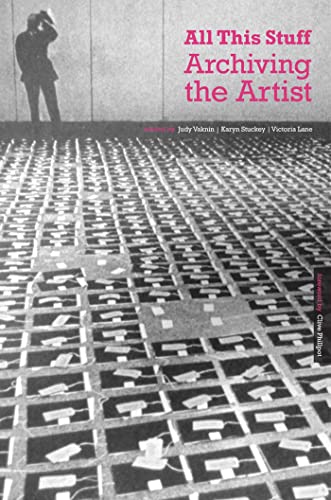
Introduced by Clive Phillpot, and including artists and writers such as Gustav Metzger, Bruce McLean, Barbara Steveni, John Latham, Barry Flanagan, Edward Burra, Penelope Curtis, and Neal White, All This Stuff breaks new ground in the field of archive theory. It documents the innovative ways in which the arts are challenging the distinctions, processes, and crossovers between artworks and archives. This critical reexamination exemplifies how the field of art archiving is changing theory and practice as well as our understanding of what an archive is, or could be. Valuable insights are given into the archival process and the book also explores how archives can be made accessible and the unpredictable ways in which they may be explored and reinterpreted in the future.
Die Inhaltsangabe kann sich auf eine andere Ausgabe dieses Titels beziehen.
Über die Autorin bzw. den Autor
Judy Vaknin is an archivist and was formerly responsible for the care and management of archives and special collections at Middlesex University. Karyn Stuckey manages the archives and special collections for architects Foster + Partners. She is chair of ARLIS’s Art and Design Archives Committee and secretary of the Architectural Records Section of the International Council of Archives. She was archivist for, and presented and published papers on, George Bernard Shaw, Jocelyn Herbert, and Stanley Kubrick. Victoria Lane is the collections manager for the Black Cultural Archives and was formerly the archivist for Richard Deacon, the Barry Flanagan Estate, the Henry Moore Institute, and the Tate Archive.
Auszug. © Genehmigter Nachdruck. Alle Rechte vorbehalten.
All This Stuff Archiving the Artist
By Judy Vaknin, Karyn Stuckey Victoria LaneLibri Publishing
Copyright © 2013 Libri Publishing
All rights reserved.
ISBN: 978-1-907471-76-6All rights reserved.
Contents
Acknowledgements,
Introduction by Clive Phillpot,
CHAPTER ONE From Out of the Shadows Penelope Curtis,
SECTION 1 – ARTISTS,
CHAPTER TWO An Interview with Gustav Metzger,
CHAPTER THREE The Impossibility of Archiving in the Mind of an Artist Still Living Bruce McLean and Donald Smith,
CHAPTER FOUR Experiments and Archives in the Expanded Field Neal White,
CHAPTER FIVE An Interview with Barbara Steveni,
CHAPTER SIX Artists and Archives: A Correspondence Uriel Orlow and Ruth Maclennan,
CHAPTER SEVEN The Artist in the Archive: Frederico Câmara Victoria Lane,
SECTION 2 – ARCHIVISTS,
CHAPTER EIGHT All that Stuff! Anna McNally,
CHAPTER NINE Archive as Event: Creative Archiving for John Latham Athanasios Velios,
CHAPTER TEN Barry Flanagan's Archive: Interconnectivities Jo Melvin and Meirian Jump,
SECTION 3 – ART HISTORIANS AND THEORISTS,
CHAPTER ELEVEN Witnessing the Archive: Art, Capitalism and Memory Sas Mays,
CHAPTER TWELVE "I Can Never Find Anything among the Piles of Old Paper and General Rubbish": Edward Burra and his Archive Jane Stevenson,
List of Contributors,
CHAPTER 1
FROM OUT OF THE SHADOWS1
Penelope Curtis
The Archive inside the Archive
Artists may well keep their own stuff in the belief that, in due course, ideas expressed in different ways on bits of paper or in other media will once again become useful. This is perhaps not so very different to anyone's reason for keeping notes from the past; but in the artist's case there is the additional task of developing and then maintaining a reputation, so that, towards the end of a career, the retained stuff may acquire more value than it had at the beginning. Rather than being a question of financial gain (though that can be involved), this is about how much the work of a whole career can make the early stuff count.
Archives tend to be seen as two dimensional, which is a great problem for artists who try out their ideas in the round. Rather few places keep much in the way of three-dimensional artistic archive, though architectural archives are an obvious exception. The Henry Moore Institute in Leeds can be seen as unusual in its collecting activity, which ranged across period and practice, as well as media, taking it well beyond the monographic archive where, as in the case of the Musée Rodin or of Moore himself, diversity of medium is offset by the purely monocular lens.
The recent display at Tate Britain, which revealed a good deal of Naum Gabo's archive for the first time in public, also implicitly revealed why this material was in the archive and, indeed, why it had ever been archived at all: it was flat, or could be made flat. Gabo's bank of ideas for sculpture was expressed in a form that lay exactly on the threshold between the two- and the three-dimensional. These proto-sculptures were expressed in 'archival' form from the very outset; the idea of the archive was, indeed, integral to their meaning. In this sense, they signal that which is particular to the archive and which I want to signal here: its often peculiar position between past and future tense.
The Henry Moore Institute not only housed the archives of sculptors but also asked artists to come and use thosethose archives. This meant, obviously enough, relating the archive of one artist to another. Sometimes this was straightforward and the artist acte
„Über diesen Titel“ kann sich auf eine andere Ausgabe dieses Titels beziehen.
Suchergebnisse für All This Stuff: Archiving the Artist

Beispielbild für diese ISBN
All This Stuff: Archiving the Artist
Anbieter: Ria Christie Collections, Uxbridge, Vereinigtes Königreich
Verkäuferbewertung 5 von 5 Sternen

Zustand: New. In English. Artikel-Nr. ria9781907471766_new
Neu kaufen
EUR 32,55
EUR 13,96 Versand
Versand von Vereinigtes Königreich nach USA
Versand von Vereinigtes Königreich nach USA
Anzahl: Mehr als 20 verfügbar
Foto des Verkäufers
All This Stuff
Anbieter: moluna, Greven, Deutschland
Verkäuferbewertung 5 von 5 Sternen
Zustand: New. KlappentextIntroduced by Clive Phillpot, and including artists and writers such as Gustav Metzger, Bruce McLean, Barbara Steveni, John Latham, Barry Flanagan, Edward Burra, Penelope Curtis, and Neal White, All This Stuff breaks new gro. Artikel-Nr. 448388727
Neu kaufen
EUR 32,54
EUR 48,99 Versand
Versand von Deutschland nach USA
Versand von Deutschland nach USA
Anzahl: Mehr als 20 verfügbar