
Verwandte Artikel zu Converging World: Connecting Communities in Global...
Converging World: Connecting Communities in Global Change (Schumacher Briefings, 13, Band 13) - Softcover
Buch 12 von 17: Schumacher Briefings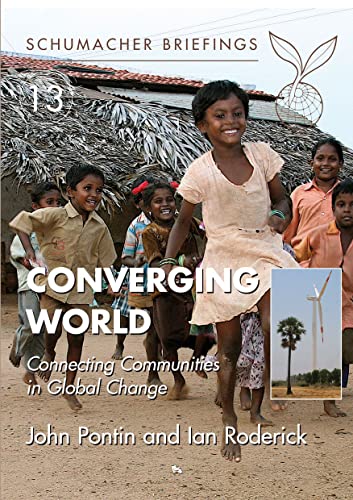
Inhaltsangabe
The principle of 'contraction and convergence' can be applied to climate change, showing us a way forward by reducing the ecological footprint of some while increasing that of others. Such convergence has many dimensions: technological change, cultural diversity, human rights and political power. This Briefing explores these ideas and describes how a charity put these ideas into action. Inspired by the work of Social Change and Development (SCAD) in India, the charity has directly reduced carbon emissions by erecting wind turbines in India, funded by individuals and businesses with high emissions elsewhere in the world in return for an allocation of the carbon saved. The Converging World is an action story which tackles the complexities of climate change, environmental degradation and social injustice.
Die Inhaltsangabe kann sich auf eine andere Ausgabe dieses Titels beziehen.
Über die Autorin bzw. den Autor
John Pontin has a keen interest in sustainability, sitting on the boards of Sustainability West, Business West and the RSA's Advisory Council. He is a board member of the Natural Step (part of Forum for the Future). His company JT Design Build has developed a national profile for its stance on green issues in construction.
Ian Roderick is the Director of the Schumacher Institute for Sustainable Systems, a new think-and-do tank created by the Schumacher Society. He is also president of the UK Systems Society and a leading light in the Go Zero project in Somerset.
Auszug. © Genehmigter Nachdruck. Alle Rechte vorbehalten.
Converging World
Connecting Communities in Global Change
By John Pontin, Ian RoderickUIT Cambridge Ltd
Copyright © 2007 John Pontin and Ian Roderick
All rights reserved.
ISBN: 978-1-903998-92-2All rights reserved.
Contents
Preface by Ian Roderick,
Foreword by Cletus Babu,
1 What does Convergence mean?,
2 The Converging World: the story so far,
3 Towards Convergence,
4 A very short history of Convergence,
5 Convergence as a unifying principle,
6 A critique of The Converging World,
Conclusions,
Resources,
CHAPTER 1
What does Convergence mean?
To converge means to merge, unify, unite, approach, and gather together. There is a dynamic quality to this word; it's as if we can always get a little closer. The opposite of converge is diverge, which means to move or draw apart, to vary, to deviate and to extend in a different direction. It suggests separateness, boundaries, and maybe disagreements.
We can see convergence and divergence in nature with co-operating and competing organisms making up complex ecosystems, which exhibit both these types of process to maintain a fine balance. How often do we say that in our social lives 'we have to get a balance', and how often do we blame an over-emphasis on divergent processes as the cause of the ills of our society?
For example, the history of the West since the Renaissance has been driven by expansion and by economic growth, so much so that we now claim that our economic systems are necessarily locked into ever greater volumes of production and distribution, which produces an increasing gap between those who have and those who don't – this is both among and within nations. Divergent growth not only causes tensions and conflict, but it feeds on itself and has led to a crisis point in our overuse of resources and disregard for waste. The current focus on atmospheric pollution is a direct symptom of a multitude of divergent processes.
It is tempting to suggest that we impose some opposite, converging process whereby we curtail overall growth and introduce the idea of equal rights to equal shares of all resources. Unfortunately there appears to be no will to vote this in, and we have tragic examples of how imposing something like this gets perverted and ends in disaster. But it may happen this way, as Noam Chomsky says:
"Suppose it was discovered tomorrow that the greenhouse effect has been way underestimated, and that the catastrophic effects are actually going to set in 10 years from now, and not 100 years from now, or something. Well, given the state of the popular movements we have today, we'd probably have a fascist takeover – with everybody agreeing to it, because that would be the only method for survival that anyone could think of. I'd even agree to it, because there are no other alternatives around right now." – Chomsky, 2002
This frightening prospect of a self-imposed, fascist convergent mechanism would probably contain horrors on a vast scale. However, Chomsky continues by saying that we don't have to wait for the disasters to happen; we have to create the groundwork to adapt and cope. These mechanisms, if we take a moral stand, should be convergent. They should bring people and people together, and people and nature together.
Balance is needed, and we need to hold and live with contradictions and even paradoxes. Convergence and divergence are both required within complex systems; they are opposites, but we need to find a way to accept the dynamic unity of these opposites that need each other. Communities do develop separately: they may pull away and diverge, but forces for convergence are required to prevent them springing too far apart; they need reasons and goals for uniting in common purpose for mutual benefit. It is our contention that our present world systems have too few converging or correcting mechanisms to do this. As a result we have extraordinary wealth in some parts of the world and abject poverty elsewhere, and this divergence feeds on itself.
The challenge of The Converging World is to discover and implement mechanisms for convergence in order to counteract the forces that separate.
At the core of any construct of a converging world is the natural world. We now have a perspective on this planet that shows how remarkable life is, and how life is essential to the maintenance of the atmosphere, the seas and even the rocks. Our actions are destroying this fine balance. We have introduced new, divergent processes by burning fossil fuels and peat bogs, and we have inhibited convergent processes like the absorptive action of the rainforests, by chopping them down and burning them.
Proper regard for convergent processes would restore that balance. It would see human activity as part of the natural systems: our waste will be Earth's resource, our resource will be Earth's bounty in mutual beneficial cycles rather than the destructive, one-way processes that we have currently created. All societies need to converge to similar benign relationships with the Earth. The model for those relationships is what we propose is at the heart of our future work, especially our relationship with the atmosphere.
The Converging World is a big idea. It derives in part from the 'Contraction & Convergence' principle proposed by Aubrey Meyer of the Global Commons Institute (Schumacher Briefing No. 5), which sees, across the world, an equal per capita right to emit 'carbon'.
Contraction & Convergence
"Should Contraction & Convergence fail to occur, the globally asymmetric growth of emissions and income will continue, triggering rates of damage that will collapse security and overwhelm the [global] economy. The need to avoid this is obvious and absolute." – Global Commons Institute
The year 2006 may be a turning point in history. The media created a storm over climate change, and the last vestige of any dissent about global warming being real and serious almost disappeared under a hail of articles, publications, films and conferences and important reports.
A cynical view is that this media attention is transient; global warming fatigue will set in, just like fatigue over famine disasters or HIV/AIDS in Africa. Perhaps, though, we have attained some critical mass in the thoughts of enough people, perhaps some paradigm shift is under way and we, as yet, have no idea what the consequences of that may be.
If so, then major credit goes to the work of Aubrey Meyer and the Global Commons Institute (GCI), who have consistently presented and represented the concept of Contraction & Convergence.
Contraction & Convergence (C&C) is a framework for international action; it is generally considered fair and simple. C&C says that the right to emit carbon dioxide is a human right that should be allocated on an equal basis to all humankind.
Carbon dioxide is a useful proxy for all greenhouse gases, the concentrations of which are now threatening to produce irreversible climate change with potentially devastating effects on all life. The C&C idea is that we should estimate what levels of global emissions are acceptable to the Earth, which will then determine how much we need to cut back (contract). Once we know this, an equal per capita allowance is calculated which is used as a starting point for reduction and for trading (Convergence).
So by deciding an acceptable level for CO2 in the Earth's atmosphere we can determine the maximum global emissions per year. This gives us an equal per capita amount: each...
„Über diesen Titel“ kann sich auf eine andere Ausgabe dieses Titels beziehen.
Suchergebnisse für Converging World: Connecting Communities in Global...

Beispielbild für diese ISBN
Converging World: Connecting Communities in Global Change (Schumacher Briefing) (Schumacher Briefings)
Anbieter: AwesomeBooks, Wallingford, Vereinigtes Königreich
Verkäuferbewertung 5 von 5 Sternen

Paperback. Zustand: Very Good. Converging World: Connecting Communities in Global Change (Schumacher Briefing) (Schumacher Briefings) This book is in very good condition and will be shipped within 24 hours of ordering. The cover may have some limited signs of wear but the pages are clean, intact and the spine remains undamaged. This book has clearly been well maintained and looked after thus far. Money back guarantee if you are not satisfied. See all our books here, order more than 1 book and get discounted shipping. Artikel-Nr. 7719-9781903998922
Gebraucht kaufen
EUR 4,17
EUR 4,92 Versand
Versand von Vereinigtes Königreich nach USA
Versand von Vereinigtes Königreich nach USA
Anzahl: 2 verfügbar
Beispielbild für diese ISBN
Converging World: Connecting Communities in Global Change (Schumacher Briefings)
Anbieter: WorldofBooks, Goring-By-Sea, WS, Vereinigtes Königreich
Verkäuferbewertung 5 von 5 Sternen
Paperback. Zustand: Very Good. The book has been read, but is in excellent condition. Pages are intact and not marred by notes or highlighting. The spine remains undamaged. Artikel-Nr. GOR001092808
Gebraucht kaufen
EUR 2,58
EUR 6,69 Versand
Versand von Vereinigtes Königreich nach USA
Versand von Vereinigtes Königreich nach USA
Anzahl: 3 verfügbar
Beispielbild für diese ISBN
Converging World: Connecting Communities in Global Change (Schumacher Briefing) (Schumacher Briefings)
Anbieter: Bahamut Media, Reading, Vereinigtes Königreich
Verkäuferbewertung 4 von 5 Sternen

Paperback. Zustand: Very Good. This book is in very good condition and will be shipped within 24 hours of ordering. The cover may have some limited signs of wear but the pages are clean, intact and the spine remains undamaged. This book has clearly been well maintained and looked after thus far. Money back guarantee if you are not satisfied. See all our books here, order more than 1 book and get discounted shipping. Artikel-Nr. 6545-9781903998922
Gebraucht kaufen
EUR 7,02
EUR 8,33 Versand
Versand von Vereinigtes Königreich nach USA
Versand von Vereinigtes Königreich nach USA
Anzahl: 2 verfügbar
Foto des Verkäufers
Schumacher Briefings 13 Converging World
Verlag:
Green Books Ltd, 2007
ISBN 10: 1903998921
ISBN 13: 9781903998922
Gebraucht
Softback
Erstausgabe
Anbieter: Yare Books, Great Yarmouth, Vereinigtes Königreich
Verkäuferbewertung 5 von 5 Sternen
Softback. Zustand: Very Good. Zustand des Schutzumschlags: No Cover. First Edition. Artikel-Nr. g002785
Gebraucht kaufen
EUR 9,04
EUR 31,94 Versand
Versand von Vereinigtes Königreich nach USA
Versand von Vereinigtes Königreich nach USA
Anzahl: 1 verfügbar