
Verwandte Artikel zu Your Complete Guide To Facial Cosmetic Surgery
Inhaltsangabe
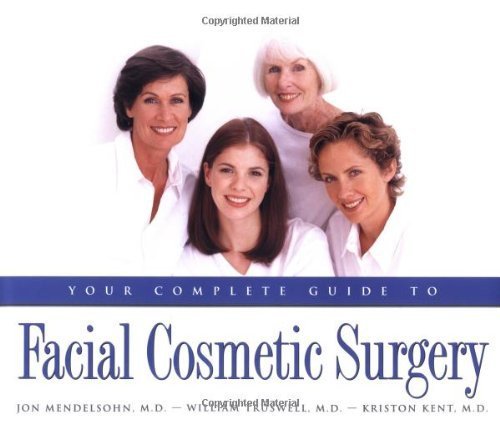
From choosing a doctor to postsurgical recovery, this guidebook for facial cosmetic surgery provides tips for every stage of the most popular procedures including facelifts, lip augmentation, and rhinoplasty. Potential risks and complications, realistic expectations, and criteria for determining if one is a good candidate for surgery are addressed by three experienced plastic surgeons. The newest materials used in cosmetic surgery, such as Restylane, longer-lasting wrinkle filler, and surgical techniques that promote quicker healing are discussed. An insightful introduction supplies a brief history of cosmetic surgery and dispels common myths.
Die Inhaltsangabe kann sich auf eine andere Ausgabe dieses Titels beziehen.
Über die Autorin bzw. den Autor
Jon Mendelsohn, MD, is the coauthor of The Non-Surgical Facelift Book. He is the medical director of the Advanced Cosmetic Surgery & Laser Center and a facial plastic surgeon in private practice. He lives in Cincinnati, Ohio. William Truswell, MD, is the coauthor of The Non-Surgical Facelift Book. He is the medical director of the Aesthetic Laser and Cosmetic Surgery Center and a facial surgeon in private practice. He lives in Northampton, Massachusetts. Kriston Kent, MD, is a plastic surgeon. He lives in Naples, Florida.
Auszug. © Genehmigter Nachdruck. Alle Rechte vorbehalten.
Your Complete Guide to Facial Cosmetic Surgery
By Jon Mendelsohn, William Truswell, Kriston KentAddicus Books, Inc.
Copyright © 2004 Jon Mendelsohn, M.D.; Kriston Kent, M.D.; and William Truswell, M.D.
All rights reserved.
ISBN: 978-1-886039-70-4All rights reserved.
Contents
Acknowledgments,
Introduction,
1 Contemplating Facial Cosmetic Surgery,
2 Choosing a Facial Cosmetic Surgeon,
3 Before and After Facial Cosmetic Surgery: What to Expect,
4 Facelift,
5 Midface Lift,
6 Eyelid Lift,
7 Browlift,
8 Rhinoplasty,
9 Otoplasty,
10 Wrinkle Fillers,
11 Chin and Cheek Implants,
12 Lip Augmentation,
13 Skin Rejuvenation,
14 Scar Revision,
15 Follow-up Skin Care,
Resources,
Index,
Glossary,
About the Authors,
CHAPTER 1
CONTEMPLATING FACIAL COSMETIC SURGERY
Are you among the thousands of Americans who are thinking about facial cosmetic surgery? Have you wondered how you might look after a facelift ... a nose job ... an eyelid lift? Are you brimming with energy on the inside but showing your age on the outside? If so, facial cosmetic surgery may be for you. Each year, more and more Americans are choosing to turn back the clock with cosmetic surgery.
Before we discuss the most common procedures, let's take a look at why our facial skin and tissues age. Not only will this help you understand how facial structure changes with age, but also it will give you insights about lifestyle habits that can help you maintain the results of cosmetic surgery procedures.
How Facial Structure Changes
Why does facial skin eventually start to droop? Consider this analogy: If you've ever had a lined coat or jacket cleaned, you may have found that the lining shrank during dry cleaning or laundering, making the outer fabric sag. Think of your facial skin as the outer fabric and your bones and supporting tissues as the lining. As those bones and tissues shrink and your muscles lose volume and tone, the skin slips downward, sometimes drooping much as your jacket's outer fabric drapes over the hemline.
Beneath your skin, the SMAS — short for superficial musculoaponeurotic system — also begins to sag and droop. Here come jowls, low brows, and other unwanted folds. The SMAS is the curtain of muscles of facial expression and the surrounding connective tissue. As the SMAS descends, the skin becomes less taut.
Layers of fat, called fat pads, under the eyes and under the skin on our cheeks also keep us looking younger. When gravity pulls at the cheek pads, it can create sagging skin and hollows under the eyes; it also deepens the nasolabial folds, the grooves that run from both sides of the nose to the corners of the mouth. As the cheek pads get longer, they become less rounded, the face appears flatter, and their weight pulls down the corners of the mouth. As muscles surrounding the eyes shrink and weaken, they sometimes develop small gaps through which fat protrudes, creating little bumps under the eyes.
In addition to changes in the underlying structures of the face, the skin itself changes. We start seeing broken capillaries, rough patches, discolorations, fine lines, and enlarged pores.
Why Skin Ages
Slowing Metabolism
Over the years your metabolic rate — the pace at which your body absorbs and processes nutrients — gets slower. As a result your system produces less of just about everything, including blood, bone, the skin proteins collagen and elastin, and natural skin oils. Skin-cell growth and replacement also slow down.
As the connective tissues in your body weaken, your skin's support structure is undermined. With less collagen, which acts as a glue to hold tissues together, and elastin, the fibrous protein in elastic tissues, your skin starts to lose its snap, kind of like an elastic waistband after years of wear. When you were younger, your skin bounced back from all types of stresses, but as the calendar pages flew by, so did your skin's resilience.
Sun Damage
Compare the skin on the underside of your arm to that on the front. That's one way to see how the sun damages your skin. The skin on your under arm is white and unflawed, but the skin on the front of your arm is darker and has been affected by the sun. In fact, you've been bombarded for years with the sun's ultraviolet alpha and beta waves (UV-A and UV-B rays); the more time you've spent in the sun, the more your unprotected skin has been injured.
UV-A and UV-B rays are responsible for photoaging — sun-induced skin damage. UV rays are more harmful at high altitudes, in the summer, and closer to the equator. The sun causes almost as much damage as your biological clock does, sometimes more. Sunlight on unprotected skin penetrates several layers to stimulate pigment-producing melanin, which protectively comes to the surface and makes you tan or freckle. Tanned skin filters out some of the UV rays, but harmful amounts still get through. And over time those cute freckles may turn into liver spots, sun spots, or age spots.
Repeated sun exposure, beginning in childhood, accumulates to break down collagen and elastin, worsening wrinkles and fine lines. Sun exposure also breaks down blood vessels, resulting in spider veins. If you haven't protected your eyes properly, you may also have permanent squint lines.
You might see pink scaley lesions on your skin called actinic keratoses — small, hardened areas of sun-damaged skin that are often precancerous. Since sun exposure is the number one cause of skin cancer, ask your doctor about any peculiar or unexplained blemishes, especially if they grow or change shape.
Genetics
You have a lot to thank your parents and grandparents for, including your facial bone structure, skin thickness and tone, and pigmentation. These ancestors may have passed along other factors that affect your skin, such as a tendency to gain weight or a medical condition such as hypothyroidism, which often dries out the skin.
Poor Nutrition and Hygeine
Nutrition plays a big role in the condition of your skin. The condition of your skin and hair can testify to this. A poor diet, inadequate fluid intake, and substance abuse are reflected in the appearance of your skin. The longer harmful habits continue, the greater the damage they cause to skin and overall health. Obesity can affect how early and how severely your face loses its youthful firmness. Not only is there more fat to slide into your chin and neck, but every time you lose weight only to gain it back, your skin becomes a bit more slack.
Proper cleansing and moisturizing of the skin is important, also. Too little hygiene is bad for the skin; similarly, over cleansing can remove natural oils, which is damaging to the skin.
Inadequate Sleep
Your body is rejuvenated every time you sleep, repairing the physical insults and psychological strains of the day. Tissues need a hiatus during which they, like you, get a new lease on life. Thus, chronic lack of sleep is a key contributor to premature aging.
Illness and Injury
Injuries and skin disorders such as acne and herpes can leave the face scarred and the features uneven. Chronic illnesses and long-term stress rob your skin of nutrients, especially when accompanied by inadequate self-care. Many medications and topical creams can also deplete nutrients, usually by making...
„Über diesen Titel“ kann sich auf eine andere Ausgabe dieses Titels beziehen.
Suchergebnisse für Your Complete Guide To Facial Cosmetic Surgery

Beispielbild für diese ISBN
Your Complete Guide to Facial Cosmetic Surgery
Anbieter: Majestic Books, Hounslow, Vereinigtes Königreich
Verkäuferbewertung 4 von 5 Sternen

Zustand: Used. pp. vii + 168 Illus. (Col.). Artikel-Nr. 58158069
Gebraucht kaufen
EUR 22,69
EUR 7,68 Versand
Versand von Vereinigtes Königreich nach USA
Versand von Vereinigtes Königreich nach USA
Anzahl: 1 verfügbar
Beispielbild für diese ISBN
Your Complete Guide to Facial Cosmetic Surgery
Anbieter: Biblios, Frankfurt am main, HESSE, Deutschland
Verkäuferbewertung 4 von 5 Sternen
Zustand: Used. pp. vii + 168. Artikel-Nr. 1850385952
Gebraucht kaufen
EUR 22,97
EUR 9,95 Versand
Versand von Deutschland nach USA
Versand von Deutschland nach USA
Anzahl: 1 verfügbar
Beispielbild für diese ISBN
Your Complete Guide To Facial Cosmetic Surgery
Anbieter: Romtrade Corp., STERLING HEIGHTS, MI, USA
Verkäuferbewertung 5 von 5 Sternen

Zustand: New. This is a Brand-new US Edition. This Item may be shipped from US or any other country as we have multiple locations worldwide. Artikel-Nr. ABBB-123668