
Verwandte Artikel zu The Essential George Washington: Two Hundred Years...
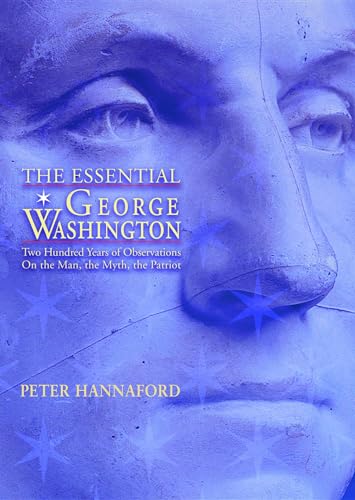
The Essential George Washington: Two Hundred Years of Observations on the Man, the Myth, the Patriot - Hardcover
Inhaltsangabe
Author Peter Hannaford, known as a chronicler of the 40th President, Ronald Reagan, found his own interest in George Washington reawakened when he served for six years on the Mount Vernon Advisory Committee.
Die Inhaltsangabe kann sich auf eine andere Ausgabe dieses Titels beziehen.
Über die Autorin bzw. den Autor
Author Peter Hannaford has had a long career in American politics and public affairs. He is a former Reagan adviser and current senior consultant to APCO Worldwide, a public affairs/strategic communications firm based in Washington, DC. Mr. Hannaford was director of issues and research in Reagan's 1976 presidential nomination campaign. In the 1980 campaign he was senior communications adviser to Mr. Reagan. He also served as assistant to the governor and director of public affairs for then-Governor Reagan in Sacramento. He is the author of eleven books and numerous articles, columns, and essays.
Auszug. © Genehmigter Nachdruck. Alle Rechte vorbehalten.
Excerpt
NAPOLEON BONAPARTE
(1769-1821)
FRENCH SOLDIER, EMPEROR, EXILE
"They wanted me to be another Washington."
In 1792, the French monarchy was overthrown in therevolution, and young Napoleon?unlike most army officers?sidedwith the revolutionaries. He rose in power as histactical brilliance took him to victory after victory and, in1799, joined a plot to overthrow the French Directory,replacing it with the Consulate. Within three years he wasmade First Consul for life, soon crowning himself EmperorNapoleon I. In 1803, war broke out with England, Russia,Austria, and Sweden; by 1805, Napoleon's armies hadcrushed all rivals but England, which was protected by thesea and her powerful navy. During the first decade of the century,France dominated much of continental Europe.Napoleon installed various relatives as heads of states hecontrolled. His audacious invasion of Russia in 1812 proveda disaster, and he was forced to retreat, with several hundredthousand troops dying from freezing temperatures and starvationon the way. The allies?England, Austria, Prussia, andRussia?joined forces and, in 1814, captured Paris, forcingNapoleon to abdicate. He was exiled to Elba, off the westcoast of Italy. In 1815, he escaped to France and for a time?calledThe Hundred Days?he returned to his past glory,which ended that spring with defeat in the Battle of Waterloo.Exiled to the remote South Atlantic island of St. Helena,Napoleon often ruminated on his lost empire. Bold, daring,and resourceful, Napoleon Bonaparte lacked Washington'spatience, reflective qualities, and consensus-building ability.
They wanted me to be another Washington.
?The above quotation is from a letter by Benjamin West, the painter, to Rufus King, May 3, 1797, published in Literary History of the United States (1963). This was soon after Napoleon's early victories, when he had begun to see himself as the potential leader of a great French empire.
THOMAS PAINE
(1737-1809)
POLITICAL THEORIST, PAMPHLETEER
"The character and services of this gentleman are sufficient
to put all those men called kings to shame."
Passionate and combative, Tom Paine become the chiefpropagandist for the American Revolution. Born inThetford, Norfolk, England, this small, wiry son of a Quakerfarmer and corset maker left school at thirteen to work forhis father. Several jobs later, he became an excise tax collector.In 1772, he was dismissed after publishing a pamphletagitating for higher salaries for excisemen as a means of endingcorruption in the service. Meanwhile, he was studying onhis own and had met Benjamin Franklin. In 1774, armedwith a letter of introduction from Franklin, he sailed forAmerica and landed a job as assistant editor of PennsylvaniaMagazine in Philadelphia, a position he held from 1775-77.He also published articles anonymously, including onedenouncing slavery. At the time he took up his editorialduties the colonies were divided over the issue of whether todeclare independence from Great Britain.
On January 10, 1776, Paine's pamphlet Common Sensewas published. It galvanized support for independence. Hewrote, "Freedom has been hunted around the globe. Asiaand Africa have expelled her ... and England has given herwarning to depart. O, receive the fugitive and prepare in timean asylum for mankind." Washington credited Paine withchanging many minds from doubt to support for independence.In particular, Common Sense had a powerful effect onthe men who created the Declaration of Independence. Afterthe Declaration, he joined the Continental Army, seeing firsthand the hardships being suffered by the ill-equipped troops.Public discouragement was widespread. In December 1776,Paine published the first of sixteen pamphlets in the seriestitled The Crisis. The first opened with the words "These arethe times that try men's souls." Washington ordered it readto "every corporal's guard in the army."
Paine's passion and frankness would, however, ultimatelyget him into trouble. In 1781, he joined John Laurens'sdiplomatic mission to Paris, and in 1787 went on to Londonwhere he wrote The Rights of Man, attacking critics of theFrench Revolution (Member of Parliament Edmund Burke inparticular) and English institutions in general. In this workPaine held up Washington as a model for monarchs to follow.This tome so angered British authorities that he was indictedfor treason.
He fled to France, where he was elected to the NationalConvention. He argued, on humanitarian grounds, againstthe execution of Louis XVI, angering the Jacobins. Narrowlyescaping the guillotine himself, he was imprisoned in Paris in1793. He languished there for ten months before JamesMonroe, then United States ambassador, and other Americanfriends secured his release.
In 1794-96, deeply affected by the French Revolution,Paine wrote The Age of Reason, in which he attacked organizedreligion and extolled Deism, the belief in a God whoexerts no influence on the actions of individuals. His once-widespreadpopularity with the American public evaporated.Washington's friends, in particular, turned their backs on himafter he wrote a scathing and bitter letter, blamingWashington for insufficient effort to extricate him from hisFrench prison sentence. Paine returned to the United States in1802, ostracized. His health began to fail, and in 1809 hedied an outcast in New York City.
The character and services of this gentleman are sufficient to put all those men called kings to shame. While they are receiving from the sweat and labors of mankind a prodigality of pay to which neither their abilities nor their services can entitle them, he is rendering every service in his power, and refusing every pecuniary reward. He accepted no pay as commander-in-chief; he accepts none as President of the United States.
?From Rights of Man, 1791-92
As to you, sir, treacherous to private friendship (for so you have been to me, and that in the day of danger) and a hypocrite in public life, the world will be puzzled to decide whether you are an apostate or an impostor, whether you have abandoned good principles or whether you ever had any.
?Letter to Washington, July 30, 1796
ANN PAMELA CUNNINGHAM
(1816-75)
SAVIOR OF MOUNT VERNON
"Oh, it cannot be possible!"
As a young woman living near Charleston, SouthCarolina, Ann Pamela Cunningham was severely injured in ahorseback-riding accident and became a semi-invalid. Duringher convalescence, her mother visited relatives in Washington,D.C., and returned home by boat. As the boat glided downthe Potomac, the mother spied Mount Vernon. Her excitementturned to shock, for George Washington's home wasgoing to ruin. Columns were missing from the portico, theroof was in disrepair, the grounds overgrown. When this wasrelated to Ann Pamela, she decided to make the rescue ofMount Vernon her life's work.
...
„Über diesen Titel“ kann sich auf eine andere Ausgabe dieses Titels beziehen.
Suchergebnisse für The Essential George Washington: Two Hundred Years...

Beispielbild für diese ISBN
Essential George Washington: Two Hundred Years of Observations on The Man, The Myth, The Patriot (Images from the Past)
Verlag:
Applewood Books, Bennington, 1999
ISBN 10: 1884592236
ISBN 13: 9781884592232
Gebraucht
Hardcover
Erstausgabe
Anbieter: Bookplate, Chestertown, MD, USA
Verkäuferbewertung 4 von 5 Sternen

Hardcover. Zustand: Near Fine. Zustand des Schutzumschlags: Near Fine. 1st Edition. Clean, unmarked, sharp corners, firm hinges with DJ in NF condition. KRM/Pres/Washington. Artikel-Nr. ABE-1743782277505
Gebraucht kaufen
EUR 4,58
EUR 7,55 Versand
Versand innerhalb von USA
Versand innerhalb von USA
Anzahl: 1 verfügbar
Foto des Verkäufers
The Essential George Washington: Two Hundred Years of Observations On the Man, the Myth, the Patriot
Verlag:
Images from the Past, Vermont, 1999
ISBN 10: 1884592236
ISBN 13: 9781884592232
Gebraucht
Hardcover
Erstausgabe
Signiert
Anbieter: Between the Covers-Rare Books, Inc. ABAA, Gloucester City, NJ, USA
Verkäuferbewertung 5 von 5 Sternen

Hardcover. Zustand: Fine. Zustand des Schutzumschlags: Fine. First edition. Fine in fine dustwrapper. Hardcover with Dustwrapper Inscribed by author on half title page. Artikel-Nr. 228629
Gebraucht kaufen
EUR 41,19
EUR 4,89 Versand
Versand innerhalb von USA
Versand innerhalb von USA
Anzahl: 1 verfügbar