
Verwandte Artikel zu Eric Voegelin: The Restoration of Order (Library of...
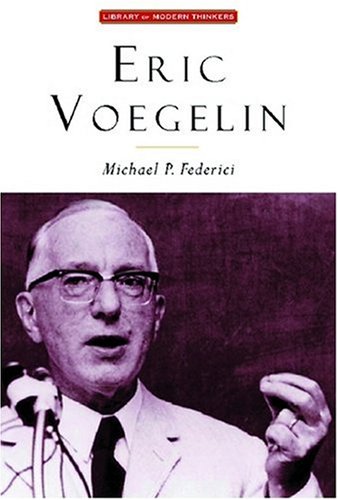
Inhaltsangabe
Buch von Federici, Michael P.
Die Inhaltsangabe kann sich auf eine andere Ausgabe dieses Titels beziehen.
Über die Autorin bzw. den Autor
Michael P. Federici is professor of political science and international relations at Middle Tennessee State University. He previously served on the faculty at Mercyhurst University. He received his Ph.D. in Politics from The Catholic University of America in Washington, D.C. and his B.S. in Economics from Elizabethtown College. Federici has written or edited several books, including The Challenge of Populism, Eric Voegelin: The Restoration of Order, The Political Philosophy of Alexander Hamilton, Rethinking the Teaching of American History, and The Culture of Immodesty in American Life and Politics.
Auszug. © Genehmigter Nachdruck. Alle Rechte vorbehalten.
Eric Voegelin
The Restoration of OrderBy Michael P. FedericiISI Books
Copyright © 2007 Michael P. FedericiAll right reserved.
ISBN: 978-1-882926-74-9
Introduction
Writing a book about Eric Voegelin's political theory is a challenging task. The author must explain the philosophical and historical substance of Voegelin's work, capture the importance of his contribution to scholarship and to the restoration of Western civilization, and evaluate criticisms of his political theory. Several factors, including the volume of his scholarship, make forming these objectives into a cogent study of his political philosophy a formidable project. Voegelin wrote twenty-one books and more than one hundred scholarly articles that together mark the intellectual and existential journey of a seminal twentieth-century philosopher. The philosophical density and historical scope of his work add to the challenge of explaining and analyzing his political theory. Moreover, there are several dimensions to Voegelin's intellectual achievement, including a history of political ideas, a new science of politics, a philosophy of order and history, and a philosophy of consciousness.The volume, scope, theoretical complexity, and multidimensionality of his work make it difficult to convey the meaning of his political philosophy intricately and to connect all its aspects in a brief book. To review as much of Voegelin's political theory as possible, and to introduce it to a wide audience, it is necessary to be expository when discussing some parts of his work and analytical when discussing others. This book focuses on the central components of Voegelin's political philosophy and tries to leave esoteric issues regarding his work to more specialized scholars.
Whatever the level of analysis, explaining Voegelin's political philosophy requires both the exposition of his ideas and an understanding of the context in which they were created. The context for Voegelin's political philosophy includes the political and historical circumstances in which he wrote and the evolution of his scholarly work as a whole, with its shifts in emphasis and its development of new philosophical vistas. It is also important to have some grasp of Voegelin's biographical profile, since his political philosophy was shaped by personal encounters he had with totalitarianism and other spiritually suffocating ideologies.
But as complex as Voegelin's political philosophy may seem, there is a common thread running through his work. Whether Voegelin was focusing on the philosophy of history and order, the philosophy of consciousness, the race problem in Germany, or the history of political ideas, his primary concern was to engage in the open philosophical search for the truth of existence. The responsibility of political philosophers who make this search their lifework is to articulate the truth of existence and defend it from untruth. The search for truth and order is always met with resistance-not only in society but in the imagination of the philosopher who searches for ways to articulate truth by sifting through alternative conceptions of reality (OH V, 53-54). The search cannot take place outside the war in the imagination between competing perceptions of reality. The presence of untruth is a part of the structure of consciousness that must be confronted and overcome. Voegelin's search for the truth of existence included resisting prevalent ideological distortions, diagnosing their spiritual causes, and tracing their historical development. This approach put Voegelin at odds with the dominant forces of his age.
The Contemporary Context
Our own intellectual and cultural context adds to the difficulty of explaining Voegelin's political philosophy. Voegelin's work is not well known outside a relatively small group of academics and their students. Yet within this domain Voegelin's influence is impressive. His work has inspired a growing secondary literature and his political philosophy has been applied to a variety of topics in a broad range of academic fields. His philosophy of history and philosophy of consciousness have influenced the work of thinkers who are significant in their own right. Among these are Gerhart Niemeyer, Flannery O'Connor, David Walsh, Marion Montgomery, Russell Kirk, James L. Wiser, Ellis Sandoz, Dante Germino, and Jrgen Gebhardt. Further evidence of Voegelin's influence is the creation in 1987 of the Voegelin Institute at Louisiana State University and the establishment of the Centre for Voegelin Studies in the Department of Religions and Theology at the University of Manchester. But while Voegelin's work has influenced several first-rate scholars, his political theory has not found its way into the broader culture.
Several factors have contributed to the obscurity of Voegelin's work. For one thing, as Ellis Sandoz notes, Voegelin made few concessions to those readers who were not prepared to intellectually digest difficult historical and philosophical material. While Voegelin did write some essays intended to be accessible to a wider audience, until recently many of these works were either unpublished or only available in German. In addition, the recent secondary literature on Voegelin tends to focus on his deeper theoretical work. Another factor that contributes to Voegelin's obscurity is that while he lectured at some of the leading universities in America and Europe, he spent a good part of his academic career at Louisiana State University, a school that did not provide Voegelin with institutional prestige. Furthermore, because Voegelin was so intent on working his way through a broad range of historical and philosophical sources, he generally did not take on Ph.D. students. Consequently, he has not benefited from the activity of dozens of graduate students passing on his ideas to new generations of scholars. Finally, Voegelin was often misunderstood or ignored because his political philosophy was intellectually alien to conventional ideological dispositions. Not only did the New York Times fail to review even one of Voegelin's books while he was living; its obituary of Voegelin conveys no sense of his contribution to scholarship, his intellectual genius, or his imaginative vision.
Time did publish a feature five-page article on Voegelin's analysis of gnosticism, which appeared about a year after the publication of The New Science of Politics. The context for the article is interesting, and it provides some sense of how Voegelin's work was perceived by the broader culture in a rare case of its popular dissemination. In the March 9, 1953, issue of Time, which celebrated the magazine's thirtieth year of publication, the editors put forth a list of "convictions" and a "birthday thesis" based largely-and remarkably-on Voegelin's analysis of gnosticism. The portion of the article that dealt with Voegelin's work was a rough sketch of his understanding of gnosticism and how it has influenced the evolution of Western thinking and politics. The title of the article, "Journalism and Joachim's Children," was a reference to the thirteenth-century Calabrisan monk Joachim of Fiore (Flora), who figures prominently in Voegelin's analysis of the Western cultural crisis.
The response to the article was, as one might expect, varied. In the following two issues, Time ran several related letters to the editor. Some were comical: "I find your recent gobbledygook about Gnosticism revolting. You and the Pope can play God if you want to, but whether or not man can ultimately attain perfection is far beyond the depth of either of...
„Über diesen Titel“ kann sich auf eine andere Ausgabe dieses Titels beziehen.
Suchergebnisse für Eric Voegelin: The Restoration of Order (Library of...

Beispielbild für diese ISBN
Eric Voegelin: The Restoration of Order (Library of Modern Thinkers)
Anbieter: World of Books (was SecondSale), Montgomery, IL, USA
Verkäuferbewertung 5 von 5 Sternen

Zustand: Very Good. Item in very good condition! Textbooks may not include supplemental items i.e. CDs, access codes etc. Artikel-Nr. 00108776455
Gebraucht kaufen
EUR 9,80
Versand gratis
Versand innerhalb von USA
Versand innerhalb von USA
Anzahl: 1 verfügbar
Beispielbild für diese ISBN
Erick Voegelin (Library of Modern Thinkers)
Anbieter: Powell's Bookstores Chicago, ABAA, Chicago, IL, USA
Verkäuferbewertung 5 von 5 Sternen
Hardcover. Zustand: Used-Like New. Clean copy. May have remainder mark. Artikel-Nr. 2036673
Gebraucht kaufen
EUR 6,25
EUR 6,50 Versand
Versand innerhalb von USA
Versand innerhalb von USA
Anzahl: 16 verfügbar
Beispielbild für diese ISBN
Eric Voegelin: The Restoration of Order
Anbieter: Revaluation Books, Exeter, Vereinigtes Königreich
Verkäuferbewertung 5 von 5 Sternen
Hardcover. Zustand: Brand New. 249 pages. 8.25x5.75x1.00 inches. In Stock. Artikel-Nr. 1882926749
Neu kaufen
EUR 83,01
EUR 11,68 Versand
Versand von Vereinigtes Königreich nach USA
Versand von Vereinigtes Königreich nach USA
Anzahl: 1 verfügbar