
Verwandte Artikel zu Helping People with Developmental Disabilities Mourn:...
Inhaltsangabe
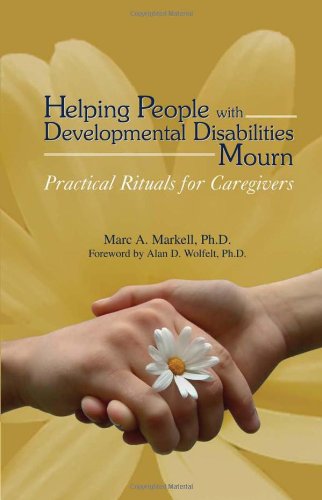
Frequently, people with developmental disabilities are excluded from bereavement ceremonies when a loved one or friend dies, therefore not receiving the special care needed for comprehending their own feelings of loss. Focusing on creating mourning rituals for special needs people, this guide offers specific rituals and techniques for caregivers to use while helping explain death and dying. With more than 20 examples such as the use of pictures and storytelling or drawing and music, these practical tools can substantially lend to the understanding of grief and sadness for intellectually and developmentally disabled adults and adolescents.
Die Inhaltsangabe kann sich auf eine andere Ausgabe dieses Titels beziehen.
Über die Autorin bzw. den Autor
Marc A. Markell, PhD, is a professor of special education at St. Cloud State University. He frequently presents workshops on grief and loss for schools, churches, community organizations, and at local, state, national, and international conferences; and he conducts grief support groups and provides individual grief counseling. He is also a certified thanatologist through the Association of Death Educators and Counseling and is certified in death and grief education from the Center for Loss and Life Transition. He lives in St. Cloud, Minnesota. Alan D. Wolfelt, PhD, serves as the director of the Center for Loss and Life Transition. He writes the "Children and Grief" column for Bereavement Magazine and has appeared on Larry King Live, The Oprah Winfrey Show, and Today. He is the author of Healing a Teen's Grieving Heart, Healing Your Grieving Heart, and Understanding Your Grief. He lives in Fort Collins, Colorado.
Auszug. © Genehmigter Nachdruck. Alle Rechte vorbehalten.
Helping People with Developmental Disabilities Mourn
Practical Rituals for Caregivers
By Marc A. MarkellCenter for Loss and Life Transition
Copyright © 2005 Marc A. Markell, Ph.D.
All rights reserved.
ISBN: 978-1-879651-46-3All rights reserved.
Contents
Title Page,
Dedication,
Copyright Page,
Dedication,
Foreword,
Preface,
About the terminology in this book,
Introduction,
Ritual One - Use of Photographs in Ritual,
Ritual Two - Using Storytelling in Ritual,
Ritual Three - Use of Memory Objects in Ritual,
Ritual Four - Use of a Plant (or Tree) in Ritual,
Ritual Five - Use of Drawing in Ritual,
Ritual Six - Use of Music in Ritual,
Ritual Seven - Use of Writing in Ritual,
Ritual Eight - Use of Stones in Ritual,
Ritual Nine - Use of Photos of the Death Process,
Ritual Ten - Use of Space & Location in Ritual,
Ritual Eleven - Use of Daily Objects in Ritual,
Ritual Twelve - Use of Daily Memory in Ritual,
Ritual Thirteen - Use of Packing Up Belongings in Ritual,
Ritual Fourteen - Use of a Pendant or Ornament in Ritual,
Ritual Fifteen - Use of a Heart Picture in Ritual,
Ritual Sixteen - Use of Light in Ritual,
Ritual Seventeen - Use of Burying an Object in Ritual,
Ritual Eighteen - Use of a Memory Gift in Ritual,
Ritual Nineteen - Use of Play-Doh in Ritual,
Ritual Twenty - Use of Food in Ritual,
Final Thoughts,
CHAPTER 1
Ritual One
Use of Photographs in Ritual
In brief:
Show a photo or photos of the person who has died to the individual with a disability and talk about the person to help the individual mourn the loss. If the individual with a disability is nonverbal, the facilitator can verbalize "for the individual" about the loss.
Materials:
A photo or photos of the person who died.
Directions:
If the ritual is done in a classroom environment, have the students and others (with and without developmental disabilities) gather in a circle in the classroom, outdoors or in an environment where the students most often interacted with the person who died. Such environments may include the cafeteria if the person who died was a cook at the school or the music room if the person who died was a music teacher.
After the individuals have gathered, pass a photo of the person who died from person to person around the circle. Each person who holds the picture talks about the person while looking at it. Each person could say whatever they are thinking or feeling while looking at the photo. They could also say a word that comes to their mind.
If an individual in the circle is unable to verbalize her thoughts and feelings, a person who is able to speak (a facilitator) can "speak for" the individual holding the picture. The facilitator may say something they remember about an interaction between the individual and the person who died. For example, "I remember when Joe (the person who died) helped Elena (the individual with a developmental disability) paint a picture. I also remember Joe and Elena laughing while they painted."
If the ritual is done in a home environment, the gathering could be done at a kitchen table, in a family room or outdoors. Again, each person in the group (with and without disabilities) would take a turn holding the photo and talking about the person who died.
Example: Kari, a student in a high school class for people with severe and profound developmental disabilities, had lived with severe health complications since birth. Most of the students in her class had been together since elementary school and knew each other very well. They were aware of Kari's health difficulties. In February of the year, Kari's health began to deteriorate quickly. She was hospitalized for several days and then she died.
The day following Kari's death, the teacher sat with the students and told them the news. They were all aware that Kari might die soon because the teacher had kept the students updated on Kari's situation. The students, teacher, and assistants cried together and talked about Kari and what she meant to each of them. After the visitation and funeral, which only a few of the students attended, the teacher decided that it might be healing for the entire class to do a ritual at school.
The following morning, the students gathered in a circle. The teacher had a picture of Kari that had been taken for the school yearbook. The teacher invited the students and assistants to take turns holding the photo and saying whatever they wanted about Kari. The teacher started; she held the picture and said, "I will always remember Kari's smile." She passed the photo to a student sitting to her left. The student took the photo and looking at it said, "Friend Kari, friend." The picture continued to be passed around the circle. When it came to Anna, a student who was nonverbal, the teacher sat next to Anna and, as Anna held the picture, the teacher said, "Kari would sit with Anna and laugh." Anna smiled.
After the picture had been passed around the entire circle, the teacher asked if anyone would like another turn to say anything. One student took another turn and then the group sat in silence for a few moments prior to moving away from the circle and continuing on with their day.
Ritual Two
Using Storytelling in Ritual
In brief:
Write a story about the person who has died in collaboration with the individual with a disability.
Materials:
Paper and writing utensil (pen or pencil) or a computer to write a story about the person who died.
Directions:
Write a story about the person who died in collaboration with the individual. After the story is written, read it to and discuss it with the individual. It may be most beneficial to co-write the story with the individual with a developmental disability if she or he is able to assist in the writing. If the individual is unable to assist in the writing, the facilitator can write the story independently.
If the facilitator writes the story independently, it may be helpful for the facilitator writing the story to verbalize his story-writing process while the individual with a disability is present. For example:
"I want to write a story about Kim - let's see - Kim taught at this high school, so I will write 'Kim Jackson taught at Hill High School.' OK, what else? Well, Kim loved her students - in fact I don't know anyone who loved students as much as Kim did - I'll write, 'Kim loved to see her students each morning. She would stand at the door and say good morning to each student as they came to the room.' OK, that's good. I also need to write about how her students felt about her: 'Kim's students liked Kim, too. They said that Kim was a nice teacher and they learned a lot from her.' Now I want to write about the day that Kim died - that is difficult, but I feel it's important. OK - 'One day, the students came to school, but Kim was not at the door. The students were worried. Jeff Miller was their teacher for the day. He sat down with the students and told the students that Kim was not going to come back to school. He told them that Kim died in a car accident. ' Yes, that's what happened. I think I want to write what 'died' means. He said that 'being dead means that Kim's body doesn't work anymore. Kim cannot see or taste or feel anything.'"
It certainly depends on the ability of the individual as to how long and involved the story would be written. This type of story could also be used to describe...
„Über diesen Titel“ kann sich auf eine andere Ausgabe dieses Titels beziehen.
Suchergebnisse für Helping People with Developmental Disabilities Mourn:...

Beispielbild für diese ISBN
Helping People with Developmental Disabilities Mourn: Practical Rituals for Caregivers
Anbieter: World of Books (was SecondSale), Montgomery, IL, USA
Verkäuferbewertung 5 von 5 Sternen

Zustand: Good. Good condition ex-library book with usual library markings and stickers. Artikel-Nr. 00106058124
Gebraucht kaufen
EUR 4,57
Versand gratis
Versand innerhalb von USA
Versand innerhalb von USA
Anzahl: 1 verfügbar
Beispielbild für diese ISBN
Helping People with Developmental Disabilities Mourn: Practical Rituals for Caregivers
Anbieter: World of Books (was SecondSale), Montgomery, IL, USA
Verkäuferbewertung 5 von 5 Sternen
Zustand: Very Good. Item in very good condition! Textbooks may not include supplemental items i.e. CDs, access codes etc. Artikel-Nr. 00104697362
Gebraucht kaufen
EUR 4,57
Versand gratis
Versand innerhalb von USA
Versand innerhalb von USA
Anzahl: 1 verfügbar
Beispielbild für diese ISBN
Helping People with Developmental Disabilities Mourn : Practical Rituals for Caregivers
Anbieter: Better World Books, Mishawaka, IN, USA
Verkäuferbewertung 5 von 5 Sternen
Zustand: Good. Former library copy. Pages intact with minimal writing/highlighting. The binding may be loose and creased. Dust jackets/supplements are not included. Includes library markings. Stock photo provided. Product includes identifying sticker. Better World Books: Buy Books. Do Good. Artikel-Nr. 7846267-6
Gebraucht kaufen
EUR 6,18
Versand gratis
Versand innerhalb von USA
Versand innerhalb von USA
Anzahl: 1 verfügbar
Beispielbild für diese ISBN
Helping People with Developmental Disabilities Mourn : Practical Rituals for Caregivers
Anbieter: Better World Books: West, Reno, NV, USA
Verkäuferbewertung 5 von 5 Sternen
Zustand: Good. Former library copy. Pages intact with minimal writing/highlighting. The binding may be loose and creased. Dust jackets/supplements are not included. Includes library markings. Stock photo provided. Product includes identifying sticker. Better World Books: Buy Books. Do Good. Artikel-Nr. 7846267-6
Gebraucht kaufen
EUR 6,18
Versand gratis
Versand innerhalb von USA
Versand innerhalb von USA
Anzahl: 1 verfügbar
Foto des Verkäufers
Helping People with Developmental Disabilities Mourn Practical Rituals for Caregivers
Verlag:
Companion Press, Fort Collins, CO, 2005
ISBN 10: 1879651467
ISBN 13: 9781879651463
Gebraucht
Paperback
Erstausgabe
Anbieter: True Oak Books, Highland, NY, USA
Verkäuferbewertung 5 von 5 Sternen
Paperback. Zustand: Very Good+. First Edition; First Printing. 83 pages; B&W illustrations. Very Good condition. No noteworthy defects. No markings. ; - We offer free returns for any reason and respond promptly to all inquiries. Your order will be packaged with care and ship on the same or next business day. Buy with confidence. Artikel-Nr. HVD-47317-A-0
Gebraucht kaufen
EUR 15,57
Versand gratis
Versand innerhalb von USA
Versand innerhalb von USA
Anzahl: 1 verfügbar