
Verwandte Artikel zu Tourism Employment: Analysis and Planning (Aspects...
Tourism Employment: Analysis and Planning (Aspects of Tourism, 6, Band 6) - Hardcover
Buch 4 von 96: Aspects of Tourism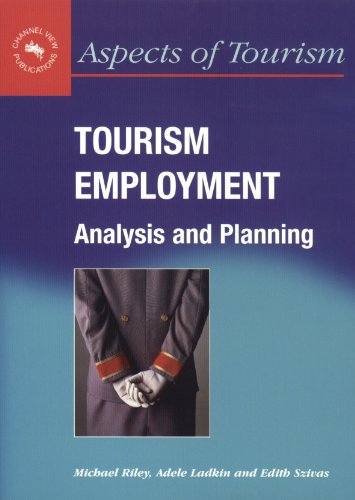
Inhaltsangabe
This book is an attempt to understand tourism employment in a holistic way. Using ideas from labour economics, work psychology and industrial sociology the authors look at tourism employment in both its workplace context and its wider economic and social environment and attempt to tell a coherent story. Both behavioural and economic perspectives are used to address questions that are salient to manpower planning, education planning and tourism management. By examining the diversity and commonality within occupations against the background of a dynamic labour market the text develops themes that contribute to our understanding of the behaviour of workers and managers in the industry.
Die Inhaltsangabe kann sich auf eine andere Ausgabe dieses Titels beziehen.
Über die Autorinnen und Autoren
Michael Riley is Professor of Organisational Behaviour at the School of Management Studies for the Service Sector University of Surrey, Guildford UK. His work over two decades centres upon the labour aspects of tourism and he has written extensively on human resource management and labour market issues.
Adele Ladkin is a Reader in Tourism at the International Centre for Tourism and Hospitality Research, School of Service Industries, Bournemouth University, UK. Her research interests are in the areas of tourism education, career analysis and labour mobility in the tourism and hospitality industry, and the meetings, incentives, conventions, and exhibitions industry. She is Assistant Editor in Chief for the International Journal of Tourism Research.
Dr. Edith Szivas is a Lecturer in Tourism at the School of Management Studies for the Service Sector, University of Surrey, UK, where she is Course Leader for the Management and Tourism BSc (Hons) Degree. Her research interests and publications are in the field of labour economics, mobility, economic transition and tourism planning and development.
Michael Riley is Professor of Organisational Behaviour at the School of Management Studies for the Service Sector University of Surrey, Guildford UK. His work over two decades centres upon the labour aspects of tourism and he has written extensively on human resource management and labour market issues.Adele Ladkin is a Reader in Tourism at the International Centre for Tourism and Hospitality Research, School of Service Industries, Bournemouth University, UK. Her research interests are in the areas of tourism education, career analysis and labour mobility in the tourism and hospitality industry, and the meetings, incentives, conventions, and exhibitions industry. She is Assistant Editor in Chief for the International Journal of Tourism Research.Dr. Edith Szivas is a Lecturer in Tourism at the School of Management Studies for the Service Sector, University of Surrey, UK, where she is Course Leader for the Management and Tourism BSc (Hons) Degree. Her research interests and publications are in the field of labour economics, mobility, economic transition and tourism planning and development.
Auszug. © Genehmigter Nachdruck. Alle Rechte vorbehalten.
Tourism Employment Analysis and Planning
By Michael Riley, Adele Ladkin, Edith SzivasMultilingual Matters
Copyright © 2002 Michael Riley, Adele Ladkin and Edith Szivas
All rights reserved.
ISBN: 978-1-873150-31-3All rights reserved.
Contents
Introduction: The Concept of the Book,
Part 1: Understanding the Industry,
1 Diversity and Planning: The Dynamic Nature of the Industry,
2 Attraction and Accessibility,
3 Labour Productivity,
4 Pay Determination,
5 The Nature of Service Labour,
Part 2: Analysis: Some Empirical Studies,
6 The Principles of Biographical Analysis,
7 Mobility into Tourism,
8 Career Analysis and Labour Markets: A Study of the Career Paths of Hotel Managers,
9 Motivation and Occupational Choice: A Study of Orientations in Tourism,
10 Occupational Classification and Analysis,
11 Skill Accumulation Patterns: A Case of Culinary Skills,
12 Personal Career Strategies in the Context of Market Orientation,
Part 3: Human Resource Development,
13 Human Resource Management: An Overview,
14 Vocational Education and Markets: Tourism Education,
15 Planning and Development,
Bibliography,
Index,
CHAPTER 1
Diversity and Planning: The Dynamic Nature of the Industry
Introduction
The intention in Chapter 1 is to introduce problems that the tourism industry bequeaths to those intending to undertake any form of planning or research in relation to labour and education. The point is not to deter but to forewarn and to encourage realism in the outputs of studies.
Difficulties in Defining Tourism
Like any other form of research or planning, labour planners come across the first hurdle – what is tourism? After decades of research in the field, it is surprising how difficult it is to reach a universally meaningful definition of tourism. Numerous attempts have been made so far – both from the supply and the demand side but finding a universally applicable definition for tourism is hampered by a number of other factors. Some of the difficulties in finding a definition are outlined in Table 1.1.
Tourism is not a recognised industry in the Standard Industrial Classification (Cooper et al., 1998) and most countries' national accounts would not list tourism as a separate entity. In most statistical systems the best approximation we can get on tourism (and especially on tourism employment) is to look up the restaurant and catering entry. This, of course, is largely due to the fact that tourism is seen as an industry dominated by the hospitality sector.
However, tourism does not only consist of the hospitality sector and any planner must be aware of the fact that tourism is a 'multiproduct industry' with strong linkages to other economic sectors (Diamond, 1977). Probably the most obvious example for this inter-linkage is the transport industry where most businesses share their operation between the two sectors. To illustrate the point, consider to what extent, for example, taxi or coach companies are part of tourism?
The paucity of tourism statistics or at least their incompleteness is strongly inter-linked with the above discussed points. The dominance of the hospitality sector and the difficulty in drawing the boundaries of tourism encourage the view that the magnitude of tourism can be estimated from data on the hospitality sector. But the opposite is also true; in the absence of comprehensive data, we often resort to using hospitality-related data and narrow the discussion to the hotel and catering industries. Given the diversity in the tourism industry, this practice inevitably restricts our view of the industry and can lead to conclusions that are only partially true.
The true dimensions of the tourism industry clearly stretch beyond the hospitality sector as the industry would not function without a number of other sectors and operators who together form this complex industry. Any plan should take into account that apart from hotels, the tourism industry also includes a number of other sectors and activities, namely:
• Transport.
• Tour operators, travel agencies.
• Tourist attractions.
• Conference business.
• Tour guides.
• Tourist information services.
• Souvenir shops, beach vendors.
• Relevant government offices.
• NGOs.
• Educational establishments.
In addition to the above points, there is also the added complexity that arises from the fact that most tourist facilities are, in fact, shared between the tourists and the locals. The extent to which facilities are shared between 'hosts' and 'guests' is largely influenced by the economic distance between them and the type of tourism at the destination. Whatever the proportion of tourist usage, the important question is how do we decide which hotel or tourist attraction or shop is part of the tourism industry and which one is not?
It will come as no surprise that, as tourism is difficult to pin down, then defining tourism employment has its own problems. Just who is employed in tourism?
Defining Tourism Employment
When attempting to define tourism employment a useful starting point is supply-side definitions as they approach tourism as an aggregate of businesses and organisations. For example, a supply-side definition by Leiper (1979) states that:
the tourist industry consists of all those firms, organisations and facilities which are intended to serve the specific needs and wants of the tourists. (p. 400).
The definition is clear but it is only when we try to collate a list of these facilities for a manpower survey or labour market analysis that we realise the inherent difficulties in finding the boundaries of tourism employment (Szivas, 1999). Some of the issues are summarised below:
• Apart from the obvious choices such as hotels and travel agents, we find that most companies and establishments serve not only tourists but also locals. Restaurants, tourist attractions, taxis and other forms of transport all fall into this latter category. Recognising this, Smith (1988) classified facilities and firms serving the tourists into two levels: one tier encompasses all those establishments whose total revenue is derived from tourists, while on a second tier are those businesses which serve both the tourists and the locals as well. For our manpower survey we might opt to include those operators whose business is totally dependent on serving the tourists but by opting for this, we exclude the majority of businesses. This is especially true for developing countries where the patronage of tourism facilities is predominantly from the international tourist.
• The complexity and the neglect with which tourism is often handled at official levels means that there is no precise definition. This leads to a lack of statistics to quantify the dimensions of tourism employment (World Tourism Organisation, 1983). Consequently, the exact boundaries of tourism employment are as difficult to draw as it is to define tourism itself (Burns, 1993).
• The discussion on tourism employment tends to be focused on hotel employment. This clearly simplifies matters but has serious shortcomings as the boundaries of the industry stretch beyond the hotel sector and tourist expenditure also occurs in restaurants, shops and recreational facilities. Furthermore, tourists also use transportation and financial services, contributing...
„Über diesen Titel“ kann sich auf eine andere Ausgabe dieses Titels beziehen.
Suchergebnisse für Tourism Employment: Analysis and Planning (Aspects...

Beispielbild für diese ISBN
Tourism Employment: Analysis and Planning (Aspects of Tourism, 6)
Anbieter: Ria Christie Collections, Uxbridge, Vereinigtes Königreich
Verkäuferbewertung 5 von 5 Sternen

Zustand: New. In English. Artikel-Nr. ria9781873150313_new
Neu kaufen
EUR 117,01
EUR 13,48 Versand
Versand von Vereinigtes Königreich nach USA
Versand von Vereinigtes Königreich nach USA
Anzahl: 1 verfügbar
Beispielbild für diese ISBN
Tourism Employment: Analysis and Planning (Aspects of Tourism, 6)
Verlag:
Channel View Publications, 2002
ISBN 10: 1873150318
ISBN 13: 9781873150313
Gebraucht
Hardcover
Anbieter: Phatpocket Limited, Waltham Abbey, HERTS, Vereinigtes Königreich
Verkäuferbewertung 5 von 5 Sternen
Zustand: Good. Your purchase helps support Sri Lankan Children's Charity 'The Rainbow Centre'. Ex-library, so some stamps and wear, and may have sticker on cover, but in good overall condition. Our donations to The Rainbow Centre have helped provide an education and a safe haven to hundreds of children who live in appalling conditions. Artikel-Nr. Z1-C-007-01462
Gebraucht kaufen
EUR 121,57
EUR 12,70 Versand
Versand von Vereinigtes Königreich nach USA
Versand von Vereinigtes Königreich nach USA
Anzahl: 1 verfügbar
Beispielbild für diese ISBN
Tourism Employment: Analysis and Planning
Anbieter: Revaluation Books, Exeter, Vereinigtes Königreich
Verkäuferbewertung 5 von 5 Sternen
Hardcover. Zustand: Brand New. 200 pages. 8.25x5.75x0.50 inches. In Stock. Artikel-Nr. __1873150318
Neu kaufen
EUR 120,36
EUR 14,93 Versand
Versand von Vereinigtes Königreich nach USA
Versand von Vereinigtes Königreich nach USA
Anzahl: 1 verfügbar
Foto des Verkäufers
Tourism Employment: Analysis & Planning: Analysis and Planning
Anbieter: moluna, Greven, Deutschland
Verkäuferbewertung 5 von 5 Sternen
Gebunden. Zustand: New. Über den AutorMichael Riley is Professor of Organisational Behaviour at the School of Management Studies for the Service Sector University of Surrey, Guildford UK. His work over two decades centres upon the labour aspects of tour. Artikel-Nr. 905710816
Neu kaufen
EUR 113,51
EUR 48,99 Versand
Versand von Deutschland nach USA
Versand von Deutschland nach USA
Anzahl: 1 verfügbar
Foto des Verkäufers
Tourism Employment : Analysis & Planning: Analysis and Planning
Verlag:
Multilingual Matters Limited Feb 2002, 2002
ISBN 10: 1873150318
ISBN 13: 9781873150313
Neu
Hardcover
Anbieter: AHA-BUCH GmbH, Einbeck, Deutschland
Verkäuferbewertung 5 von 5 Sternen
Buch. Zustand: Neu. Neuware - This book is an attempt to understand tourism employment in a holistic way. Using ideas from labour economics, work psychology and industrial sociology the authors look at tourism employment in both its workplace context and its wider economic and social environment and attempt to tell a coherent story. Both behavioural and economic perspectives are used to address questions that are salient to manpower planning, education planning and tourism management. By examining the diversity and commonality within occupations against the background of a dynamic labour market the text develops themes that contribute to our understanding of the behaviour of workers and managers in the industry. Artikel-Nr. 9781873150313
Neu kaufen
EUR 152,65
EUR 35,00 Versand
Versand von Deutschland nach USA
Versand von Deutschland nach USA
Anzahl: 1 verfügbar