
Verwandte Artikel zu German Automatic Weapons of World War II (Live Firing...
German Automatic Weapons of World War II (Live Firing Classic Military Weapons in Colour Photographs) - Hardcover
Suchergebnisse für German Automatic Weapons of World War II (Live Firing...

Beispielbild für diese ISBN
German Automatic Weapons of World War II
Anbieter: ThriftBooks-Dallas, Dallas, TX, USA
Verkäuferbewertung 5 von 5 Sternen

Hardcover. Zustand: Very Good. No Jacket. May have limited writing in cover pages. Pages are unmarked. ~ ThriftBooks: Read More, Spend Less. Artikel-Nr. G1859150438I4N00
Gebraucht kaufen
EUR 11,90
Versand gratis
Versand innerhalb von USA
Versand innerhalb von USA
Anzahl: 1 verfügbar
Beispielbild für diese ISBN
German Automatic Weapons of World War II
Verlag:
Windrow & Greene, Limited, 1997
ISBN 10: 1859150438
ISBN 13: 9781859150436
Gebraucht
Hardcover
Anbieter: Better World Books, Mishawaka, IN, USA
Verkäuferbewertung 5 von 5 Sternen
Zustand: Very Good. Pages intact with possible writing/highlighting. Binding strong with minor wear. Dust jackets/supplements may not be included. Stock photo provided. Product includes identifying sticker. Better World Books: Buy Books. Do Good. Artikel-Nr. 14047545-6
Gebraucht kaufen
EUR 12,73
Versand gratis
Versand innerhalb von USA
Versand innerhalb von USA
Anzahl: 1 verfügbar
Foto des Verkäufers
German Automatic Weapons of World War II (Live Firing Classic Military Weapons in Colour Photographs)
Anbieter: GREENSLEEVES BOOKS, Oxford, Vereinigtes Königreich
Verkäuferbewertung 5 von 5 Sternen
Hardcover. Zustand: Very Good. 1859150438. 1996, bright clean copy, with dustjacket, no markings, Professional booksellers since 1981. Artikel-Nr. 166179
Gebraucht kaufen
EUR 12,93
EUR 18,60 Versand
Versand von Vereinigtes Königreich nach USA
Versand von Vereinigtes Königreich nach USA
Anzahl: 1 verfügbar
Foto des Verkäufers
German Automatic Weapons of World War II
Anbieter: Book Express (NZ), Shannon, Neuseeland
Verkäuferbewertung 3 von 5 Sternen

Hardcover. Zustand: Very Good. 128 pages. library sticker on spine - no other markings, private collector Information in text and pics of the automatic weapons used by the Germans in WWII. Artikel-Nr. 6320t
Gebraucht kaufen
EUR 18,92
EUR 39,55 Versand
Versand von Neuseeland nach USA
Versand von Neuseeland nach USA
Anzahl: 1 verfügbar
Beispielbild für diese ISBN
German Automatic Weapons of World War II; Live Firing Classic Military Weapons in Colour Photographs
Verlag:
Windrow & Greene Ltd, London, England, 1997
ISBN 10: 1859150438
ISBN 13: 9781859150436
Gebraucht
Hardcover
Anbieter: Ground Zero Books, Ltd., Silver Spring, MD, USA
Verkäuferbewertung 5 von 5 Sternen
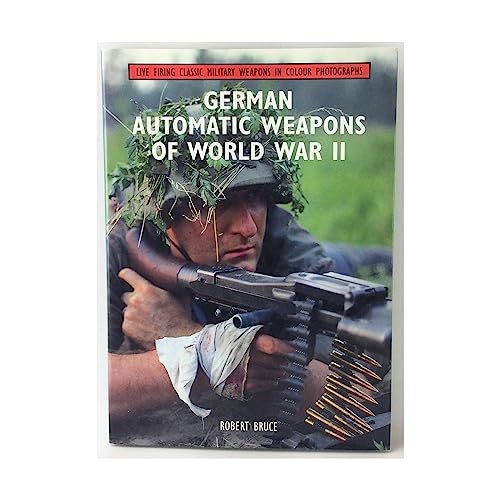
Hardcover. Zustand: Very good. Zustand des Schutzumschlags: Very good. 128 pages. Oversized volume, measuring 12 inches by 8-1/2 inches. Profusely illustrated with many color photographs and some line drawings/diagrams. Includes Introduction; Mauser Schnellfeuer-Pistole; Maschinenpistole 40/1; Maschinengewehr 34; Maschinengewehr 42; Fallschirmjaegergewehr 42/1; Fallschirmjaegergewehr 42/11; Sturmgewehr 44. Also contains Sturmgewehr 44, and an Afterword: The Postwar Legacy. Select Bibliography. Technical Specifications. In this attractive new treatment, the seven classic automatic weapons of the World War II German Wehrmacht are illustrated in color photographs with a difference. Detailed sequences show them in close-up; during step-by-step field stripping; and during handling, loading, and live-firing trials in outdoor settings, by gunners wearing authentic period uniforms. The illustrations are accompanied by concise accounts of each weapon's historical and technical background, and by accessible, non-technical descriptions of its actual firing characteristics. The author was a US Army Sergeant First Class at the time this was published. He was a former infantryman, tank crewman, and military intelligence analyst. He became an internationally recognized magazine and book author, photo-journalist, archivist, lecturer, and authority on military small arms of the 20th century. He has been shooting, evaluating, and writing about the world's infantry weapons for more than two decades. As one example, the FG 42 (German: Fallschirmjägergewehr 42, "paratrooper rifle 42") is a selective-fire 7.92×57mm Mauser automatic rifle produced in Nazi Germany during World War II. The weapon was developed specifically for the use of the Fallschirmjäger airborne infantry in 1942 and was used in very limited numbers until the end of the war. It combined the characteristics and firepower of a light machine gun in a lightweight form slightly shorter (but considerably bulkier and heavier) than the standard-issue Karabiner 98k bolt-action infantry rifle. Considered one of the most advanced weapon designs of World War II, the FG 42 influenced post-war small arms development, and many features of its design, such as general shape, stock style, gas-rotating bolt operation (itself copied from the Lewis gun) and sheet metal and plastic construction were copied by the US Army when they developed the M60 machine gun. At the time of the Battle of Crete (Operation Mercury), German Fallschirmjäger (parachute infantry) were equipped with the same assortment of small arms as the Heer, carrying only 9×19mm Parabellum chambered pistols and hand grenades on them during parachute jumps, with 9×19mm Parabellum submachine guns, 7.92×57mm Mauser chambered rifles and crew-served weapons stored separately in containers that were dropped from the wing of the exit craft. The German RZ parachute harness, with one single riser and two straps attached to the body, making the paratrooper land on his hands and knees in a forward roll, did not allow for heavier equipment such as rifles and machine guns to be safely carried during jumps. At Crete, long-range rifle and machine gun fire from dug-in Commonwealth defenders inflicted heavy casualties on the outgunned German paratroopers in the early stages of battle as they attempted to retrieve their support weapons from containers scattered all over the battlefield. These combat experiences demonstrated the need for a rifle that could be carried on the person of the paratrooper. The American M41 Johnson LMG has many parallels with the contemporary FG 42. Both had in-line stocks, fed from the left side, and both fired from the open bolt in automatic mode and closed bolt in semi-automatic mode. Despite these similarities, there is no evidence that either weapon had any effect on the design of the other. As they were both seeking to solve similar problems, it is reasonable to expect that each weapon's respective engineers approached these problems similarly but independently, unaware of the developments of their counterparts. It is not easy to determine the significance of the FG 42 in terms of weapons history. With a slightly longer barrel and belt-feeding the weapon would have been an excellent light machine gun. Its designer Louis Stange knew that, he also built a prototype with belt feed. Some features, such as the details of the gas-operated bolt selection process, were studied by US Army engineers after the war. These, along with some aspects of the MG 42 general-purpose machine gun, are commonly reported to have been incorporated in the similarly troubled M60 general-purpose machine gun. The last known derivatives of the FG 42 were the Swiss Sturmgewehr 52 and M60 machine gun. Detailed sequences show them in close-up; during step-by-step field stripping; and during handling, loading, and live-firing trials in outdoor settings, by gunners wearing authentic period uniforms. Artikel-Nr. 80006
Gebraucht kaufen
EUR 67,89
EUR 4,39 Versand
Versand innerhalb von USA
Versand innerhalb von USA
Anzahl: 1 verfügbar