
Verwandte Artikel zu Germany - Culture Smart!: The Essential Guide to Customs...
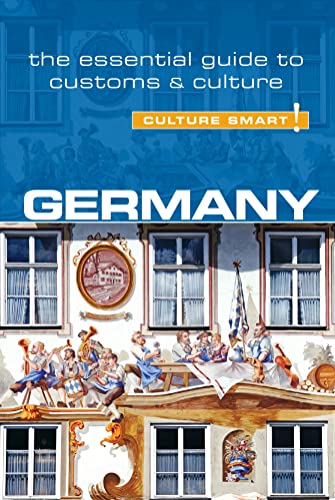
Germany - Culture Smart!: The Essential Guide to Customs & Culture (Culture Smart Germany) - Softcover
Inhaltsangabe
With the FIFA World Cup in its pocket Germany is feeling its social, political, and economic power once again. After organizing a successful World Cup in 2006 and winning it against Argentina in Brazil in 2014, Germany sees a note of confidence, even triumphalism, permeating the country.
As a European leader committed to the success of the EU and the Eurozone, Germany is a leading driver of European affairs. It emerged from the recession of 2008 as the strongest economic power in Europe, and German manufacturing, product brand value, and exports are going from strength to strength.
What are the implications of this new world confidence for German society itself? In the last few years we have seen East and West Germany come together socially and achieve a greater degree of economic balance as a long-term result of German re-unification. At the same time German society itself is internationalizing, with increased immigration and the adaptation of age-old values and attitudes to a multinational, multicultural era. Traditional attitudes of formality and rigid protocol in business are softening as German business globalizes.
This new, updated edition of Culture Smart! Germany examines these changes. It explains how German traditional values and working methods are adapting to take advantage of international opportunities and global society while maintaining the commitment to quality, organization, and time that marks out German business life. It shows how the traditional differences between Germany's regions are lessening, enabling society to come together and better absorb new immigrants, and above all how Germans are losing the fear and guilt associated with their twentieth-century wars and finding a new voice on the international stage.
Die Inhaltsangabe kann sich auf eine andere Ausgabe dieses Titels beziehen.
Über die Autorin bzw. den Autor
Barry Tomalin, M.A. is Lecturer in International Communication and Cultures at the London Academy of Diplomacy. A former producer and presenter with the BBC World Service, he has worked in over sixty countries worldwide, including France, Algeria, and Francophone West Africa. He is the author of Culture Smart! France and Culture Smart! Italy and many other books on international culture and business.
Auszug. © Genehmigter Nachdruck. Alle Rechte vorbehalten.
Germany
By Barry TomalinBravo Ltd
Copyright © 2015 Kuperard
All rights reserved.
ISBN: 978-1-85733-711-2All rights reserved.
Contents
Cover,
Title Page,
Copyright,
About the Author,
Map of Germany,
Introduction,
Key Facts,
Chapter 1: LAND AND PEOPLE,
Chapter 2: VALUES AND ATTITUDES,
Chapter 3: CUSTOMS AND TRADITIONS,
Chapter 4: MAKING FRIENDS,
Chapter 5: THE GERMANS AT HOME,
Chapter 6: TIME OUT,
Chapter 7: TRAVELING,
Chapter 8: BUSINESS BRIEFING,
Chapter 9: COMMUNICATING,
Appendix: Simple Vocabulary,
Further Reading,
CHAPTER 1
LAND & PEOPLE
The 81 million people of the Federal Republic of Germany occupy a landmass of 137,847 square miles (357,022 square kilometers) at the very heart of Europe. Not the largest country in Europe but the powerhouse of the European Union, Germany is a beautiful, varied, and fascinating place to live, work, or visit. The impact of her scholars, scientists, artists, musicians, writers, philosophers, and politicians on European culture has been profound, and has influenced much of the way the modern world thinks and acts.
Although Germany had been settled for thousands of years, it became a single political entity only in 1871, when it was unified under Wilhelm I of Prussia by the statesman Otto von Bismarck. Who, then, are the German people, where did they come from, and what are they like today? A good way to start is by taking a look at the land that has shaped the people.
GEOGRAPHY
Germany occupies a pivotal position in Central Europe, bounded to the north by the North Sea, Denmark, and the Baltic Sea; to the east by Poland and the Czech Republic; to the south by Austria and Switzerland; and to the west by France, Luxembourg, Belgium, and the Netherlands. So many neighboring territories have always created a security problem and, with historically shifting borders, German-speaking populations have periodically found themselves incorporated into other countries. This is particularly true of the Alsace region of France and the German-speaking part of Switzerland. Until unification in 1871 the word "Germany" had been a geographical term, referring to an area occupied by small states, ruled by priests and princes, and for much of its history under the dominance of Rome and the Holy Roman Empire that succeeded it.
Germany has a wide variety of landscapes. There are three main geographical regions: the lowland plain in the north, the uplands in the center, and a mountainous region in the south. The lowlands include several river valleys and a large area of heathland (the Lüneburger Heide, the oldest national park in Germany).
At sea level on the North Sea and Baltic coasts there are sand dunes, marshlands, and several islands including the North Friesian islands, the South Friesian islands, Rügen, and Heligoland in the North Sea. The eastern part of the lowland plain is Germany's breadbasket, rich in agricultural land. Between Hanover in the north and the Main River in the south are Germany's uplands with low mountains, valleys, and river basins. The mountains include the Taunus and Spessart ranges, and the Fichtelgebirge in the east.
The part of Germany best known to visitors is probably the southwestern mountain region containing the Black Forest (Schwarzwald), where the famous Schwarzwälderkirschtorte (a chocolate, cream, kirsch, and cherry cake) comes from. In the far south are the Bavarian Alps with Germany's highest peak, the Zugspitze, at 9,718 feet (2,962 meters).
The other major feature of the German landscape is its rivers. The most important of these is the Rhine, which rises in Switzerland and flows along the border with France before entering Germany proper and eventually flowing out through the Netherlands to the North Sea. The Rhine is both a major water transportation network and home to some of Germany's most beautiful scenery. Magnificent fortress-castles guard its banks. Vineyards cascade down the hill slopes to the river and its tributaries, the Mosel and the Neckar, yielding the grapes that produce the Hocks and Rieslings for which Germany is so well known. The Ruhr, traditional center of German industry, is also a tributary of the Rhine. The Elbe rises in the Czech Republic and flows northwest across the German plain to the North Sea, and the Danube (in German, Donau) rises on the eastern slopes of the Black Forest and flows eastward before entering Austria. The Oder and Neisse rivers form the international border with Poland in the east. Other major rivers are the Main, the Weser, and the Spree.
There are many large lakes on the northeastern plain, but those in the mountainous south are more dramatic. The most famous of these is Lake Constance (Bodensee).
Some 30 percent of the countryside is unspoilt woodland. About 80 percent of Germany is agricultural land, but the number of farms has diminished and agriculture makes up only 0.8 percent of the German economy (2012 figures) and employs only 1.5 of the German workforce.
Germany, historically and today, is a focal point of European interaction, both through its nine bordering states and through its waterways carrying goods from all over Europe to the North Sea and Baltic ports.
CLIMATE
Germany's climate is temperate and marine. The northern lowlands are slightly warmer than the mountainous south, which gets most of the rain and snow. The average rainfall is 23–27 inches (600–700 mm) a year. Temperatures range from 21°F (–6°C) in the mountains, and 35°F (1.5°C) in the lowlands, in winter, to 64°F (18°C), and even 68°F (20°C) in the valleys, in summer.
The Föhn
A peculiar feature of the Alpine climate in southern Germany is the Föhn. This is a warm, dry wind that blows down the leeward slope of a mountain. As moist air rises up the windward side, it cools and loses its moisture. When it descends it heats up because of the increase in pressure, and can cause a 10° rise in temperature in a short period. The Föhn brings clear, warm weather, and is often marked by beautiful twilight periods. Expect sudden atmospheric changes.
THE GERMAN PEOPLE: A BRIEF HISTORY
Every country has its own founding myth. In Britain it is the story of the Celts, King Arthur, and the mysterious land of Avalon. In the United States it is the story of the Founding Fathers.
"Germany" was not a name chosen by peoples who inhabited the area. "Germania" was the name they were given by the Roman historian Tacitus, who rather admired them.
The original Germans were hunter-gatherers who seem to have migrated westward and southward from Asia and from northeastern Europe around 2300 BCE, and who settled in areas around the Danube. They seem to have arrived in two main waves. The first were Celtic peoples, who raised crops, bred livestock, and traded with their Mediterranean neighbors. Archeological finds suggest that these people were among the first to develop copper and tin mining, and to make implements and containers out of bronze. Later arrivals, probably originally from southern Russia, moved into north and central Germany, and these are the real ancestors of the German-speaking peoples. They introduced the use of iron, developed metal tools and weapons, and eventually absorbed the peoples of the existing Celtic Bronze Age culture.
The German tribes spread along the northeastern frontier of the Roman Empire and became Rome's most ferocious opponents. A...
„Über diesen Titel“ kann sich auf eine andere Ausgabe dieses Titels beziehen.
Suchergebnisse für Germany - Culture Smart!: The Essential Guide to Customs...

Beispielbild für diese ISBN
Germany - Culture Smart!: The Essential Guide to Customs & Culture
Anbieter: World of Books (was SecondSale), Montgomery, IL, USA
Verkäuferbewertung 5 von 5 Sternen

Zustand: Very Good. Item in very good condition! Textbooks may not include supplemental items i.e. CDs, access codes etc. Artikel-Nr. 00099928834
Gebraucht kaufen
EUR 4,66
Versand gratis
Versand innerhalb von USA
Versand innerhalb von USA
Anzahl: 1 verfügbar
Beispielbild für diese ISBN
Germany - Culture Smart!: The Essential Guide to Customs & Culture
Verlag:
Kuperard (edition Second Edition, Second edition), 2015
ISBN 10: 1857337115
ISBN 13: 9781857337112
Gebraucht
Paperback
Anbieter: BooksRun, Philadelphia, PA, USA
Verkäuferbewertung 5 von 5 Sternen
Paperback. Zustand: Very Good. Second Edition, Second edition. It's a well-cared-for item that has seen limited use. The item may show minor signs of wear. All the text is legible, with all pages included. It may have slight markings and/or highlighting. Artikel-Nr. 1857337115-11-1
Gebraucht kaufen
EUR 4,66
Versand gratis
Versand innerhalb von USA
Versand innerhalb von USA
Anzahl: 1 verfügbar
Beispielbild für diese ISBN
Germany - Culture Smart! (Second Edition, Second)
Anbieter: ThriftBooks-Atlanta, AUSTELL, GA, USA
Verkäuferbewertung 5 von 5 Sternen
Paperback. Zustand: Very Good. No Jacket. May have limited writing in cover pages. Pages are unmarked. ~ ThriftBooks: Read More, Spend Less. Artikel-Nr. G1857337115I4N00
Gebraucht kaufen
EUR 5,94
Versand gratis
Versand innerhalb von USA
Versand innerhalb von USA
Anzahl: 1 verfügbar
Beispielbild für diese ISBN
Germany - Culture Smart! (Second Edition, Second)
Anbieter: ThriftBooks-Atlanta, AUSTELL, GA, USA
Verkäuferbewertung 5 von 5 Sternen
Paperback. Zustand: Good. No Jacket. Pages can have notes/highlighting. Spine may show signs of wear. ~ ThriftBooks: Read More, Spend Less. Artikel-Nr. G1857337115I3N00
Gebraucht kaufen
EUR 5,94
Versand gratis
Versand innerhalb von USA
Versand innerhalb von USA
Anzahl: 1 verfügbar
Beispielbild für diese ISBN
Germany - Culture Smart! (Second Edition, Second)
Anbieter: ThriftBooks-Atlanta, AUSTELL, GA, USA
Verkäuferbewertung 5 von 5 Sternen
Paperback. Zustand: Good. No Jacket. Former library book; Pages can have notes/highlighting. Spine may show signs of wear. ~ ThriftBooks: Read More, Spend Less. Artikel-Nr. G1857337115I3N10
Gebraucht kaufen
EUR 5,94
Versand gratis
Versand innerhalb von USA
Versand innerhalb von USA
Anzahl: 1 verfügbar
Beispielbild für diese ISBN
Germany - Culture Smart! : The Essential Guide to Customs and Culture
Anbieter: Better World Books, Mishawaka, IN, USA
Verkäuferbewertung 5 von 5 Sternen
Zustand: Good. Pages intact with minimal writing/highlighting. The binding may be loose and creased. Dust jackets/supplements are not included. Stock photo provided. Product includes identifying sticker. Better World Books: Buy Books. Do Good. Artikel-Nr. 8830689-6
Gebraucht kaufen
EUR 6,11
Versand gratis
Versand innerhalb von USA
Versand innerhalb von USA
Anzahl: 1 verfügbar
Beispielbild für diese ISBN
Germany - Culture Smart! : The Essential Guide to Customs and Culture
Anbieter: Better World Books, Mishawaka, IN, USA
Verkäuferbewertung 5 von 5 Sternen
Zustand: Very Good. Former library copy. Pages intact with possible writing/highlighting. Binding strong with minor wear. Dust jackets/supplements may not be included. Includes library markings. Stock photo provided. Product includes identifying sticker. Better World Books: Buy Books. Do Good. Artikel-Nr. 13499990-75
Gebraucht kaufen
EUR 6,11
Versand gratis
Versand innerhalb von USA
Versand innerhalb von USA
Anzahl: 1 verfügbar
Beispielbild für diese ISBN
Germany - Culture Smart! The Essential Guide to Customs & Culture
Anbieter: WorldofBooks, Goring-By-Sea, WS, Vereinigtes Königreich
Verkäuferbewertung 5 von 5 Sternen
Paperback. Zustand: Very Good. The book has been read, but is in excellent condition. Pages are intact and not marred by notes or highlighting. The spine remains undamaged. Artikel-Nr. GOR009318730
Gebraucht kaufen
EUR 3,85
EUR 6,53 Versand
Versand von Vereinigtes Königreich nach USA
Versand von Vereinigtes Königreich nach USA
Anzahl: 2 verfügbar
Beispielbild für diese ISBN
Germany - Culture Smart! : The Essential Guide to Customs and Culture
Anbieter: Better World Books Ltd, Dunfermline, Vereinigtes Königreich
Verkäuferbewertung 5 von 5 Sternen
Zustand: Good. Former library copy. Pages intact with minimal writing/highlighting. The binding may be loose and creased. Dust jackets/supplements are not included. Includes library markings. Stock photo provided. Product includes identifying sticker. Better World Books: Buy Books. Do Good. Artikel-Nr. 13531929-75
Gebraucht kaufen
EUR 6,04
EUR 5,83 Versand
Versand von Vereinigtes Königreich nach USA
Versand von Vereinigtes Königreich nach USA
Anzahl: 1 verfügbar
Beispielbild für diese ISBN
Germany - Culture Smart!: The Essential Guide to Customs & Culture
Anbieter: Majestic Books, Hounslow, Vereinigtes Königreich
Verkäuferbewertung 4 von 5 Sternen

Zustand: New. pp. 168. Artikel-Nr. 373714581
Neu kaufen
EUR 13,90
EUR 7,58 Versand
Versand von Vereinigtes Königreich nach USA
Versand von Vereinigtes Königreich nach USA
Anzahl: 1 verfügbar