
Inhaltsangabe
This work is about new themes and changed political styles. More precisely, it means the "interrelated extension of 'participatory dispositions and techniques' and the 'partial change' of the 'political agenda' through the surge of a new set of political demands" (Poguntke, 1993). The book assembles the most important articles which deal with such underlying changes or with the political results of the "New Politics", that is, political parties and new social movements. New politics theory recognises that, throughout the post-war period, western political agendas have been dominated by the "Old Politics", which have largely been centred around conflicts between "haves" and "have-nots", and were chiefly concerned with the overriding goals of stability and security, be it economic or military (Inglehart, 1977). From the 1970s onwards, however, the agenda of the new politics represented a substantial departure form these well-trodden paths. The younger and better educated citizens of western democracies began to concern themselves with political goals like ecology, self-determination, non-military approaches to international conflict resolution, equal rights for minorities, and improvement of the conditions in the Third World. These new concerns surfaced in the upsurge of environmental action groups, protest movements against nuclear power plants, the mobilization of massive resistance against the arms race (particularly against the deployment of cruise missiles and Pershing II), the new women's movement and a wide range of other groups concerned with this agenda. The book goes on to describe how these groups tried to accomplish their goals of their own vision for society by using participatory techniques like mass demonstrations, boycotts, occupations of building sites and so on. It also shows how these techniques are more mainstream in the 1990s. The effects of these new politics are also analyzed. In particular, the effect on the Left is assessed, especially in the attempts to redefine welfare and affluence. Dissention over matters of ecology has also led to fragmentation in the Left. At the same time, some sceptics have taken the 1970s and 1980s Left phenomenon as a temporary distraction from the materialist essence of politics (fuelled by the absence of real problems). The book also offers explanations for the new political phenomenon, in particular, the views of Ronald Inglehart, who maintains that gradual and persistent shifts in value orientations among western mass publics are the most important cause for the surge of the new politics.
Die Inhaltsangabe kann sich auf eine andere Ausgabe dieses Titels beziehen.
Suchergebnisse für New Politics (The International Library of Politics...

Beispielbild für diese ISBN
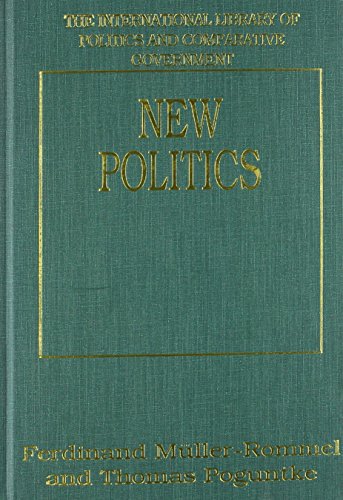
New Politics (The International Library of Politics and Comparative Government)
Anbieter: Ammareal, Morangis, Frankreich
Verkäuferbewertung 5 von 5 Sternen

Hardcover. Zustand: Très bon. Ancien livre de bibliothèque avec équipements. Edition 1995. Ammareal reverse jusqu'à 15% du prix net de cet article à des organisations caritatives. ENGLISH DESCRIPTION Book Condition: Used, Very good. Former library book. Edition 1995. Ammareal gives back up to 15% of this item's net price to charity organizations. Artikel-Nr. H-060-702
Gebraucht kaufen
EUR 3,14
EUR 16,50 Versand
Versand von Frankreich nach USA
Versand von Frankreich nach USA
Anzahl: 1 verfügbar