
Verwandte Artikel zu Qualitative Research for Development: A Guide for Practition...
Inhaltsangabe
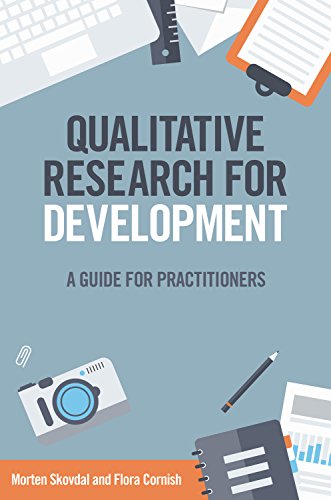
How do we know whether our development programmes are reducing poverty and empowering the most vulnerable people? What evidence do we have to support our theory of change? Qualitative research for development aims to build the research capacity of development practitioners so that their work benefits from the significant contributions offered by solid qualitative research. The book guides development practitioners through the process of planning, conducting and reporting on a qualitative study, whilst simultaneously highlighting the role of qualitative research in improving the impact, quality and accountability of development programmes. It covers in detail data collection methods such as participatory learning and action, Photovoice, individual interviews, focus group discussions and participant observation. It demystifies qualitative research and builds the skills and confidence of development practitioners to use qualitative methods authoritatively, and to communicate findings to different audiences. The book draws on considerable hands-on experience and incorporates case studies from Save the Children and other international organizations to illustrate 'good practice'. To facilitate learning, all the chapters include a series of practical activities that can help the reader to engage actively with the material. This book is an indispensable learning tool for all development practitioners within NGOs and government departments, as well as researchers and students working in the field of impelementation science.
Die Inhaltsangabe kann sich auf eine andere Ausgabe dieses Titels beziehen.
Über die Autorin bzw. den Autor
Morten Skovdal is Associate Professor in the Department of Public Health at the University of Copenhagen.
Auszug. © Genehmigter Nachdruck. Alle Rechte vorbehalten.
Qualitative Research for Development
A guide for practitioners
By Morten Skovdal, Flora CornishPractical Action Publishing
Copyright © 2015 Save the Children Fund
All rights reserved.
ISBN: 978-1-85339-854-4All rights reserved.
Contents
List of figures, tables, boxes, and activities,
About the authors,
Preface,
Acknowledgements,
1 Improving programme impact and accountability through qualitative research,
2 Designing and planning a qualitative study,
3 Interviews and focus group discussions,
4 Participant observation,
5 Participatory data collection methods,
6 Photovoice: methodology and use,
7 Analysing qualitative data,
8 Writing a research report,
Glossary,
CHAPTER 1
Improving programme impact and accountability through qualitative research
Abstract
Qualitative research has much to offer to the practical work of humanitarian and development organizations. Growing recognition of the potential for qualitative research to enhance programme impact is putting pressure on development practitioners to adapt a 'research approach' in their monitoring, evaluation, accountability, and learning work. This introductory chapter starts off by outlining some of the ways in which qualitative research can be used to improve the impact, quality, and accountability of development projects and programmes. It will then introduce some basic principles of qualitative research and illustrate some of the ways in which qualitative research can be incorporated into various stages of the programme cycle.
Keywords: Qualitative research; research for development; monitoring and evaluation; programme impact; programme accountability; evidence
Learning objectives
After reading this chapter, you will be able to:
• outline the ways in which qualitative research can improve development programmes and their impact;
• describe the link between qualitative research and accountability;
• explain what qualitative research is, including its strengths and weaknesses; and
• identify ways of integrating qualitative research into a programme cycle.
Key terms (definitions)
• Accountability: The means by which people and organizations are held responsible for their actions by having to account for them to other people.
• Evidence: The available body of facts or information indicating whether a belief or proposition is true or valid.
• Findings: Summaries, impressions, or conclusions reached after an examination or investigation of data.
• Formative evaluation: An early examination of an active programme with the aim of identifying areas for improvement in its design and performance.
• Generalizability: The ability to make statements and draw conclusions that can have a general application.
• Programme cycle: The process and sequence in which a programme develops from start to finish.
• Qualitative research: A method of inquiry that takes as a starting point the belief that there are benefits to exploring, unpacking, and describing social meanings and perceptions of an issue or a programme.
• Research: To study something systematically, gathering and reporting on detailed and accurate information.
Towards a 'research approach' in monitoring and evaluation
With an ever-growing emphasis on evidence-informed programming, there is a push for development practitioners to strengthen the quality of their monitoring, evaluation, accountability, and learning (MEAL) activities. For many development practitioners, evidence continues to be associated with quantitative evaluations of development initiatives. In fact, until recently, many people working in MEAL have been suspicious of qualitative methods and have had little incentive to develop a qualitative evidence capacity (Bamberger et al., 2010). While quantitative evidence is crucial for decision making and rightfully continues to play a key role in the development of evidence, there is growing recognition of the need for qualitative evidence.
This recognition is born out of the fact that development programmes have often been designed and implemented without sufficient qualitative evidence to understand the needs, wishes, and context of the target population. Too often, local perspectives have been neglected in the design, implementation, and evaluation of programmes, despite local voices containing crucial information that can help development practitioners understand pathways to programme success and failure (Chambers, 1983, 1997).
Qualitative research can systematize and formalize the process of generating qualitative evidence. Qualitative research can be used to understand the context of a programme better; it can provide us with insights to new issues and help us understand the complexity of connections and relationships between people, programmes, and organizations. It can provide beneficiaries with an opportunity to share their perspectives of an issue or a programme, which in turn can help us understand the nuances with regard to how different people experience a programme. Importantly, qualitative research can be used to ensure that development programmes resonate with local realities and expectations.
However, given the dominance of quantitative MEAL efforts, many development practitioners lack the skills and confidence to authoritatively produce qualitative evidence. In particular, there continues to be confusion and lack of clarity within development organizations about what qualitative evidence looks like and how best to conduct rigorous qualitative studies.
Although we welcome a drive for more rigorous qualitative research, we also recognize that in a 'development organization' context, there is a tension between achieving rigour, what is feasible, and what is considered useful.
We accept that some development practitioners are likely to face significant constraints in adapting some of the practices we describe in this book. We are therefore not looking to turn you into an 'academic researcher'; rather, we aim to introduce you to the 'rules of the game' for conducting rigorous qualitative research at all stages of a development project cycle. We want to encourage and equip you with the knowledge and skills required to adopt a 'research approach' (see Box 1.1) in your MEAL and development activities (Laws et al., 2013).
We believe that it is important for development practitioners to engage with qualitative research and adapt a 'research approach' in the generation of qualitative evidence for four main reasons.
• Development practitioners are at the frontline, responding to humanitarian and development needs, which makes them particularly well suited to identifying issues on which research is required and to taking an active role in facilitating research.
• Development practitioners can accelerate the use of research findings and translate them into programming and advocacy.
• With the turn to evidence-informed policy and practice, interventions need to be based on systematic qualitative research from the ground as well as on evidence from evaluations in other locations. Assessing value for money and taking programmes to scale cannot be based on anecdotes and impressions.
• Systematic qualitative research helps development practitioners improve the quality, accountability, and...
„Über diesen Titel“ kann sich auf eine andere Ausgabe dieses Titels beziehen.
Suchergebnisse für Qualitative Research for Development: A Guide for Practition...

Beispielbild für diese ISBN
Qualitative Research for Development
Anbieter: PBShop.store UK, Fairford, GLOS, Vereinigtes Königreich
Verkäuferbewertung 5 von 5 Sternen

PAP. Zustand: New. New Book. Shipped from UK. Established seller since 2000. Artikel-Nr. CX-9781853398544
Neu kaufen
EUR 27,57
EUR 4,84 Versand
Versand von Vereinigtes Königreich nach USA
Versand von Vereinigtes Königreich nach USA
Anzahl: 15 verfügbar
Beispielbild für diese ISBN
Qualitative Research for Development
Anbieter: PBShop.store US, Wood Dale, IL, USA
Verkäuferbewertung 5 von 5 Sternen
PAP. Zustand: New. New Book. Shipped from UK. Established seller since 2000. Artikel-Nr. CX-9781853398544
Beispielbild für diese ISBN
Qualitative Research for Development: A guide for practitioners
Verlag:
Practical Action Publishing, 2015
ISBN 10: 1853398543
ISBN 13: 9781853398544
Gebraucht
Softcover
Anbieter: Phatpocket Limited, Waltham Abbey, HERTS, Vereinigtes Königreich
Verkäuferbewertung 5 von 5 Sternen
Zustand: Good. Your purchase helps support Sri Lankan Children's Charity 'The Rainbow Centre'. Ex-library, so some stamps and wear, but in good overall condition. Our donations to The Rainbow Centre have helped provide an education and a safe haven to hundreds of children who live in appalling conditions. Artikel-Nr. Z1-T-001-02191
Gebraucht kaufen
EUR 22,75
EUR 12,38 Versand
Versand von Vereinigtes Königreich nach USA
Versand von Vereinigtes Königreich nach USA
Anzahl: 1 verfügbar
Beispielbild für diese ISBN
Qualitative Research for Development: A guide for practitioners
Anbieter: Ria Christie Collections, Uxbridge, Vereinigtes Königreich
Verkäuferbewertung 5 von 5 Sternen
Zustand: New. In English. Artikel-Nr. ria9781853398544_new
Neu kaufen
EUR 32,20
EUR 13,13 Versand
Versand von Vereinigtes Königreich nach USA
Versand von Vereinigtes Königreich nach USA
Anzahl: Mehr als 20 verfügbar
Beispielbild für diese ISBN
Qualitative Research for Development: A Guide for Practitioners
Anbieter: Majestic Books, Hounslow, Vereinigtes Königreich
Verkäuferbewertung 4 von 5 Sternen

Zustand: New. pp. 224. Artikel-Nr. 373893256
Neu kaufen
EUR 48,79
EUR 7,56 Versand
Versand von Vereinigtes Königreich nach USA
Versand von Vereinigtes Königreich nach USA
Anzahl: 1 verfügbar
Beispielbild für diese ISBN
Qualitative Research for Development: A Guide for Practitioners
Anbieter: Revaluation Books, Exeter, Vereinigtes Königreich
Verkäuferbewertung 5 von 5 Sternen
Paperback. Zustand: Brand New. 207 pages. 9.25x6.25x0.75 inches. In Stock. Artikel-Nr. x-1853398543
Neu kaufen
EUR 46,41
EUR 11,63 Versand
Versand von Vereinigtes Königreich nach USA
Versand von Vereinigtes Königreich nach USA
Anzahl: 2 verfügbar
Foto des Verkäufers
Qualitative Research for Development : A Guide for Practitioners
Verlag:
Practical Action Publishing Okt 2015, 2015
ISBN 10: 1853398543
ISBN 13: 9781853398544
Neu
Taschenbuch
Anbieter: AHA-BUCH GmbH, Einbeck, Deutschland
Verkäuferbewertung 5 von 5 Sternen
Taschenbuch. Zustand: Neu. Neuware - How do we know whether our development programmes are reducing poverty and empowering the most vulnerable people What evidence do we have to support our theory of change Qualitative research for development aims to build the research capacity of development practitioners so that their work benefits from the significant contributions offered by solid qualitative research. The book guides development practitioners through the process of planning, conducting and reporting on a qualitative study, whilst simultaneously highlighting the role of qualitative research in improving the impact, quality and accountability of development programmes. It covers in detail data collection methods such as participatory learning and action, Photovoice, individual interviews, focus group discussions and participant observation. It demystifies qualitative research and builds the skills and confidence of development practitioners to use qualitative methods authoritatively, and to communicate findings to different audiences. The book draws on considerable hands-on experience and incorporates case studies from Save the Children and other international organizations to illustrate 'good practice'. To facilitate learning, all the chapters include a series of practical activities that can help the reader to engage actively with the material. This book is an indispensable learning tool for all development practitioners within NGOs and government departments, as well as researchers and students working in the field of impelementation science. Artikel-Nr. 9781853398544
Neu kaufen
EUR 40,81
EUR 35,00 Versand
Versand von Deutschland nach USA
Versand von Deutschland nach USA
Anzahl: 2 verfügbar
Foto des Verkäufers
Qualitative Research for Development
Anbieter: moluna, Greven, Deutschland
Verkäuferbewertung 5 von 5 Sternen
Zustand: New. Artikel-Nr. 597114243
Neu kaufen
EUR 33,03
EUR 48,99 Versand
Versand von Deutschland nach USA
Versand von Deutschland nach USA
Anzahl: Mehr als 20 verfügbar